
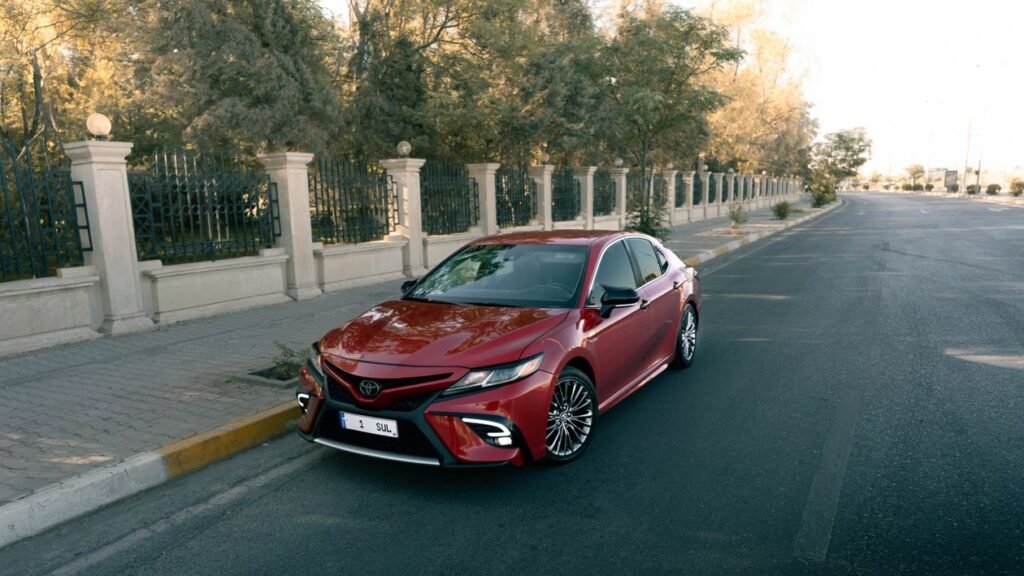
The eighth generation Camry is the one enthusiasts quietly call the best Camry ever made. Launched for the 2018 model year on Toyota’s TNGA platform, the XV70 finally made the Camry good to drive, while keeping the durability that made the name famous. It also brought the last ever Camry V6 with 301 hp, and all wheel drive returned in 2020 for the first time since the early 1990s.
So who does it suit? Drivers who want a big comfortable sedan that is also genuinely pleasant on a winding road. Families who need space, safety and low running costs. Snow belt buyers, for whom the 2020 and newer all wheel drive cars are a revelation. Used buyers who want near luxury refinement at mainstream prices. Our Toyota Camry model guide puts the generations side by side.
This page covers the 2018 to 2024 generation in detail: the 2.5, the V6, the hybrid, the 8 speed gearbox teething troubles on early cars, the recalls, which years to buy, and what the car costs to run.
Toyota Camry 2018 to 2024 at a glance
| Item | Details |
|---|---|
| Generation and years sold | XV70, the eighth generation. US model years 2018 to 2024, built in Georgetown, Kentucky. Facelifted for the 2021 model year. |
| Body style | 4 door sedan only. |
| Main engines | 2.5 liter four cylinder with 203 hp and 184 pound feet of torque, 206 hp on XSE with dual exhaust. 3.5 liter V6 with 301 hp and 267 pound feet. 2.5 liter hybrid with 208 hp combined. |
| Gearboxes | Eight speed conventional automatic on petrol cars. Electronically controlled CVT on the hybrid. |
| Drive | Front wheel drive standard. All wheel drive available from the 2020 model year on 2.5 liter cars, sending up to 50 percent of torque rearward and disconnecting on the highway. |
| Seats | 5 |
| Boot space | 15.1 cubic feet, generous for a sedan. |
| Fuel economy highlights | 2.5 liter rated around 28 mpg city and 39 highway. Hybrid LE rated 51 city and 53 highway, among the best figures of any non plug in sedan. |
Engines and specs that matter
The 2.5 liter four is the default right answer for most buyers. With 203 hp it is strong enough for confident highway merging, and the 28 city and 39 highway economy is excellent for a car this size. It pairs with an eight speed conventional automatic. This is the engine in most of the used cars you will see, and it is a proven, durable unit.
The 3.5 liter V6 is the one to buy with your heart. With 301 hp and 267 pound feet of torque it turns the Camry into a genuinely quick car, pulling hard and quietly with the smoothness only a V6 gives. It was the last V6 ever offered in a Camry, which gives it a certain collector appeal. The trade off is fuel economy at around 22 city and 33 highway, and it is front wheel drive only.
The hybrid is the smart money. With 208 hp combined it is nearly as quick as the 2.5, and the Hybrid LE returns 51 mpg city and 53 highway, figures that embarrass cars half its size. The Hybrid LE uses a lithium ion battery while the SE and XLE use nickel metal hydride. Toyota backs the hybrid components with a 10 year and 150,000 mile warranty, which removes most of the battery anxiety on used cars.
The eight speed automatic deserves attention because it defines which years to buy. The 2018 and 2019 cars had documented shift quality troubles: hesitation, jerky shifts and gear hunting, which Toyota addressed with several software update bulletins. From 2020 onward the gearbox is well sorted, and the 2021 facelift cars are the smoothest of the run.
Which one suits you? Commuting and family duty, take a 2021 to 2024 2.5 with the sorted gearbox. Snow belt, the 2020 and newer all wheel drive 2.5 is superb. Maximum economy, the hybrid LE is nearly unbeatable. Want the last of an era, a 2021 to 2023 V6 is a future classic you can drive every day. The 2021 facelift also brought updated Toyota Safety Sense and standard smartphone integration.
Common problems of this generation
The XV70 is a strong reliability generation, but the 2018 launch year carries the most complaint and recall volume. Read this section before you look at any 2018 car.
Eight speed gearbox shift quality, 2018 to 2019
The new eight speed automatic had teething troubles in its first two years. Owners of 2018 and 2019 cars report hesitation, jerky shifts and gear hunting in town driving. Toyota issued several software update bulletins that largely sorted the behavior by 2020. On any 2018 or 2019 car, take a long test drive through stop and go traffic and feel for smooth shifts. If you feel hesitation or harshness, our guide to transmission problem signs and symptoms explains how to tell a software trait from a gearbox with real trouble, and you should favor a 2020 or newer car instead.
Fuel pump recall, 2018 to 2020
The 2018 to 2020 cars were part of the Denso low pressure fuel pump recall, where pump failure can cause the engine to stall while driving. Dealers replace the pump free of charge. Confirm this recall is closed on any car you buy by running the VIN through the NHTSA recall checker.
2018 launch year recalls and 2020 engine casting issue
The 2018 cars carry several additional recalls: some 2.5 liter engines with pistons larger than specification carrying a stall risk, a fuel delivery pipe connection fault on 2018 V6 cars with a fire risk, and seatbelt pretensioner campaigns. Separately, certain 2020 cars with the 2.5 liter engine may have porous engine castings that can crack, causing coolant leaks, overheating and stalling. These are all free dealer remedies, but they make the paperwork check essential: run the VIN and confirm every campaign is closed before you buy.
Should you buy this generation
This Camry suits buyers who want the complete package: comfort, space, economy, safety and now genuinely enjoyable driving. The 2021 to 2024 cars are the sweet spot, with the sorted gearbox, the facelift updates and full safety kit. The hybrid suits high mileage drivers who will repay the premium in fuel savings within a couple of years.
Who should skip it? Buyers who cannot verify recall history should be cautious, because the 2018 cars carry the longest recall list. Anyone who dislikes the feel of a conventional automatic hunting for gears should test a 2018 or 2019 carefully or simply buy a 2021 or newer car. If you want the absolute cheapest used Camry, the older XV50 generation costs less to buy.
The good buys are 2021 to 2024 cars in any engine: past the gearbox troubles, with the facelift and the updated safety systems. The 2020 all wheel drive 2.5 is the pick for winter climates. The hybrid LE is the economy champion. The year to be careful with is 2018 above all: the first year of a full redesign with the most recalls and the unsorted gearbox.
Whatever the year, run through this checklist before you hand over money:
- Run the VIN through the NHTSA recall checker and confirm all campaigns are closed, especially the fuel pump recall.
- On a 2018 or 2019, drive in stop and go traffic and feel for hesitant or jerky shifts.
- On a 2020 2.5 liter, ask about the engine casting recall and check the coolant level.
- Check the engine oil level yourself and ask about consumption.
- On a hybrid, ask for a battery health check printout from a Toyota dealer.
- Test every electronic system, including the infotainment and driver assists.
- Look at all four tyres for uneven wear.
- Get a pre purchase inspection from an independent Toyota specialist on any 2018 car.
Running and repair costs
Running a Camry is cheap for a car this size, which is a big part of its appeal. Parts are plentiful and every shop knows these cars. Typical US prices for the common jobs look like this:
| Job | Typical cost in US dollars |
|---|---|
| Front brake pads, fitted | 150 to 350 for pads alone, 250 to 500 with new rotors; class typical fitted jobs land around 300 to 370 per axle |
Brake costs are mainstream for the class, and hybrid cars typically wear their brake pads more slowly thanks to regenerative braking. Beyond brakes, budget the usual consumables and stay on top of servicing: the eight speed automatic rewards clean fluid and the hybrid rewards nothing more than regular use. The expensive mistake is buying a 2018 with unresolved gearbox or recall issues; the purchase price saving will not cover the aggravation.
Questions and answers
Is the 2018 to 2024 Toyota Camry reliable?
Yes, with one caveat. This is a strong reliability generation and the best selling passenger car in the US through its run. The caveat is the 2018 launch year, which carries the most complaints and recalls: gearbox shift quality troubles, fuel pump and fuel pipe recalls, and piston issues on some 2.5 liter cars. Buy a 2020 or newer car with all recalls closed and it is one of the most dependable sedans you can own.
What is wrong with the 2018 Camry transmission?
The new eight speed automatic had software teething troubles in 2018 and 2019: hesitation, jerky shifts and gear hunting at town speeds. Toyota released several software updates that largely fixed the behavior, and 2020 and newer cars are well sorted. If you are considering a 2018 or 2019, drive it in stop and go traffic and only buy one that shifts smoothly.
Should I buy the V6 or the hybrid?
Buy the hybrid if economy matters: 208 hp combined with up to 53 mpg highway is an unbeatable combination, and the 10 year hybrid component warranty covers the battery. Buy the V6 if you love smooth, effortless pace: 301 hp makes it genuinely quick and it was the last V6 Camry ever built. Most buyers are best served by the 2.5 four, which splits the difference well.
Is the all wheel drive Camry worth it?
Yes, if you face real winters. Offered from 2020 on 2.5 liter cars, it sends up to 50 percent of torque to the rear axle when needed and disconnects on the highway to save fuel. It transforms the Camry into a confident winter car with only a small economy penalty. In mild climates the front wheel drive car is all you need.