
If the battery light comes on while you are driving, your car is telling you the charging system has stopped doing its job. The battery is no longer being charged by the alternator, and the car is running on whatever charge is left in the battery. That can last twenty minutes or two hours, but it will not last the whole day. Treat it as an urgent warning: turn off anything electrical you do not need, and drive straight to a repair shop or a safe place to park. Do not turn the engine off until you are somewhere you are happy to be stuck, because it may not start again.
What the battery light actually monitors
Despite its name and its battery shaped symbol, this light is not really about the battery itself. It watches the voltage in the electrical system while the engine runs. With the engine running, a healthy system sits at roughly 13.5 to 14.5 volts, because the alternator is generating power and topping up the battery at the same time. If that voltage drops too low or climbs too high, the light comes on. A weak battery alone rarely triggers it while driving, because once the engine is running the alternator takes over. That is why a battery light that appears mid journey almost always points at the charging side of the system, not at a flat battery.
The light should appear when you turn the key to the on position and go out a second or two after the engine starts. If it never appears at all, the bulb or the circuit for the light may have failed, which matters because you would then get no warning when a real fault happens.
The most common causes
- A worn out alternator. This is the cause in the majority of cases. Inside the alternator, brushes wear down, bearings get noisy, and the voltage regulator can fail. There are usually early clues before the light appears, and our guide to the early signs of a failing alternator covers the dimming lights, strange noises and warning smells to watch for.
- A snapped or slipping drive belt. The alternator is turned by a belt driven from the engine. If that belt breaks or slips badly, charging stops instantly. A broken belt often stops the water pump and power steering pump too, so the temperature gauge and heavy steering may join the party within minutes.
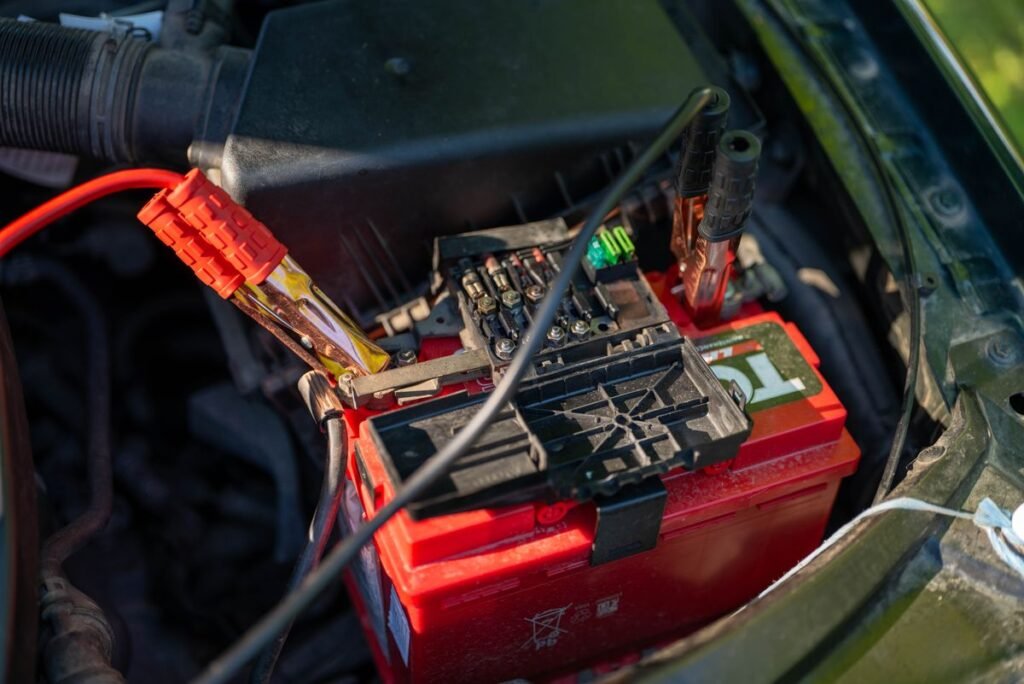
- Loose or corroded battery connections. Heavy corrosion on the terminals or a loose clamp can stop charge reaching the battery even though the alternator is fine. This is the cheapest cause on the list and the first thing to check.
- Damaged wiring or a bad earth strap. The thick cable between the alternator and battery, and the earth strap between the engine and the body, both carry the full charging current. A frayed cable or a rusty earth point adds resistance and drops the voltage.
- A battery at the end of its life. A battery with an internal short can overload the charging system and bring the light on. Age matters here: most car batteries last three to five years, and our guide on how long car batteries usually last explains how climate and short trips shorten that span.
What to do in the first five minutes
Stay calm and cut the electrical load. Switch off the air conditioning, heated seats, heated screens and the blower fan. Keep the lights on if it is dark or raining, because being seen matters more than saving charge, but turn off everything else. Avoid using the windows and the stereo. Every amp you save buys you distance.
Then pick your destination carefully. A repair shop is best. Home is fine if it is close. What you should not do is stop the engine at a shop or a fuel station just to ask a question, because a car running on battery alone often refuses to restart. Keep the engine running until you reach a place where a tow truck could reach you easily. If the steering suddenly gets heavy or the temperature gauge starts climbing, the drive belt has probably failed, and you should pull over and switch off at once to protect the engine from overheating.
Simple checks you can do yourself
Once you are parked somewhere safe, open the hood and look before you touch. Is the drive belt still there and tight? Are the battery terminals covered in white or green crust? Does a terminal wiggle when you push it by hand? Those three visual checks find a good share of faults.
If you own a basic multimeter, you can learn a lot in two minutes. Set it to DC volts and measure across the battery terminals:
| Reading | What it tells you |
|---|---|
| 12.4 to 12.7 volts, engine off | The battery itself is holding a reasonable charge |
| Below 12.2 volts, engine off | The battery is discharged or failing |
| 13.5 to 14.5 volts, engine running | The alternator is charging correctly |
| 12.6 volts or less, engine running | The alternator is not charging; this is your fault |
| Over 15 volts, engine running | The regulator has failed and the system is overcharging |
Cleaning corroded terminals costs nothing but time: disconnect the negative terminal first, scrub the posts and clamps with a wire brush or an old toothbrush and hot water, dry everything, reconnect and tighten. If the light goes out after that, you found the problem. If it stays on with a healthy reading at idle, ask a shop to test the system under load, because some alternators only fail when they get hot or when demand rises.
What the repair usually costs
Prices vary by car, but these are honest ranges for parts and labor at an independent shop in the United States. A drive belt replacement usually runs 100 to 250 dollars. Cleaning and tightening terminals is often free to 50 dollars. A replacement alternator is the big one: 350 to 900 dollars fitted for most mainstream cars, and 900 to 1,500 dollars or more for premium brands and cars where the alternator is buried behind other parts. A new battery, if that is the real cause, costs 120 to 300 dollars fitted. Dealers charge more for the same work, mostly on the labor rate. Always ask for the diagnosis in writing before approving an alternator, because a 30 dollar cable has fooled many people into buying a 600 dollar part.
Frequently asked questions
Can I drive with the battery light on?
Only as far as the nearest safe place or repair shop. The car is running on stored battery charge, and once that is gone the engine will cut out, often with no further warning.
My battery light flickers on and off. What does that mean?
A flickering light usually means charging is cutting in and out: a slipping belt, a loose connection, or alternator brushes that are nearly worn through. It is an early warning, so get it checked this week rather than next month.
The light came on but the car starts fine every morning. Is it the battery?
Probably not. A car that starts strongly has a battery holding charge. A light that appears while driving points at the alternator, the belt or the wiring, and those parts should be tested first.