
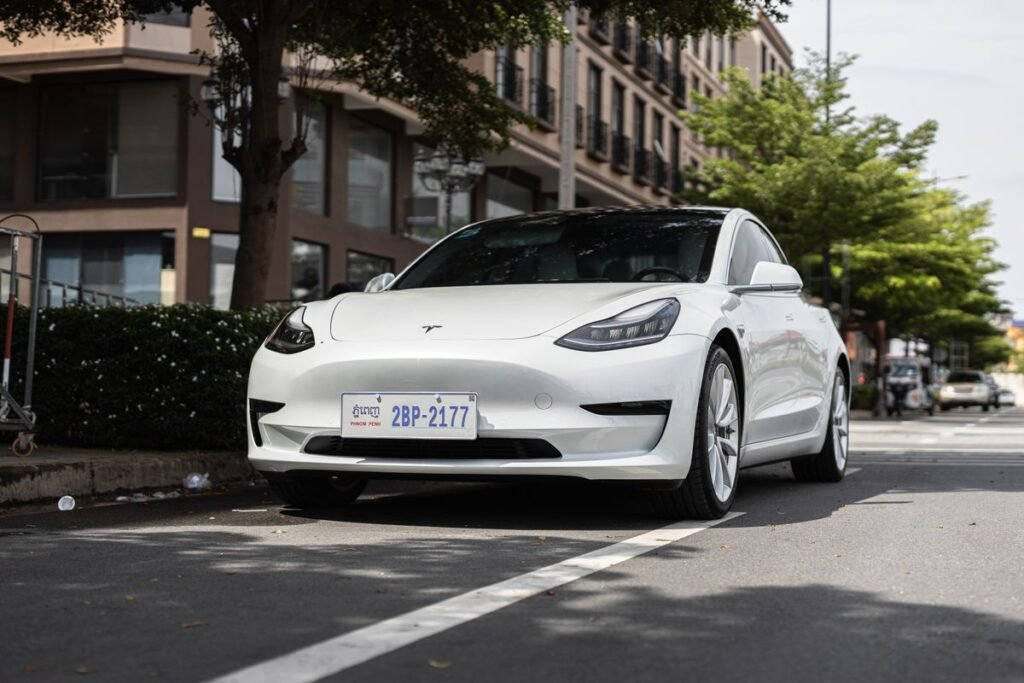
The Tesla Model 3 is the electric sedan that turned Tesla from a niche maker into a mass market brand. It launched in 2017 as the affordable Tesla, a mid size four door sedan with a fastback shape, and it became the first electric car to pass one million global sales, in June 2021.
So who does it suit? Commuters who want very low running costs, drivers who do regular long trips on motorways served by Superchargers, and buyers who want strong performance without a luxury badge. One thing to know first: the model year matters more than the mileage.
Tesla Model 3 at a glance
The quick facts first. The Model 3 is a battery electric mid size sedan, built at Fremont in California and at Gigafactory Shanghai in China, with rear wheel drive or dual motor all wheel drive and a 15 inch centre touchscreen that controls almost everything.
| Item | Details |
|---|---|
| Generations covered | Pre facelift, 2017 to 2023; Highland facelift, 2024 to present |
| Body style | 4 door sedan with a fastback shape, five seats, front and rear storage |
| Battery sizes today | 57.5, 79 or 82 kWh lithium ion, LFP on the base car, nickel based on Long Range and Performance |
| EPA range today | 272 miles rear wheel drive, 363 miles Long Range rear wheel drive, 341 miles Long Range all wheel drive, 303 miles Performance |
| Charging | AC at 7.6 kW on rear wheel drive and 11.5 kW on Long Range, DC fast charging up to 170 kW and 250 kW, NACS connector |
| Best used buy | 2022 or 2023 Long Range all wheel drive, or a 2024 Highland Long Range if your budget reaches it |
Generations explained
Two generations cover the Model 3 cars most buyers will meet, and the running changes inside the first generation matter almost as much as the facelift itself.
| Generation | Years | What changed |
|---|---|---|
| Pre facelift | 2017 to 2020 | Launch car, Long Range only at first, Standard Range added in 2019, chrome trim, resistive heating, radar and ultrasonic sensors |
| 2021 refresh | 2021 to 2023 | Chrome delete, heat pump, power trunk, double pane glass, new console, radar removed April 2021, ultrasonic sensors removed October 2022 |
| Highland | 2024 to present | New nose and tail lights, drag 0.219, revised suspension, ventilated seats, 8 inch rear screen, 17 speakers, ambient lighting, stalk replaced by steering wheel buttons, stalk returning for 2026 |
The pre facelift car from 2017 to 2020 is the budget entry point, and 2019 and 2020 are the settled years of that early run. The 2017 launch car was Long Range only, with an EPA range of 310 miles, while the Standard Range car promised 220 miles when it arrived in 2019. Inspect the body closely, because early build quality is the known weakness.
The 2021 refresh from 2021 to 2023 is the value sweet spot. The heat pump makes a real difference to winter range, the double pane glass makes the cabin quieter, and the chrome delete ages better. Long Range all wheel drive range rose from 322 miles to 353 miles with this refresh, and peaked at 358 miles in 2022. Our guide to electric car maintenance explains what an electric car still needs serviced, and what it does not.
The Highland from 2024 to the present is the quietest and most comfortable Model 3, with about 10 percent more range than the car it replaced, largely from the lower drag nose and better rear diffuser. The revised suspension and extra sound deadening fix the two biggest complaints about the old car, road noise and a firm ride. The one change to test before you buy is the steering wheel turn signal buttons, which replaced the stalk. Try them on a test drive, and know that Tesla is returning the stalk for the 2026 model year.
Battery, range and charging: the specs that matter
The base rear wheel drive car is the efficiency pick. Its LFP battery is 57.5 kWh in current cars, with an EPA range of 272 miles, and it charges at up to 170 kW on a Supercharger. The LFP chemistry has one big practical advantage: Tesla recommends charging it to 100 percent regularly, so the range you see on the screen is the range you can actually use every day. Buy it if most of your driving is commuting and local trips, and you can charge at home overnight.
The Long Range rear wheel drive car is the range champion. Its 82 kWh nickel based battery gives an EPA range of 363 miles, the longest of any Model 3, with charging at up to 250 kW. The Long Range all wheel drive car trades a little range for grip, with an EPA range of 341 miles and 0 to 60 mph in 4.2 seconds, and it is the pick if you drive in snow or heavy rain.
The Performance car is the speed pick. It uses the same 82 kWh nickel based battery, with an EPA range of 303 miles and 0 to 60 mph in 3.1 seconds, plus larger wheels, performance tyres, lowered suspension and upgraded brakes. Buy it only if you will use the pace, because the larger wheels and softer tyres cost more to replace and cut the range.
Charging is where the ownership decision is made. At home, the Long Range car charges at 11.5 kW on AC, which adds roughly 40 miles of range per hour, while the rear wheel drive car charges at 7.6 kW. A home wall charger costs about 450 dollars for the unit, before installation, and home charging costs roughly 4 cents per mile at a residential rate of about 14 to 16 cents per kWh. On the road, a Supercharger costs about 35 to 50 cents per kWh, so the same mile costs roughly three times as much.
Battery health is the check that matters most on a used Model 3. Charge the car to 100 percent and compare the rated range on the screen with the EPA figure for that trim and year: a car showing 10 percent less than its original EPA range has lost about 10 percent of its capacity. Ask the seller for a battery health report, and check the warranty left on the car, because Tesla covers the battery and drive unit for 8 years, with a minimum of 70 percent capacity retention, up to 100,000 miles on the rear wheel drive car and 120,000 miles on Long Range and Performance cars. Walk away from any car that will not charge to full, shows a sudden range drop, or has a battery warning on the screen.
Common problems by generation
The Model 3 has no engine, gearbox, exhaust or timing belt to fail, so its problems sit in the suspension, the small 12 volt battery, the heating system and the electronics.
Pre facelift, 2017 to 2023
Front upper control arm creak is the most reported fault. The arms develop a creaking sound on turns and at low speed, usually between 30,000 and 80,000 miles, and Tesla revised the part in mid 2020, so later cars are less affected. The small 12 volt battery is the next common failure: it powers the screens, lights and computers, and it tends to quit without warning around year 3 or 4, leaving the car unresponsive until it is replaced. Ask when it was last changed, and watch for slow unlocking or a black screen on waking. Check the recall history too: in December 2021 Tesla recalled 356,309 Model 3 cars built between 2017 and 2020 over the rear view camera wiring harness, and in July 2026 the US safety regulator opened a preliminary evaluation into a front lower lateral link on 2018 to 2020 cars. Run the VIN through a recall check and confirm every recall is closed. Our guide to car battery problem signs shows what a failing low voltage battery looks like before it strands you.
Highland, 2024 to present
The Highland has the cleanest record so far, with early production niggles rather than one big fault. The turn signal buttons on the steering wheel are the most complained about change, so test them properly before you buy. In January 2025 Tesla recalled some 2024 to 2025 Model 3 cars over a computer fault that could stop the rear view camera displaying, and in February 2025 more than 370,000 Model 3 and Model Y cars were recalled over possible loss of power steering assistance. Both were fixed by software updates, so confirm the car has the latest software installed.
Which one should you buy
On a tight budget, look at a 2019 or 2020 Standard Range Plus or rear wheel drive car with the battery health check passed and the 12 volt battery recently replaced. In the middle ground, a 2022 Long Range all wheel drive car is the smart modern buy, with the peak 358 mile range, the heat pump and the revised control arms, provided the battery and suspension checks pass.
If you want a nearly new car, a 2024 or newer Highland Long Range is the cleanest buy, with the quietest cabin, the best ride and the longest warranty left. The Long Range rear wheel drive Highland is the pick if range matters most, while the Performance Highland is the pick only if you want the pace and accept the tyre bills.
Whatever the generation, run through this checklist before you hand over money:
- Charge to 100 percent, compare the rated range with the EPA figure for that trim and year, and ask for a battery health report in writing.
- Check the battery warranty left from the original in service date, not the model year, and confirm the 70 percent retention cover.
- Listen for a creak from the front upper control arms on slow turns, and check for uneven tyre wear.
- Ask when the 12 volt battery was last replaced, and watch for slow unlocking or a black screen on waking.
- Test the heating and air conditioning on full, including the heat pump on a 2021 or newer car.
- Run the VIN through a recall check and confirm every recall is closed.
- Test the turn signal buttons on a Highland car on a real drive, and test every screen function.
- Check the tyre date codes and tread depth, inspect the panel gaps on early cars, and confirm the charging cable and both key cards are included.
Running and repair costs
The Model 3 is one of the cheapest cars in this guide to run, because there is no oil, no spark plugs, no timing belt and no exhaust to service. Tesla publishes a short service list: rotate the tyres every 6,250 miles, replace the cabin air filter every 2 years, check the brake fluid every 4 years, and clean and lubricate the brake calipers every year or 12,500 miles where roads are salted in winter. Most owners report annual maintenance of roughly 250 to 500 dollars over the first five years. Typical US prices:
| Job | Typical cost in US dollars |
|---|---|
| Tyre rotation, every 6,250 miles | 60 to 120 |
| Cabin air filter replacement, every 2 years | 150 to 300 |
| Brake fluid check and change, every 4 years | 120 to 250 |
| 12 volt battery replacement | 100 to 260 |
| Front upper control arms, pair | 200 to 750 |
| Four tyres, fitted | 900 to 1,600 |
| Home wall charger unit, before installation | About 450 |
| High voltage battery pack, out of warranty | 12,000 to 20,000 |
Tyres are the biggest running cost, because the car is heavy and quick, and a set lasts 25,000 to 40,000 miles. Rotate them on schedule, because a rotation costs a few dollars and can add thousands of miles to a set that costs over a thousand. Check the pressure regularly, because low pressure cuts range and wears tyres faster, and our guide to how to check tire pressure shows the simple routine that protects both. Insurance is the cost buyers forget: full coverage typically runs 2,000 to 3,500 dollars per year, so get a quote before you buy, not after.
Questions and answers
Is the Tesla Model 3 reliable?
Yes, in its settled years and with the battery checked. The weak spots are specific: front upper control arm creak on pre facelift cars, the 12 volt battery failing around year 3 or 4, early heat pump sensor faults on 2021 cars, and software related recalls that are fixed over the air. The battery itself is durable, with Tesla fleet data showing about 85 percent capacity retained after 200,000 miles.
Which Tesla Model 3 year is best to buy used?
The consensus pick is a 2022 Long Range all wheel drive car for value, with the peak 358 mile EPA range, the heat pump and the revised control arms, or a 2023 car for the newest pre facelift car with the most warranty left. If your budget reaches a nearly new car, a 2024 Highland Long Range is the cleanest buy.
Should I buy a Model 3 with an LFP or a nickel battery?
Buy the LFP battery if you charge at home and drive mostly local miles, because you can charge it to 100 percent every day without worrying about degradation, and it is the toughest chemistry Tesla fits. Buy the nickel battery in a Long Range or Performance car if you do regular long trips, because it gives more range and faster Supercharging, and charge it to 80 percent for daily use, saving 100 percent for trips.
How much does it cost to charge a Tesla Model 3 at home?
At a residential rate of about 14 to 16 cents per kWh, home charging costs roughly 4 cents per mile, because the Model 3 uses about 25 kWh per 100 miles. A full charge of the Long Range car costs roughly 12 to 14 dollars at home, against about 29 to 41 dollars at a Supercharger at 35 to 50 cents per kWh.