
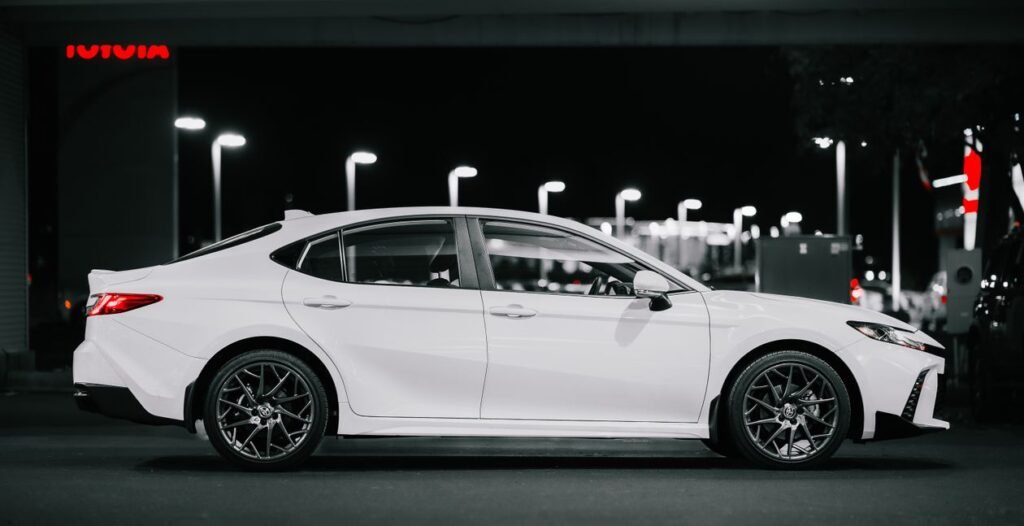
The ninth generation Camry is a bold bet: hybrid only, no pure petrol engine, no V6. Launched for the 2025 model year, the XV80 pairs a 2.5 liter four cylinder with Toyota’s latest hybrid system for 225 hp in front wheel drive form or 232 hp with all wheel drive, while returning up to 53 mpg in town. It is the most efficient Camry ever built, and it is still the current generation today.
So who does it suit? Buyers who want a brand new car with used car fuel bills. Commuters who do big miles and will repay any price premium in fuel savings. Drivers who like the idea of 500 plus miles between fill ups. Early adopters who are comfortable buying a car with no long term reliability record yet. Our Toyota Camry model guide puts the generations side by side.
This page covers the 2025 to present generation in detail: the hybrid only lineup, the real world economy, the two recalls already issued, what early owners report, who should buy now and who should wait, and what the car costs to run.
Toyota Camry 2025 to present at a glance
| Item | Details |
|---|---|
| Generation and years sold | XV80, the ninth generation. US model years 2025 to present, built in Georgetown, Kentucky. Still the current generation. |
| Body style | 4 door sedan only. |
| Main engine | 2.5 liter four cylinder with Toyota Hybrid System 5. Total system output 225 hp with front wheel drive, 232 hp with electronic on demand all wheel drive. No pure petrol engine and no V6 in North America. |
| Gearbox | Electronically controlled CVT on every trim. |
| Drive | Front wheel drive standard. Electronic on demand all wheel drive available on every trim, adding a third electric motor on the rear axle. |
| Seats | 5 |
| Boot space | 15.1 cubic feet. |
| Fuel economy highlights | LE front wheel drive rated 53 mpg city and 50 highway. Even the sporty XSE all wheel drive manages 44 city and 43 highway. |
Engines and specs that matter
There is only one powertrain, and that is the point. Every XV80 Camry pairs a 2.5 liter four cylinder making 163 pound feet of torque with Toyota’s fifth generation hybrid system and a lithium ion battery. Front wheel drive cars make 225 hp combined, all wheel drive cars make 232 hp combined. The gearbox is an electronically controlled CVT in every car.
The economy figures are the headline. The LE front wheel drive is rated 53 mpg city and 50 highway for 51 combined, which means a realistic 500 plus miles from the tank. Even the heavier all wheel drive XSE returns 44 city and 43 highway. If you do 15,000 miles a year, the fuel saving over the old 2.5 petrol is worth several hundred dollars annually.
The driving experience divides opinion in a useful way. The hybrid system is smooth and quiet in town, and the extra electric torque makes the car feel responsive off the line. Drivers who love engine noise and gears will miss the old V6; nobody else will. Toyota Safety Sense 3.0 is standard on every trim, with the full suite of driver assists.
One practical note: because the XV80 keeps the underlying body structure, doors and roofline of the previous generation, it feels familiar inside. Cabin space and the 15.1 cubic foot boot are essentially unchanged, so you are buying new technology in a known quantity of a car.
Which one suits you? Maximum economy, take the LE front wheel drive: the lightest car with the best figures and the lowest price. Want all weather ability, any trim with the electronic all wheel drive works. Want the sporty look, the SE and XSE add style without ruining the economy story. There is no wrong engine choice because there is only one engine.
Common problems of this generation
The honest truth first: this car is barely two model years old, so long term reliability data does not exist. What exists is two recalls and a small number of early owner complaints. The powertrain itself has no documented pattern of failures so far.
Blank instrument cluster recall, 2025 to 2026
The big one is the instrument cluster recall covering about 508,000 cars from model years 2025 to 2026. A software fault in the 7 inch combination meter fitted to LE, SE and Nightshade trims can leave the display blank at startup, and the same fault can disable the turn signals, hazard lamps and warning buzzers including the seatbelt reminder. Cars with the larger 12.3 inch cluster in XLE and XSE trims are not affected. The fix is a dealer software update, which cannot be done over the air, so every affected car needs a workshop visit. Cars built after early June 2026 fall outside the affected production window. If you buy used, confirm this recall is closed before you drive the car home.
Hybrid inverter bolt recall, 2025 to 2026
The second recall covers certain 2025 to 2026 hybrid cars for a loose bolt inside the hybrid inverter, which can cause a loss of drive power or in the worst case a fire. Dealers replace the inverter assembly free of charge. Like the cluster recall, this is a free dealer remedy, but confirm it is completed on any used car you consider by running the VIN through the NHTSA recall checker.
Early owner complaints, small numbers
Beyond the recalls, early owner reports mention isolated issues rather than patterns: some drivers report the seat shifting or popping, the forward collision warning sounding while reversing, and occasional infotainment reboots. One third party reliability index scores the 2025 car 76 out of 100 from just a handful of complaints, which is too thin a sample to mean much. Treat these as things to check on a test drive, not reasons to avoid the car. Our guide on how long EV batteries last answers the other big question new hybrid buyers ask, about battery life.
Should you buy this generation
This Camry suits buyers who want the newest technology and the lowest fuel bills. If you buy new or nearly new, you get a full factory warranty, both recalls have free remedies, and the hybrid powertrain is an evolution of the most proven hybrid system in the industry. The economy figures are real and the car is genuinely pleasant to drive.
Who should skip it, or wait? Buyers who need a proven long term record should wait a few more years or buy the previous XV70 generation instead, which has a deep reliability history. Buyers who dislike the feel of a CVT should test drive carefully, because there is no conventional automatic or manual option. And buyers considering an early build 2025 car must verify both recalls are completed.
The good buys are 2026 model year cars built after June 2026, which fall outside the instrument cluster recall window, and XLE and XSE trims in any year, which were never affected by the cluster fault. On any used example, confirm both recalls are closed and ask for the full service history.
Whatever the year, run through this checklist before you hand over money:
- Run the VIN through the NHTSA recall checker and confirm both recalls are closed.
- Start the car and confirm the instrument cluster display lights up fully.
- Test the turn signals, hazard lamps and warning buzzers.
- Drive in town and on the highway and listen for anything unusual from the hybrid system.
- Test the infotainment thoroughly, including phone pairing.
- Check the seat for looseness or popping noises.
- Ask for full service history and confirm the free scheduled maintenance was done.
- On a hybrid, ask for a battery health check printout from a Toyota dealer.
Running and repair costs
Running costs are the reason to buy this car: the fuel bills are tiny and Toyota includes two years or 25,000 miles of scheduled maintenance free. The hybrid components carry a 10 year and 150,000 mile warranty. Typical US prices for the common jobs look like this:
| Job | Typical cost in US dollars |
|---|---|
| Front brake pads, fitted | 150 to 350 for pads alone, 250 to 500 with new rotors; class typical fitted jobs land around 300 to 370 per axle |
No model specific repair figures exist yet for a car this new, but the class benchmarks apply: brake jobs land in the same band as the previous generation. Hybrid cars typically wear their brake pads more slowly than petrol cars thanks to regenerative braking, so expect longer intervals between pad changes. The expensive mistake here is not mechanical but financial: paying a big premium over a nearly new XV70 for economy gains you may never recoup if you drive low miles.
Questions and answers
Is the 2025 Toyota Camry reliable?
Too early to say with confidence. The hybrid powertrain is an evolution of Toyota’s proven system and has no documented pattern of failures, which is encouraging. But the car has already had two recalls, a blank instrument cluster fault and a hybrid inverter bolt issue, and long term data simply does not exist yet. Buy one for the warranty and the economy, not for a proven record.
What are the 2025 Camry recalls?
Two main recalls: one for a software fault that can leave the 7 inch instrument cluster blank and disable turn signals and hazards on LE, SE and Nightshade trims, fixed with a dealer software update; and one for a loose bolt inside the hybrid inverter that can cause loss of drive power, fixed by replacing the inverter. Both are free at dealers. Confirm both are closed on any used car.
Is the Camry hybrid only now?
In North America, yes. The XV80 dropped the pure petrol 2.5 and the 3.5 V6 entirely. Every car pairs the 2.5 liter four with the hybrid system for 225 hp front wheel drive or 232 hp all wheel drive. If you want a non hybrid Camry, you need the previous XV70 generation from 2018 to 2024.
How economical is the 2025 Camry really?
Very. The LE front wheel drive is rated 53 mpg city and 50 highway, and owners report real world figures close to the official ones. Even the sporty all wheel drive XSE manages 44 city and 43 highway. For a car this size with this much power, nothing in the class touches it on fuel bills, which is exactly why Toyota made the hybrid the only option.