
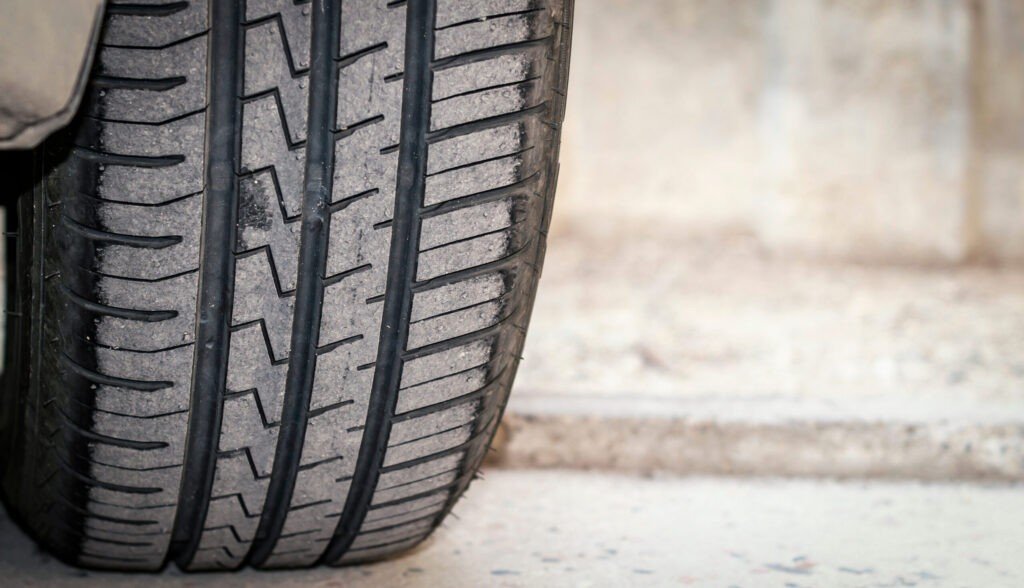
Tyre tread wears in patterns, and each pattern tells a story about pressure, alignment, suspension, or driving habits. Learning to read those patterns helps you fix the cause before you buy another set of tyres, because new tyres fitted onto an uncorrected fault will wear the same way again. Check tread across the full width of each tyre, not just the outer edge you can see easily.
Read wear across the centre and shoulders
Wear in the centre of the tread usually means over-inflation, while wear on both shoulders points to under-inflation. Even wear across the full width is what you want. Action: run your hand across the tread and look at the wear indicators. If the centre is worn smooth but the shoulders look fine, the pressure has been too high. If both shoulders are worn, it has been too low.
Look for one-sided shoulder wear
Wear on just the inner or outer shoulder points to an alignment issue, usually too much camber or toe. This wear often appears with a pull or an off-centre steering wheel. Action: compare the inner and outer shoulders of each front tyre. If one side is clearly more worn, book a four-wheel alignment and ask for the before and after readings.
Check for patchy or cupped wear
Patchy wear, where the tread looks scalloped or cupped in places, usually means a worn shock absorber or an unbalanced wheel. You may also feel vibration at speed. Action: look along the tread for dips and high spots, and note any bouncing or vibration. If you find cupping, have the shocks and wheel balance checked.
Look for flat spots
Flat spots come from hard braking that locks a wheel, or from a car standing still for a long time. A flat spot causes a thump that follows wheel speed. Action: feel around the tread for a flat area. If the car stood for months, the flat spots may work out with driving. If they came from a lock-up, the tyre may need replacement.
Check the tread depth properly
Tread depth is a legal and safety issue, and the minimum is not a target to aim for. Wet grip drops well before the legal limit. Action: check the depth across the full width with a gauge, not just in one spot. If any part is near the legal minimum, or the wear is uneven, replace the tyre. Do not wait for the wear indicators to disappear completely.
Compare all four tyres
Comparing the four tyres tells you whether the fault is on one corner or across the car. A single worn tyre points to that corner, while all four wearing the same way points to pressure or driving style. Action: look at each tyre in turn and note the pattern. If only one is worn, focus on that corner. If all four match, check pressures and alignment.
Look at the age of the tyres
Tyres age even if the tread looks fine. Old rubber hardens and cracks, and the risk of failure rises. Action: find the four-digit date code on the sidewall, which shows the week and year of manufacture. If a tyre is more than six years old, have it inspected, and consider replacement even if the tread looks acceptable.
Do not ignore cracking and bulges
Cracks in the sidewall or tread, and bulges on the sidewall, mean the tyre structure is failing. A bulge can burst without warning. Action: look closely at the sidewalls for cracks and feel for bulges. If you find a bulge, replace the tyre immediately and do not drive far. If you find cracking, have the tyre inspected promptly.
Rotate tyres to even out wear
Front and rear tyres wear differently, and rotation evens out the wear so all four last longer. Action: follow the maker’s rotation pattern and interval, usually every 5,000 to 8,000 miles. Mark the positions when you rotate so the pattern stays consistent.
Know when a tyre is unsafe
A tyre with exposed cords, a deep cut, a bulge, or tread below the legal limit is not safe to drive on. Action: if you see cords, a bulge, or a deep cut, fit the spare or call for recovery. Do not drive on a tyre that is structurally damaged, even a short distance at low speed.
Lesson from everyday garage work
A common pattern in everyday garage work is that new tyres get fitted onto a car with an alignment or pressure fault, and the new set wears the same way within months. The lesson is to read the old tyres before buying new ones. Action: look at the wear pattern on the old set, fix the cause, then fit new tyres. Ask the garage to show you the pattern and explain what caused it.
For related tyre checks, learn how to check tyre pressure correctly, read what uneven tyre wear is telling you, and see what to check when the car pulls to one side if wear comes with a pull.