
You turn the key and nothing happens, or you hear one loud click, or the engine turns over slowly and then gives up, and now you are stuck in a car park working out which part to blame. The starter and the alternator both touch the battery, both can leave you stranded, and both cost real money, so guessing wrong means paying for the wrong repair and still calling for a tow. This guide will show you, in plain language, what each part does, how their symptoms differ, and how a simple test tells them apart before you spend anything. But here is the question most guides skip, and it decides the whole bill. Can the car start perfectly and still have a failing alternator?
The short answer to alternator vs starter is simple. The starter is a motor that uses battery power to crank the engine for a few seconds until it starts, and then it switches off. The alternator is a generator that the running engine spins, and it makes power for everything in the car while you drive, and recharges the battery at the same time. The starter works only at the start of a trip, the alternator works for the whole trip, and that difference in timing is what makes their symptoms so different. If the thought of a big repair bill is worrying you, that worry is sensible, because the two parts sit at very different prices, and a correct diagnosis is the cheapest repair of all.
Here is a real example that shows how far apart those prices sit. RepairPal national estimates, updated in September 2026, put a starter replacement at 565 dollars to 796 dollars, with parts at 375 dollars to 516 dollars and labour at 191 dollars to 280 dollars, while an alternator replacement sits at 809 dollars to 1,088 dollars, with parts at 613 dollars to 800 dollars and labour at 196 dollars to 288 dollars, before taxes and fees. Those are national averages that vary by car and by shop, but the gap between them is real, and it is one more reason to find out which part has actually failed before you approve any work. Keep those two ranges in mind as you read, because the symptoms below will tell you which one applies to your car.
What the Starter Does
The starter is a small electric motor, usually bolted to the engine where it meets the transmission, and it has one job only, to turn the engine over fast enough for it to start running on its own. When you turn the key or press the start button, the battery sends a large current to the starter, a small switch called a solenoid connects that current and pushes a gear into the flywheel, and the motor spins the engine at a few hundred revolutions per minute. The moment the engine fires and runs on its own, the gear pulls back and the starter switches off. It works for only a few seconds at a time, but it draws more current in those seconds than every other part of the car combined, which is why a weak battery shows up first at starting time.
Because the starter works so briefly, its failures are easy to recognise once you know the sounds. A single loud click and then silence means the solenoid engaged but the motor did not turn, which points to the starter itself or to a poor connection on its heavy cable. A rapid clicking sound usually means something different, a battery too weak to hold the solenoid engaged, so it opens and closes again and again. A grinding noise means the starter gear is not meshing cleanly with the flywheel, and that is the sound to take seriously, because continuing to grind it can damage the flywheel teeth and turn a starter job into a much bigger repair.
A starter also fails gradually, not just all at once. Slow cranking that gets worse over a few weeks, a car that starts only after several tries, or a starter that works when the engine is cold but not when it is hot are all signs to act on soon. Heat is a real factor here, because a starter sits close to the exhaust on many cars, and heat soak can make a worn starter refuse to work until it cools down. If your car starts fine in the morning but refuses after a short stop at the shops on a hot day, the starter is a strong suspect. That pattern, a car that fails only when hot, is worth telling the mechanic exactly, because it points the diagnosis in the right direction. And it leads to the part that works the opposite way, only after the engine is already running.
What the Alternator Does
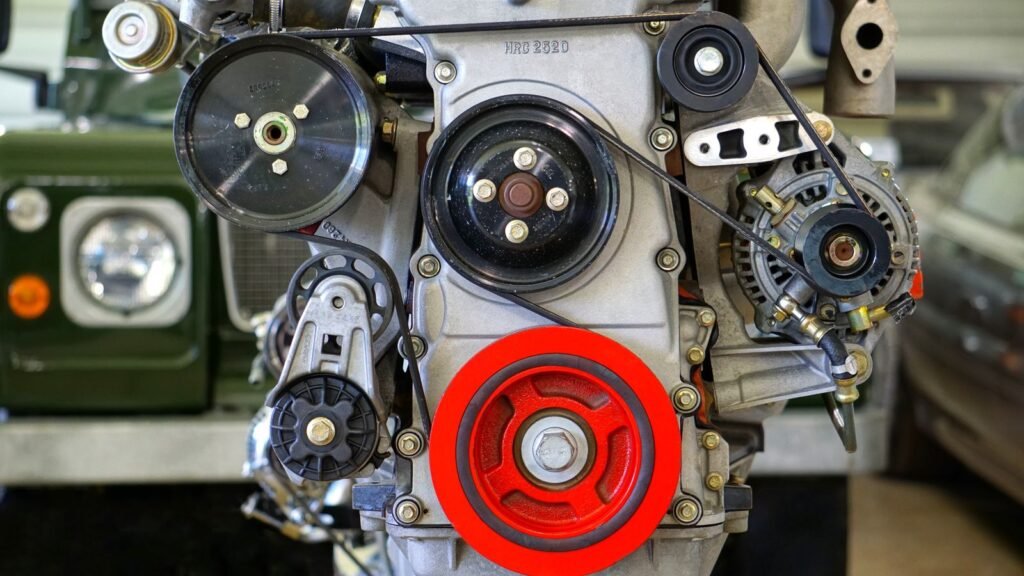
The alternator is a generator, driven by the engine through the serpentine belt, and it makes the electricity your car uses while you drive. It powers the ignition, the fuel pump, the lights, the wipers, the heater fan and the charging ports, and it recharges the battery at the same time, replacing the energy the starter took and topping up whatever the accessories used along the way. A healthy alternator puts out about 13.7 volts to 14.7 volts while the engine is running, and that higher voltage is what pushes energy back into the battery. If the battery warning light comes on while you are driving, that light is really an alternator warning, because it means the system voltage has fallen below the level the alternator should maintain.
Inside the alternator, a spinning rotor inside a set of copper windings produces alternating current, and a rectifier turns that into the direct current the car needs. A voltage regulator then holds the output steady, so the lights do not flare when you rev the engine and do not dim when you switch the heated seats on. On many modern cars the engine computer controls that regulator, raising or lowering the output to suit the load and to save a little fuel. That is why the voltage on a modern car can move around more than on an older car, and why a single reading at idle does not always tell the whole story.
Alternator failures show up while you are driving, not while you are starting, and that timing is the clearest clue of all. Headlights that dim and brighten as the engine speed changes, a whining or grinding noise from the front of the engine that rises and falls with the revs, a burning rubber smell from a slipping drive belt, or a battery that keeps going flat even though it is fairly new all point toward the alternator or its belt. The belt matters here, because an alternator cannot make power if the belt that spins it is loose, glazed or broken, so a slipping belt can look exactly like a failed alternator. Check the belt for cracks and for tension before you blame the alternator itself, and remember the key difference. A failing starter stops the car from starting, but a failing alternator lets the car start and then stops it from driving. Now put the two side by side, and the difference becomes easy to see.
Alternator vs Starter at a Glance
Use this table when you want the difference in one look. It covers what each part does, when it works, what it costs to replace and what its failure looks like. Read the row that matches your symptom, not the row that sounds cheapest, because fitting the wrong part to your symptom is how a simple job turns into a repeat visit.
| Feature | Starter | Alternator |
|---|---|---|
| What it is | An electric motor | A generator driven by the engine |
| When it works | Only for a few seconds while starting | The whole time the engine is running |
| What it does | Turns the engine over so it can start | Makes power and recharges the battery |
| Power flow | Takes a large current from the battery | Sends power to the car and to the battery |
| Main symptom | Click, no crank, or slow cranking | Battery light, dimming lights, car dies while driving |
| Warning light | Usually none | Battery warning light while driving |
| Typical cost | 565 dollars to 796 dollars | 809 dollars to 1,088 dollars |
| Parts share | 375 dollars to 516 dollars | 613 dollars to 800 dollars |
| Labour share | 191 dollars to 280 dollars | 196 dollars to 288 dollars |
The table shows why the two parts are opposites in every way that matters. The starter spends power to start the engine, the alternator makes power once the engine is running, and their failures happen at opposite ends of a trip. The cost rows use the RepairPal national averages from September 2026 quoted above, and both are before taxes and fees, so treat them as a guide for comparing quotes, not as a fixed price for your car. Use the table to check the quote you were given, then move on to the test that separates the two parts in minutes. But which symptom is which, exactly?
Reading the Symptoms: Click, Crank or Silence
Start with what you hear and see when you try to start the car, because those clues sort most cases before any tool comes out. One loud click and nothing else, with the lights staying bright, points to the starter. That is the solenoid engaging while the motor itself fails to turn, and a repair guide summary of the same symptom says exactly that, one loud click, no crank, lights stay bright, starter. Rapid clicking with dim lights points to a weak battery, not to either part, because the battery cannot hold the solenoid engaged. Slow cranking that fades away also points to the battery first, especially on a cold morning.
A car that starts normally and then dies, or that dies while driving, points the other way, toward the alternator. The battery had enough power to start the engine, but nothing was replacing that power while you drove, so the battery slowly emptied until the ignition and the fuel pump could no longer run. The same logic applies to a car that needs a jump start every morning. The battery may be the part that is flat, but if it goes flat again overnight or after a short drive, the alternator that should have recharged it is the more likely cause. Jump starting such a car again and again only treats the symptom, and each jump start leaves the battery a little weaker.
Watch the dashboard as well. A battery warning light that comes on while you are driving is an alternator warning, and it means the charging voltage has fallen. Headlights that dim when you switch the heater or the rear window heater on, then brighten again, point the same way. A grinding noise at starting time points to the starter gear and the flywheel, while a whining noise that changes with engine speed points to the alternator bearings or its drive belt. Write down exactly what you hear, when it happens, and whether the lights are bright or dim, because those three details turn a vague complaint into a diagnosis the mechanic can work with. And if you want to confirm it yourself, the next section gives you two simple tests.
Two Simple Tests That Tell Them Apart
The jump start test is the most useful test a driver can do, and it needs no tools. If the car starts with a jump start and keeps running normally for the rest of the drive, the battery was the problem, and the alternator is probably charging it again. If the car starts with a jump start but dies again soon after, or dies while you are driving, the alternator or its belt is the more likely fault, because nothing is replacing the power the car is using. If the car does not start even with a good jump start, and you hear one loud click or nothing at all, the starter or its connections are the more likely fault, because the extra power from the jump leads still cannot turn the motor.
Be careful with the jump start itself. Connect the cables in the right order, red to the dead battery positive terminal first, then red to the good battery positive, then black to the good battery negative, then black to a bare metal part of the dead car away from the battery, and keep your hands clear of moving parts. If you are unsure about any step, ask for help rather than risking a spark near the battery. A jump start is a test and a rescue, not a repair, so a car that needed one should still be tested properly before its next long drive.
The voltage test is the second test, and it needs only a cheap multimeter. With the engine off and the car sitting for an hour, a healthy battery should read about 12.6 volts across its terminals. With the engine running, the reading should rise to about 13.7 volts to 14.7 volts, which shows the alternator is charging. A reading that stays near 12 volts with the engine running means the alternator is not charging, even if the car started fine, and that is the test that catches a failing alternator before it strands you. A reading that falls well below 12 volts with the engine off means the battery itself is low. Take both readings to the shop, because they turn a guess into a number. If the tests point to a part, the next question is what that part will cost.
What Replacement Costs and What Changes the Price
Costs vary a lot by car, by part quality and by where you live, so treat every range below as a national average that varies by job, not as a fixed quote for your car. The best way to use these numbers is to compare them with the written quote you receive, and to ask the shop to break its quote into parts and labour, so you can see which part of the bill is driving the total. The ranges here come from RepairPal national estimates updated in September 2026, checked during this run, and they are before taxes and fees.
A starter replacement averages 565 dollars to 796 dollars, with parts at 375 dollars to 516 dollars and labour at 191 dollars to 280 dollars. The part is the larger share of the bill, and it varies with the car, because some starters are easy to reach and some sit buried under the intake manifold or behind the engine, which adds labour time. A remanufactured starter costs less than a new one, and many shops offer that choice, but ask about the warranty on each option before you decide, because a cheaper part with a short warranty can cost more if it fails again.
An alternator replacement averages 809 dollars to 1,088 dollars, with parts at 613 dollars to 800 dollars and labour at 196 dollars to 288 dollars. The alternator part costs more than a starter on most cars, because it is a larger and more complex unit, and the price rises further on luxury cars, on cars with a high output alternator, and on cars where the alternator is hard to reach. Some cars need the bumper or a wheel arch liner removed to reach it, and that labour shows up in the quote, so ask the shop to explain the labour time if it looks high.
Two extra costs can appear on either job, and both are worth asking about before you approve the work. The first is the drive belt, because a worn serpentine belt should be replaced while the alternator is off, and a belt job on its own later costs a second round of labour. The second is a diagnostic fee, because a proper test takes time and equipment, and some shops charge for it while others fold it into the repair. Ask whether the diagnostic fee is waived if you go ahead with the repair, and get the quote in writing with the part brand, the labour hours and any extra items listed separately. Read our guide on alternator repair cost for the full detail on that job, and our guide to car battery problem signs if the battery still looks like a suspect. But should you drive the car at all while you decide?
Can You Drive With a Bad Starter or a Bad Alternator
A bad starter and a bad alternator call for very different decisions, and mixing them up is how drivers get stranded. A car with a failing starter may still start sometimes, and if it starts, it will usually drive normally, because the starter plays no part in driving. The risk is that it refuses to start at the worst moment, in a car park late at night or far from help, so a starter that is getting worse should be booked soon, even if the car still starts most of the time. Do not keep trying to start a car with a grinding starter, because each grind can damage the flywheel teeth.
A car with a failing alternator is a different risk. It runs on the battery alone, and the battery will go flat, often within minutes if the lights, the heater fan and the wipers are all on. The engine may stumble, the dashboard may light up with warnings, and the power steering can fail on cars where the steering is electric, all with little warning. If the battery warning light comes on while you are driving, switch off the non essential electrics, the heated seats, the rear window heater and the air conditioning, and drive to a shop soon, but do not set off on a long trip. If the car has already died once and needed a jump start, do not drive it again until the charging system has been tested.
There is one more case worth knowing. A broken serpentine belt can stop the alternator, the water pump and the power steering pump at the same time on some cars, and that turns a charging fault into an overheating and steering problem as well. If the battery light comes on together with a loss of power steering or a rising temperature gauge, pull over safely, switch the engine off and call for recovery, because driving on risks the engine itself. That combination is a stop driving signal, not a drive to the shop signal. Once you know whether it is safe to drive, the last step is choosing the part and the shop.
How to Choose the Right Part and Avoid the Wrong Repair
Start with a proper test, not with a part. Ask for a test that covers the battery, the starter draw and the alternator output together, because testing only one part can miss the real fault, and the battery is often the innocent bystander in a starter or alternator failure. A battery test should show the measured voltage and the cold cranking amps it can still deliver. A charging test should show the output voltage at idle and at higher revs, and a starter test should show the current it draws while cranking. If the shop cannot show you a reading, ask why, and consider a second opinion before you approve a big part.
Choose between a new part, a remanufactured part and a quality aftermarket part with your plans for the car in mind. A new original part usually lasts longest and costs most. A remanufactured part costs less and can be a sensible choice on an older car, but check the warranty, because a short warranty on a remanufactured starter can mean paying the labour twice if it fails early. A quality aftermarket part from a known maker can match the original for less, and it is a sensible choice for most family cars. Budget parts can be tempting, but they can wear faster and cost you a second job sooner, so ask the shop what warranty comes with the part and with the labour, and get that warranty in writing.
Avoid the common traps that turn a simple repair into a repeat visit. Do not replace the battery when the symptom points to the starter, do not replace the starter when the alternator is not charging, and do not let a shop replace the alternator without checking the drive belt and the battery first, because a slipping belt or a dying battery can mimic an alternator fault exactly. Ask the shop to show you the old part, keep the invoice with the part number and the warranty, and keep the test readings with it, so a future shop can see what was fitted and what was measured. That paper trail is your proof if the same symptom returns. Read our guide on car battery replacement cost if the battery turns out to be part of the problem, so you have the full price picture before you decide. Now here are the answers to the questions drivers ask most after reading this guide.
Frequently asked questions
What is the difference between alternator and starter?
The starter is an electric motor that uses battery power to crank the engine for a few seconds until it starts, and then it switches off. The alternator is a generator that the running engine spins, and it makes power for everything in the car while you drive, and recharges the battery at the same time. The starter works only at the start of a trip, the alternator works for the whole trip.
How do I know if it is the starter or the alternator?
Use the symptom and a simple test. One loud click with bright lights points to the starter. A car that starts with a jump start but dies again soon after points to the alternator. A voltage reading that stays near 12 volts with the engine running means the alternator is not charging, and a battery and charging test confirms which part has failed before you buy anything.
Can a bad alternator drain a new battery?
Yes. A failing alternator does not recharge the battery while you drive, so the battery slowly empties until the car cannot start, or dies while driving. A new battery fitted to a car with a bad alternator will go flat again, which is why the charging system should always be tested when a fairly new battery keeps going flat.
How much does it cost to replace a starter or an alternator?
RepairPal national estimates from September 2026 put a starter replacement at 565 dollars to 796 dollars, with parts at 375 dollars to 516 dollars and labour at 191 dollars to 280 dollars, and an alternator replacement at 809 dollars to 1,088 dollars, with parts at 613 dollars to 800 dollars and labour at 196 dollars to 288 dollars, before taxes and fees. Costs vary by car, part quality and location, so get a written quote for your exact car.