
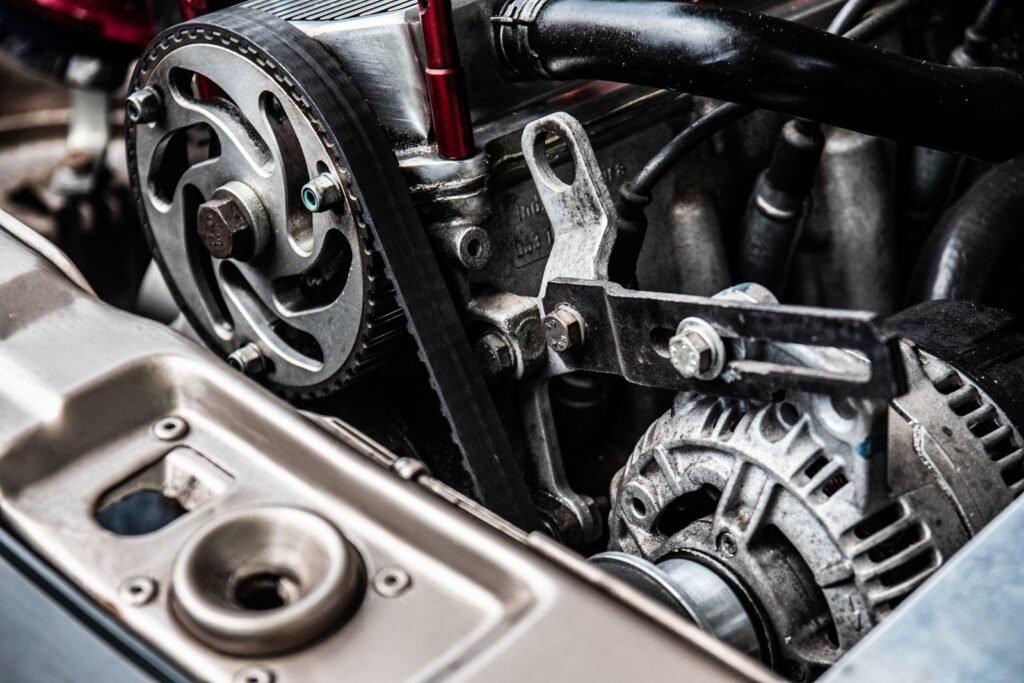
Your mechanic just said the word belt, and now you are wondering which belt he means, how much it will cost, and whether your car can wait or needs attention today. Both belts live at the front of the engine, both wear out with age, and both can leave you stranded, yet they do completely different jobs and sit at completely different prices. This guide explains each belt in plain language, shows you how to work out which one your car has, and gives you the real replacement costs, so you can approve the right job with confidence. But here is the question that decides whether the bill is a few hundred dollars or a few thousand. What happens if the wrong belt is the one that breaks?
The short answer to serpentine belt vs timing belt is simple. The serpentine belt is a single long ribbed belt on the outside of the engine, and it drives the parts that keep the car comfortable and running, the alternator, the air conditioning compressor, the power steering pump and, on many cars, the water pump. The timing belt is a toothed belt inside the engine, hidden behind a cover, and it keeps the crankshaft and the camshaft turning in sync, so the valves open and close at exactly the right moment. One belt works outside in the open, the other works inside where you cannot see it. One is a fairly quick job to change, the other takes many hours of labour and costs much more. If the idea of a timing belt breaking inside your engine is worrying you, that worry is sensible, because the damage from a snapped timing belt can cost many times more than the belt itself.
Here is a real example that shows how far apart the two jobs sit. RepairPal national estimates, updated in September 2026, put a serpentine belt replacement at 154 dollars to 212 dollars, with parts at 65 dollars to 82 dollars and labour at 89 dollars to 130 dollars, before taxes and fees. A timing belt replacement, in the same national figures, sits at 889 dollars to 1,291 dollars, with parts at 300 dollars to 426 dollars and labour at 589 dollars to 865 dollars. The timing belt costs several times as much, and most of that gap is labour, because the timing belt sits deep inside the engine while the serpentine belt sits outside in the open. Keep those two ranges in mind as you read, because the sections below will tell you which one applies to your car, and when each job is due.
What the Serpentine Belt Does
The serpentine belt is one long belt that winds its way around several pulleys at the front of the engine, which is why it is called serpentine, because it snakes from one part to the next in a single loop. It takes power from the crankshaft, the part that turns as the engine runs, and it passes that power to the alternator, which makes electricity and recharges the battery, to the air conditioning compressor, which makes cold air for the cabin, and to the power steering pump, which makes the steering wheel easy to turn. On many cars it also drives the water pump, which pushes coolant around the engine and keeps it from overheating. When the engine is running, the serpentine belt is always turning, and every one of those parts depends on it.
Because the belt sits outside the engine, you can see it when you open the bonnet, and you can check its condition yourself in a minute. Look for cracks across the ribs on the inside of the belt, for missing chunks of rubber, for fraying at the edges, and for a shiny glazed surface that looks smooth instead of grippy. A belt tensioner holds the belt tight, and a worn tensioner can let the belt slip, squeal or jump off a pulley, even when the belt itself still looks sound. Press the belt gently with a finger when the engine is off and cold, and if it feels loose or you can see deep cracks, book a check soon. A belt that looks worn is telling you its age in plain sight, and that is a useful warning to have.
A serpentine belt usually lasts about 100,000 miles, and many cars reach that age with the original belt still fitted. Age and heat wear the rubber down, even if the car has done low miles, so a car that is ten years old with its original belt is due for a close look, whatever the mileage reads. When you do replace the belt, ask the shop to check the tensioner and the pulleys at the same time, because a new belt on a worn tensioner will not last as it should. That small check can save a second visit, and it is the reason the next belt, the one you cannot see, deserves a very different kind of attention.
What the Timing Belt Does
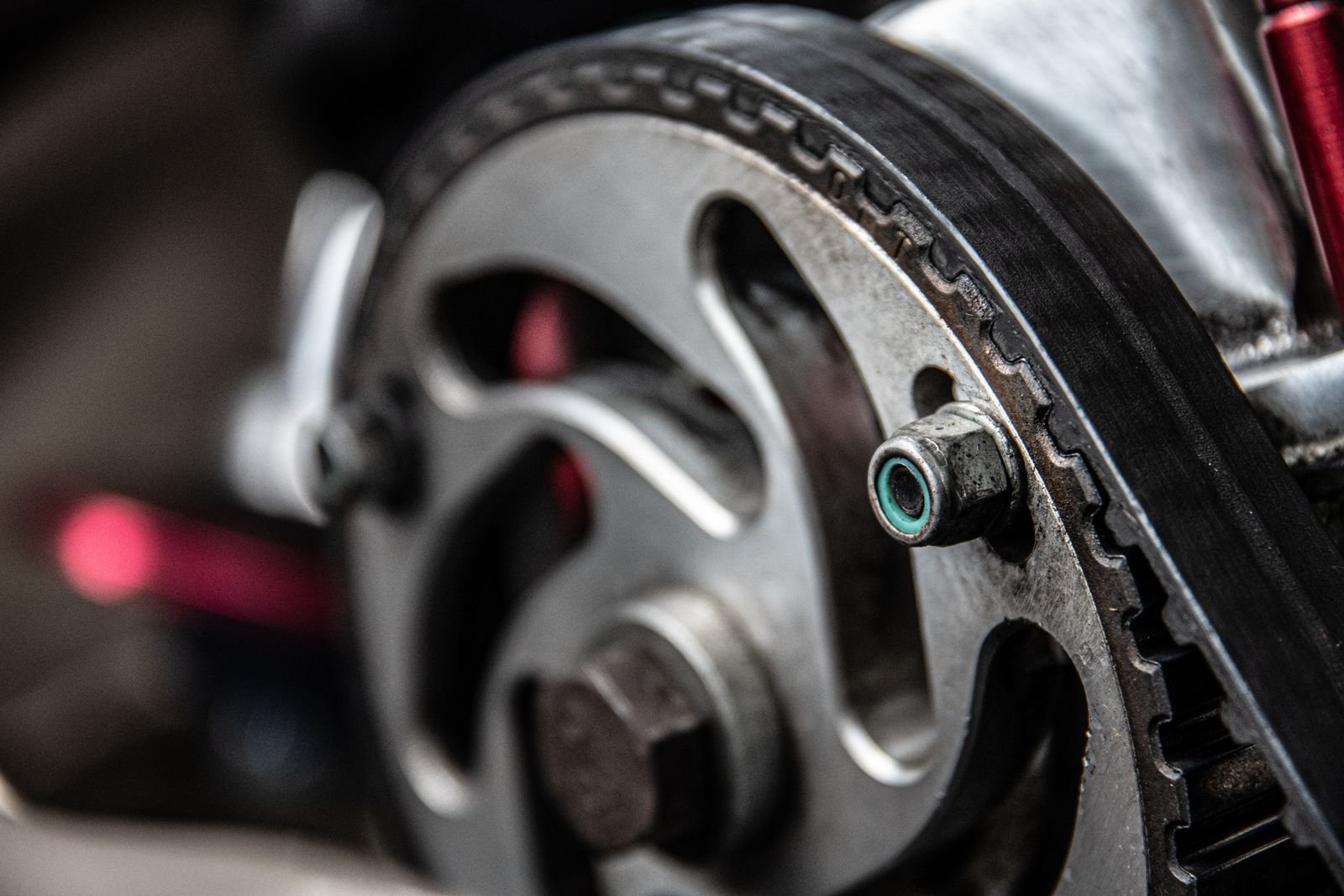
The timing belt sits inside the engine, behind a cover that keeps oil and dirt away from it, so you cannot see it without taking parts off. It has teeth on the inside edge, and those teeth grip matching teeth on the crankshaft pulley and the camshaft pulley, which keeps the two shafts turning in perfect time with each other. The crankshaft moves the pistons up and down, the camshaft opens and closes the valves, and the timing belt makes sure a valve is never open when a piston is at the top of its travel. That timing is measured in fractions of a second, and it has to stay exact at every engine speed, from idle to full throttle.
If the timing belt wears, stretches or slips by even one tooth, the engine will run badly, lose power, misfire or refuse to start. If it snaps, the timing is lost at once, and on many engines, known as interference engines, the pistons can hit the valves that are left open in their path. The result is bent valves, damaged pistons and a repair bill that can run to 2,500 dollars to 6,500 dollars, which is many times the cost of changing the belt on schedule. That is the whole reason the timing belt is a maintenance job with a fixed interval, not a part you wait to fail. The cost of changing it on time is high, but the cost of changing it too late is far higher.
Most timing belts are due at 60,000 to 100,000 miles or 7 to 10 years, whichever comes first, and your owner manual gives the exact figure for your car. The interval depends on the engine design and on the belt material, so do not borrow a figure from a friend car and apply it to your own. Many shops change the water pump, the tensioner and the pulleys at the same time as the timing belt, because those parts sit in the same place and are cheap to reach while the cover is already off. A full kit with water pump, tensioner and pulleys is commonly 850 dollars to 1,400 dollars, and while that sounds like a lot, it is still far less than the engine damage a snapped belt can cause. Now that you know what each belt does, the next step is to see them side by side.
Serpentine Belt vs Timing Belt at a Glance
Use this table when you want the difference in one look. It covers where each belt sits, what it drives, how long it lasts, what it costs to replace, and what happens if it fails. Drivers often search for timing belt vs serpentine belt when they want the same comparison from the other side, and the answer is the same either way round. Read the row that matches your question, not the row that sounds cheapest, because the cheap belt and the costly belt are not interchangeable jobs, and treating them as the same job is how a simple repair turns into engine damage.
| Feature | Serpentine Belt | Timing Belt |
|---|---|---|
| Where it sits | Outside the engine, visible under the bonnet | Inside the engine, behind a cover |
| What it looks like | One long ribbed belt | A toothed belt with teeth on the inside edge |
| What it drives | Alternator, air conditioning compressor, power steering pump and, on many cars, water pump | Crankshaft and camshaft in sync |
| What it does | Powers the accessories that keep the car running and comfortable | Keeps valves and pistons moving in exact time |
| How long it lasts | About 100,000 miles | 60,000 to 100,000 miles or 7 to 10 years |
| Typical replacement cost | 154 dollars to 212 dollars | 889 dollars to 1,291 dollars |
| Full job with extra parts | 150 dollars to 400 dollars with a new tensioner | 850 dollars to 1,400 dollars as a full kit with water pump, tensioner and pulleys |
| What happens if it breaks | Power steering, charging and air conditioning stop at once, engine may overheat | On an interference engine, pistons can hit valves and repair can cost 2,500 dollars to 6,500 dollars |
| Can you see it | Yes, open the bonnet and look at the front of the engine | No, hidden behind a cover |
The table shows the real story in one place. The serpentine belt is outside, visible, fairly quick to change and fairly cheap to replace, while the timing belt is inside, hidden, slow to change and costly, because reaching it takes hours of careful work. The cost rows use the RepairPal national averages from September 2026 quoted above, and both are before taxes and fees, so treat them as a guide for comparing quotes, not as a fixed price for your car. Use the table to check the quote you were given, then move on to the question every owner asks next, which belt does my car actually have? But how do you find that out without taking the engine apart?
How to Tell Which Belt Your Car Has
Start with the belt you can see. Open the bonnet with the engine off and cold, and look at the front of the engine for a long ribbed belt winding around several pulleys. If you can see it, that is the serpentine belt, and almost every modern car has one, whatever else it has inside. Its presence tells you nothing about the timing belt, because the timing belt is a separate part inside the engine, so seeing a serpentine belt does not mean your car has no timing belt. That is the most common mix up owners make, and it is worth clearing up before you go any further.
The owner manual is the reliable answer for the timing side. Look in the maintenance section, under timing belt, timing chain or scheduled maintenance, and it will say which one your car has and at what mileage or age it must be changed. If the manual says timing chain, your car has a chain instead of a timing belt, and a chain is designed to last the life of the engine, though it still needs clean oil and regular servicing to stay quiet and sound. If the manual gives a timing belt interval, such as 60,000 to 100,000 miles or 7 to 10 years, your car has a timing belt, and that interval is your deadline. Keep the manual page marked, because it is the document a shop will ask about when you book the job. Read our guide to timing chain replacement cost if your manual says your car has a chain, so you know what that job costs if it ever needs attention.
If you have no manual, there are two other ways to find out. The first is to search for your exact car, year, engine size and fuel type, plus the words timing belt or timing chain, and check a trusted parts catalogue or a repair guide for that exact engine, because the same model can use a belt on one engine and a chain on another. The second is to ask a shop to check the vehicle identification number, because a dealer or a good independent shop can look up the engine fitted to your car and tell you in a minute. Do not guess from the age of the car alone, and do not assume a newer car has a chain, because many newer cars still use a belt. Once you know which one you have, the next question is what each job will cost you, so get the figures clear before you book.
What Each Belt Costs to Replace
Costs vary by car, by part quality and by where you live, so treat every range below as a national average that varies by job, not as a fixed quote for your car. The best way to use these numbers is to compare them with the written quote you receive, and to ask the shop to break its quote into parts and labour, so you can see which part of the bill is driving the total. The ranges here come from RepairPal national estimates updated in September 2026, checked during this run, and they are before taxes and fees.
A serpentine belt replacement averages 154 dollars to 212 dollars, with parts at 65 dollars to 82 dollars and labour at 89 dollars to 130 dollars. The typical shop range is 120 dollars to 220 dollars, and with a new tensioner the job is commonly 150 dollars to 400 dollars. The part itself is cheap, and the labour is short, because the belt sits outside the engine and is easy to reach. A worn tensioner or a worn pulley can add to the bill, but even then the job stays far below a timing belt job, which is why a serpentine belt is one of the cheaper repairs a car can need. Read our guide to serpentine belt replacement cost for the full detail on that job, including the signs that the belt or the tensioner is worn.
A timing belt replacement averages 889 dollars to 1,291 dollars, with parts at 300 dollars to 426 dollars and labour at 589 dollars to 865 dollars. Independent shops typically charge 400 dollars to 1,000 dollars, while a full kit with water pump, tensioner and pulleys is commonly 850 dollars to 1,400 dollars. Labour is about two thirds of the timing belt bill, because the mechanic must remove covers, belts and sometimes engine mounts to reach the belt, then fit the new belt and set the timing exactly before the engine is started again. That labour is skilled work, and it is the reason a cheap quote for a timing belt should make you ask what is included, not simply celebrate the price. The timing belt replacement cost is the figure to compare with your quote, line by line, before you approve the work.
Three things move the price most. The first is the car, because a small engine with good access costs less in labour than a large engine where the belt sits tight against the bodywork. The second is the parts you choose, because a full kit costs more up front than a belt alone, yet it can save a second labour bill later if the water pump or the tensioner fails soon after. The third is the shop, because a dealer usually charges more in labour than an independent shop, while an independent shop may offer a quality aftermarket kit for less. Ask for the quote in writing, with parts, labour and any extra items listed separately, and ask whether the water pump is included, because that one line can change the total by hundreds of dollars. If the water pump is part of the job, read our guide to car water pump replacement cost, so you can judge whether the figure in your quote is fair.
What Happens When Each Belt Fails
When a serpentine belt fails, the change is sudden and obvious. The power steering goes heavy at once, the battery warning light comes on, the air conditioning stops blowing cold air, and the temperature gauge may start to climb if the water pump has stopped too. The engine itself will keep running for a short time on battery power alone, but the battery will drain fast, and the steering will be hard to turn, especially at low speed. Pull over safely, switch the engine off, and call for recovery, because driving on with no cooling and no power steering risks the engine and makes the car hard to control.
When a timing belt fails, the engine simply stops, often with no warning at all, and it will not restart. On an engine where the pistons and valves share the same space, the damage happens in the same instant the belt snaps, and the repair can cost 2,500 dollars to 6,500 dollars, which is the figure owners remember long after the tow truck has gone. On a small number of engines the pistons and valves never meet, so a snapped belt means a tow and a new belt rather than a ruined engine, but you cannot rely on that, and your owner manual or a shop can tell you which type your engine is. The difference between the two failures is simple to state, a serpentine belt failure is urgent, a timing belt failure can be ruinous, and only one of them gives you a warning you can see.
Both belts give warning signs before they fail, and both are worth acting on. A serpentine belt that squeals on a cold start, chirps when you turn the steering wheel, or shows cracks and fraying is asking to be changed. A timing belt gives fewer visible signs, because it is hidden, so listen for a ticking noise from the front of the engine, watch for rough running or a loss of power, and take a car that misfires or struggles to start for a check at once. A squeal is a warning, a tick is a warning, and a car that has passed its timing belt interval is a warning too, even if it still runs perfectly. The next section turns those warnings into dates you can put in your diary, so the job is done before the belt decides the date for you.
When to Change Each Belt
Change the serpentine belt at about every 100,000 miles, or sooner if it shows cracks, fraying, glazing or a squeal that does not go away. A car that lives in a hot climate or does many short trips may wear a belt faster, because heat and repeated bending age the rubber, so check the belt at every service and change it when the rubber looks tired, not only when the mileage is reached. The belt is cheap, the check is quick, and changing it early costs little, while waiting until it snaps costs a tow and a day without the car.
Change the timing belt at 60,000 to 100,000 miles or 7 to 10 years, whichever comes first, and use the exact figure in your owner manual for your engine. Age matters as much as mileage, because rubber ages even when the car sits still, so a low mileage car that is ten years old can still be due. If you bought a used car and you have no record of a timing belt change, treat the belt as due until a shop can prove otherwise, because a missing record is not proof the job was done. Book the job before the interval runs out, not after, and keep the invoice with the mileage and the date, so the next owner and the next shop can see when it was last changed.
When the timing belt is changed, changing the water pump, the tensioner and the pulleys at the same time is usually the sensible choice, because those parts sit behind the same cover and have lived the same life as the belt. A new belt on an old water pump can mean paying the same labour again a year later when the pump starts to leak, and that second bill can be almost as large as the first. Ask the shop to quote the belt alone and the full kit side by side, then choose with the age of the car and your plans for it in mind. A car you plan to keep for years deserves the full kit, a car you plan to sell soon may not, but either way the choice should be yours, made with both prices in front of you. Once the dates are clear, the last question is practical, can you keep driving while you decide?
Can You Drive With a Worn Belt, and What Should You Do Next
A car with a worn serpentine belt can usually be driven to a shop, if the belt is still in one piece and the steering and charging still work, but do not plan a long trip on it. A belt that is cracked or squealing can snap without more warning, and a snapped belt can leave you with heavy steering and a rising temperature gauge far from help. If the belt has already snapped, do not drive the car at all, because the water pump may have stopped and the engine can overheat in minutes. Book the repair soon, keep the trip short, and switch off the air conditioning to take load off the belt on the way to the shop.
A car that is past its timing belt interval should not be used for long trips, even if it still runs perfectly, because a timing belt often gives no warning before it snaps. Short local trips are less risky than a highway run, but the honest advice is to book the job and keep the car close to home until it is done. If the engine is ticking, misfiring or losing power, do not drive it at all, and call for recovery, because those signs can mean the belt has already slipped and the timing is no longer exact. A tow now is far cheaper than an engine rebuild later, and it is the decision a careful owner makes.
Your next step is simple. Open the owner manual, find the timing belt interval for your engine, and check whether your serpentine belt has ever been changed. If either job is due, get two written quotes, one from a dealer and one from a good independent shop, and compare them line by line for parts, labour and the water pump. Ask each shop to list the belt brand, the labour hours and the warranty on parts and labour, and choose the shop that explains its quote clearly, not simply the shop with the lowest total. That clear quote, plus the costs in this guide, gives you everything you need to approve the right job at a fair price. Now here are the answers to the questions drivers ask most after reading this guide.
Frequently asked questions
What is the difference between a serpentine belt and a timing belt?
The serpentine belt is a single long ribbed belt outside the engine, and it drives the alternator, the air conditioning compressor, the power steering pump and, on many cars, the water pump. The timing belt is a toothed belt inside the engine, behind a cover, and it keeps the crankshaft and the camshaft turning in sync, so the valves open and close at the right moment. The serpentine belt powers the accessories, the timing belt times the engine itself.
How do I know if my car has a timing belt or a timing chain?
Check the owner manual in the maintenance section, because it will say timing belt or timing chain and give the change interval if your car has a belt. A timing chain is designed to last the life of the engine, while a timing belt must be changed at 60,000 to 100,000 miles or 7 to 10 years, whichever comes first. If you have no manual, ask a shop to check the vehicle identification number, because the same model can use a belt on one engine and a chain on another.
How much does it cost to replace a serpentine belt vs a timing belt?
RepairPal national estimates from September 2026 put a serpentine belt replacement at 154 dollars to 212 dollars, with parts at 65 dollars to 82 dollars and labour at 89 dollars to 130 dollars, and a timing belt replacement at 889 dollars to 1,291 dollars, with parts at 300 dollars to 426 dollars and labour at 589 dollars to 865 dollars, before taxes and fees. A full timing belt kit with water pump, tensioner and pulleys is commonly 850 dollars to 1,400 dollars. Costs vary by car, part quality and location, so get a written quote for your exact car.
What happens if a timing belt breaks while driving?
The engine stops at once and will not restart. On an interference engine, the pistons can hit the valves and the repair can cost 2,500 dollars to 6,500 dollars. That is why a timing belt is changed on a schedule, at 60,000 to 100,000 miles or 7 to 10 years, instead of waiting until it breaks. A serpentine belt failure is urgent too, because steering, charging and air conditioning stop at once, but it does not usually destroy the engine in the way a snapped timing belt can.