
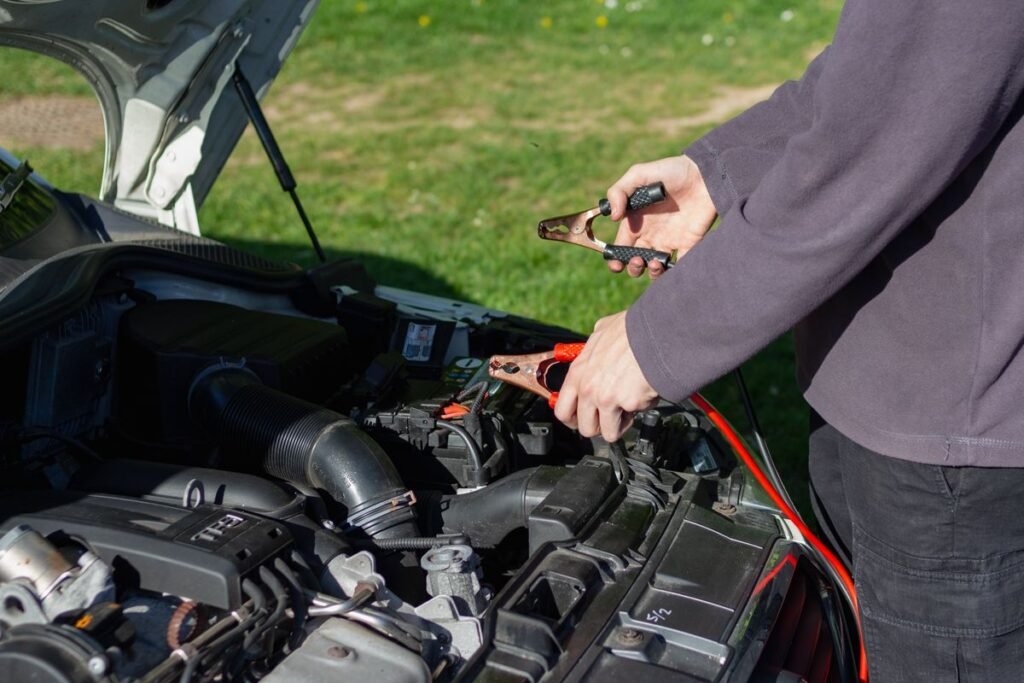
If your car will not start and the battery is flat, knowing how to jump a car safely will get you moving again in about ten minutes. You need a second car with a healthy battery or a portable jump pack, plus a set of jumper cables. Connect positive to positive first, then the negative to a metal ground point on the dead car, start the good car, then start yours. The connection order matters, because it keeps sparks away from the battery.
Before you start: is it really the battery
A jump start only fixes a flat battery, so check the clues first. If you hear a rapid clicking sound, the lights are dim, or the engine turns over very slowly, the battery is the likely problem. If the engine cranks strongly but will not fire, or there is complete silence with no dashboard lights at all even after checking the terminals, the fault is probably elsewhere. Our guide to car wont start causes and fixes runs through the other possibilities so you do not waste time jumping a car with a failed starter motor.
What you need
- A set of jumper cables, the thicker and longer the better
- A second vehicle with a charged battery of the same voltage, or a portable lithium jump pack
- Gloves and eye protection if you have them
- Both cars parked close enough for the cables to reach, but not touching
Safety first: batteries contain acid and give off hydrogen gas, and a spark in the wrong place can ignite that gas. Keep flames and cigarettes away, remove metal jewelry, and never lean directly over the battery while connecting or disconnecting leads. If a battery case is cracked, swollen, or leaking, do not jump it at all; have the car towed and the battery replaced.
Step by step: jumping with another car
Step 1: Position the cars and switch everything off
Park the good car nose to nose or alongside the dead one so the cables reach both batteries. Switch off both engines, remove the keys, and turn off lights, fans, and radios in both cars. Find both batteries and identify the positive terminal, marked with a plus sign and usually a red cover, and the negative terminal, marked with a minus sign.
Step 2: Connect the cables in the right order
- Red cable to the positive terminal of the dead battery
- Other end of the red cable to the positive terminal of the good battery
- Black cable to the negative terminal of the good battery
- Other end of the black cable to a solid unpainted metal part of the dead car engine bay, such as a bracket or strut bolt, well away from the battery
That last point is the one people get wrong. Connecting the final clamp to metal away from the battery means any small spark happens far from the battery gases.
Step 3: Start the good car, then the dead one
Start the good car and let it idle for three to five minutes so some charge flows across. Then try starting the dead car. If it does not start, wait a few more minutes and try again. If it still will not start after two or three attempts, stop: the battery may be too far gone, or the problem is something else entirely.
Step 4: Remove the cables in reverse order
With the rescued car running, remove the cables in the exact reverse order: black ground clamp first, then black from the good battery, then red from the good battery, then red from yours. Do not let the clamps touch each other or any metal while you work.
After a successful jump start
Do not switch the engine off straight away. Drive for at least 20 to 30 minutes at steady road speeds so the alternator can recharge the battery. A short hop to the shops is not enough, and you may find the car dead again when you come back. Then get the battery tested soon, because a battery that went flat once will usually do it again. Our guide on how long car batteries last explains the lifespan to expect and the signs that a replacement is due.
Jump pack and cost notes
A portable lithium jump pack removes the need for a second car and is simple to use: clamps on, switch on, start the car. Decent packs cost $50 to $120 and hold their charge for months, so many drivers keep one in the boot. If you would rather call for help, prices vary by car model and region, but typical costs are:
| Option | Typical cost |
|---|---|
| Roadside assistance jump start | $50 to $100 per call out |
| Portable jump pack to own | $50 to $120 |
| Good quality jumper cables | $20 to $50 |
| Battery test at a parts store | Usually free |
Frequently asked questions
Can jump starting damage my car?
Done in the correct order, a jump start is safe for both cars. Damage happens when cables are connected the wrong way round, which can blow fuses or harm electronics. Double check the plus and minus marks before you attach each clamp, and never let the red and black clamps touch while connected.
Why will my car still not start after connecting the cables?
The flat battery may be too weak to accept charge, the cable clamps may be sitting on corroded terminals, or the fault is not the battery at all. Clean the terminals, give it more time, and if there is still no start, have the car inspected rather than forcing it.
How long should I drive after a jump start?
Aim for at least 20 to 30 minutes of continuous driving, ideally at road speeds rather than idling. Then get the battery and charging system tested, because the jump start treated the symptom, not the cause.
A flat battery always seems to happen at the worst moment, but the fix is simple once you know the cable order. Connect red to red, ground the last black clamp away from the battery, and drive long enough for a real recharge.