
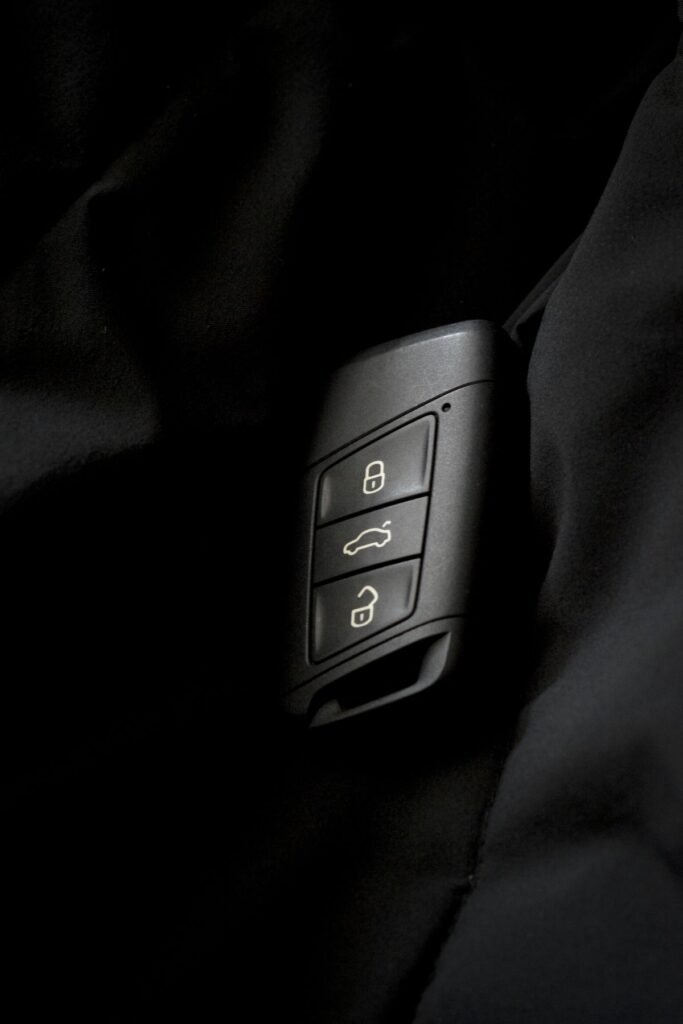
Replacing a key fob battery takes about five minutes and costs a few dollars. Most fobs use a flat coin cell, usually a CR2032 or CR2025, which you can read right off the old battery once the fob is open. The job is simple: release the hidden metal key if your fob has one, split the two halves of the case apart along the seam, lift out the old cell, note which side faces up, press the new cell in the same way, and snap the case shut. On nearly every car the fob keeps its pairing with the car, so no programming is needed after a battery swap. If the fob still does nothing with a fresh battery, the problem is usually somewhere else.
Signs the fob battery is dying
- You have to stand closer and closer to the car before the doors unlock.
- The fob works only after two or three presses, or works in the morning and fails later in the day.
- A message on the dashboard says the key is not detected, or tells you to hold the fob against the start button.
- The little light on the fob looks dim or does not flash at all when you press a button.
Most fob batteries last about 3 to 5 years. Range shrinking is the classic early warning because a weak cell still has enough power to work at short distance. Swap the battery at the first sign of this. Waiting until the cell is fully dead can leave you locked out of a car that has no visible keyhole.
Finding the right battery
The cell number is printed on the battery itself, so the surest method is to open the fob and look. Common sizes across car brands include CR2032, CR2025, CR2016, and CR2450. The numbers describe the size: a CR2032 is 20 mm wide and 3.2 mm thick. A CR2025 has the same width but is thinner, and using the thinner cell in a fob made for the thicker one can give a loose fit and intermittent contact. Buy the exact number printed on your old cell. A single cell costs roughly 2 to 8 dollars at a parts store or supermarket, and cards of two are common.
Opening the fob without breaking it
Work on a clean table so small parts cannot roll away. Most fobs follow the same design:
- Slide or press the small release and pull out the hidden metal key blade. Many fobs hide this key inside for exactly this situation.
- Find the seam where the two halves of the case meet. There is often a small notch near where the key blade sat.
- Insert the key blade, a flat screwdriver, or a coin into the notch and twist gently. The halves pop apart with a series of small clicks. Work around the seam rather than forcing one spot, because the plastic clips snap if you pry hard in one place.
- Take a photo of the open fob before you touch anything. It shows which way the battery faces and where any small parts sit.
Lift the old cell out with a fingernail or a plastic tool. Handle the new cell by its edges. Oil from your fingers on the flat faces can shorten its life and cause a poor connection, and holding it by the edges also avoids draining it slightly through your skin. Press the new cell in with the marked positive side facing the same way as the old one, which is printed side up in most fobs. Line the case halves up, squeeze them together until every clip clicks, slide the key blade back in, and test the fob on the car.
If a new battery does not fix it
First, double check the basics: the cell is the right number, it faces the right way, and the contacts inside the fob are clean and not bent flat. A contact that has lost its spring can be lifted very slightly with a small tool. Also try your second fob. If both fobs fail at once, the fault is almost certainly on the car side, not in the remotes.
A weak car battery causes exactly this kind of confusion, because the car needs enough power to run the receiver that listens for your fob. Our guide on how long car batteries last and the signs they are failing explains how to tell when the 12 volt battery is at the end of its life. And if the doors unlock fine but the engine will not crank, work through our checklist of the reasons a car will not start and their fixes before paying for a new fob, since a dead fob battery and a car that will not start are often blamed on each other.
What it costs to have someone else do it
Doing it yourself costs the price of the cell, a few dollars. A dealer will swap the battery for you, and prices vary widely: some do it for the cost of the cell, others charge 10 to 25 dollars for the service. Where people really get stung is replacing the whole fob. A brand new fob from a dealer, cut and programmed, commonly runs 100 to 400 dollars depending on the car, and locksmiths usually charge less for the same job. That is why the five minute battery swap is always worth trying first.
Frequently asked questions
Will changing the battery make the fob lose its programming?
Almost never. The pairing lives in the fob electronics and the car, not in the battery, so a quick swap keeps everything working. Swap promptly rather than leaving the fob open for days, and you will have no problems on the vast majority of cars.
How can I start the car if the fob battery is completely dead?
Use the hidden key blade to open the door. Then, on most push button cars, hold the fob itself against the start button and press the button with the fob. The car reads the chip in the fob at very close range even with a dead battery. Your manual shows the exact backup method for your model.
Why does my fob eat batteries every few months?
Cheap cells are the usual cause, so buy a known brand with a recent date on the card. A button being pressed constantly in a tight pocket or bag can also drain a cell, as can a fob stored close to the car, since some fobs keep communicating with the car when they are near it.