
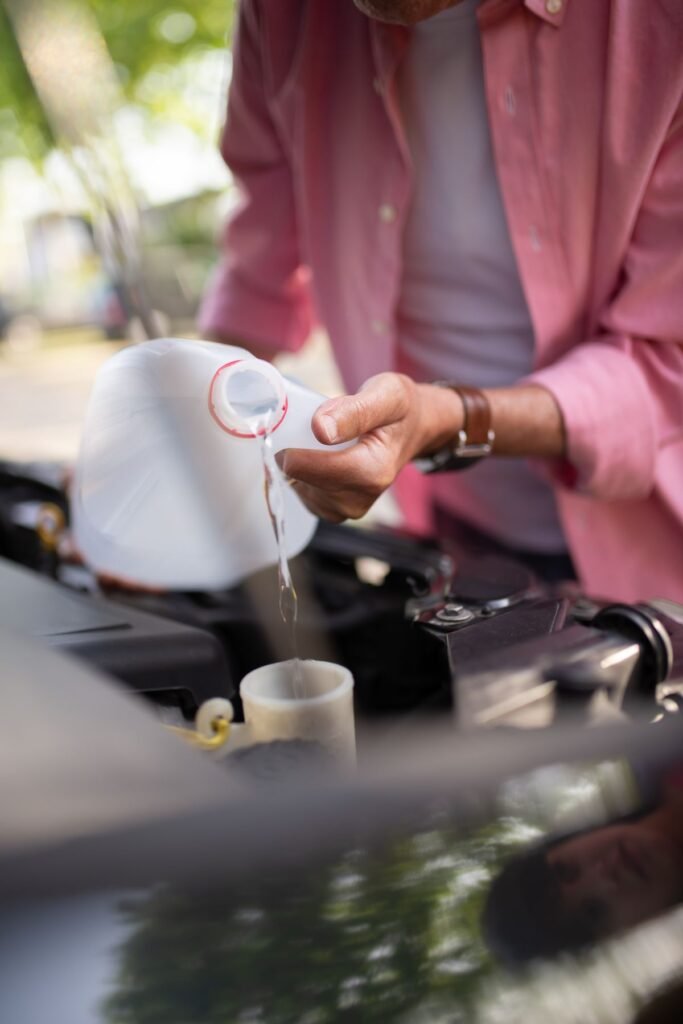
Radiator fluid, also called coolant or antifreeze, is the liquid that carries heat away from your engine and stops it from overheating. It also prevents freezing in winter, protects metal parts from rust, and lubricates the water pump. Checking it takes two minutes, and keeping it at the right level with the correct type is one of the cheapest ways to protect your engine.
This guide explains the different coolant types and colors, how to check the level, how to top up safely, and what it means when you keep seeing the coolant level low in your car. It also covers when a simple top up is not enough and the cooling system needs real attention.
What radiator fluid does inside your engine
Your engine produces far more heat than it needs. The water pump pushes coolant through passages inside the engine block, where it absorbs heat, then sends it to the radiator. Air flowing through the radiator cools the liquid, and the cycle repeats. Modern coolant is a mix of water and antifreeze concentrate, usually around fifty fifty, which raises the boiling point, lowers the freezing point, and adds anti corrosion chemicals that plain water does not have. Never run plain water for long, because it boils sooner, freezes sooner, and rusts the system from the inside.
Coolant types and colors explained
Coolant color is a guide to its chemistry, but it is not a perfect system, because brands do not all follow the same rules. Always follow the type named in your owner manual first, and treat color as a backup clue.
| Coolant type | Common colors | Typical cars | Service life |
|---|---|---|---|
| IAT (older formula) | Bright green | Older American cars, pre 2000 models | 2 years or 30,000 miles |
| OAT | Orange, red | Many GM, VW, and newer models | 5 years or 150,000 miles |
| HOAT | Yellow, gold, turquoise | Ford, Chrysler, many European cars | 5 years or 100,000 miles |
| Asian formulas | Pink, blue | Toyota, Honda, Nissan, Hyundai | 5 years or 100,000 miles |
Can you mix different coolant colors?
Try not to. Mixing types can weaken the corrosion protection, and mixing some formulas can make the coolant turn thick or form deposits that clog narrow passages. If you are stuck on the road and the level is very low, adding a little clean water is safer than driving with almost no coolant, but have the system checked and corrected soon after. For routine top ups, keep a bottle of the exact type your manual specifies in the garage.
How to check your coolant level
- Park on flat ground and wait until the engine is fully cold, ideally after the car has sat for several hours.
- Open the hood and find the translucent plastic coolant reservoir, usually marked with a thermometer symbol and the words MIN and MAX on the side.
- Read the level against the marks. It should sit between MIN and MAX, closer to MAX when cold is fine.
- Look at the color. Healthy coolant looks clean and bright. Rusty brown, cloudy, or oily looking coolant is a sign the system needs service.
If you find the coolant level low in your car again and again, the system is losing fluid somewhere. Slow leaks at hoses, the radiator, or the water pump are common, and our guide to car coolant leak signs and fixes shows where to look and what each leak costs to repair. A healthy cooling system should barely use any coolant between services.
How to top up radiator fluid safely
- Make sure the engine is completely cold. This step is not optional, see the safety warning below.
- Open the reservoir cap slowly. On most cars you top up through this plastic tank, not the radiator itself.
- Pour the correct coolant, premixed or mixed with distilled water as the bottle directs, until the level reaches MAX.
- Close the cap firmly, start the engine, and watch the temperature gauge on a short drive.
- Check the level again the next morning when cold, and top up a little if trapped air has worked its way out.
Safety warning: never open a hot system
A hot cooling system is pressurized, and opening the cap can spray boiling coolant and steam, causing serious burns. Never remove the radiator cap or reservoir cap while the engine is hot or even warm. If the temperature gauge is in the red, park, switch off, and wait. If you see steam, keep your distance and call for help instead of opening the hood fully.
When a top up is not enough
Top ups fix low levels, not the reasons behind them. Book a proper check if you notice any of the following:
- The level drops again within days or weeks of topping up
- Puddles of green, orange, or pink fluid under the parked car
- The temperature gauge climbing higher than normal, or the heater blowing cold
- Coolant that looks rusty, oily, or full of particles
- A sweet smell from the engine bay after driving
Old coolant also loses its protective strength even when the level looks fine, which is why it needs changing on schedule. A full system flush and refill at a shop usually costs $100 to $200, while a basic radiator cleaning service costs less; our radiator cleaning cost guide breaks down the options, and as always prices vary by car model and region.
Frequently asked questions
Is radiator fluid the same as antifreeze and coolant?
Yes, the three names describe the same product in daily use. Antifreeze is the concentrate, coolant is the ready to use mix of antifreeze and water, and radiator fluid is the older name for the same liquid. What matters is using the type and mix your manual specifies.
How often should I change my coolant?
It depends on the type. Older green coolant needs changing about every 2 years or 30,000 miles, while modern long life formulas last around 5 years or 100,000 to 150,000 miles. Check your owner manual, because the range between cars is large.
Can I just add water instead of coolant?
In an emergency, yes, a small amount of water is far better than driving with an almost empty system. But water alone boils and freezes at the wrong temperatures and offers no rust protection, so have the mix corrected at the first chance.
Radiator fluid is easy to forget because it hides in a plastic tank under the hood, yet it guards the most expensive part of your car. Check the level once a month, top up with the right type, and treat a falling level as an early warning worth investigating, not a chore to repeat forever.