
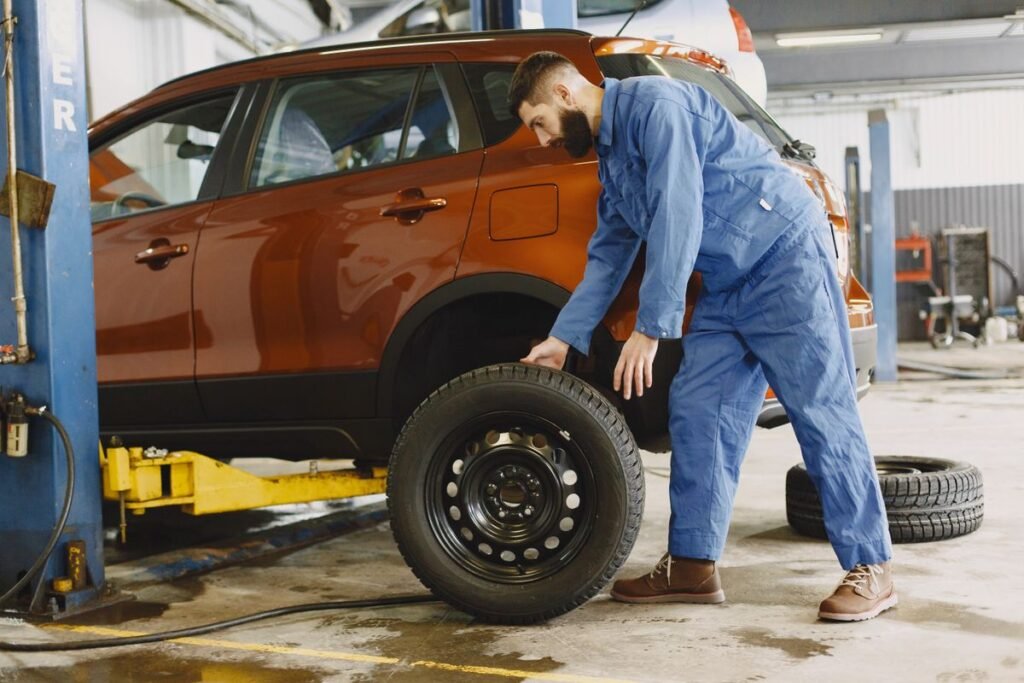
Rotate your tires every 5,000 to 8,000 miles, which for most drivers works out to every six months or at every oil change. Some manuals say 7,500 miles, some say as often as every 5,000, so check the schedule for your car and use that figure. The job is simple: each wheel moves to a different corner of the car so all four tires share the work evenly. Front tires on a typical car wear far faster than rear tires because they steer, carry most of the braking load, and on front wheel drive cars also pull the car along. Rotation spreads that wear around, which makes a set of tires last longer and keeps grip balanced at both ends of the car.
Why rotation makes tires last longer
Each corner of the car treats a tire differently. The front tires scrub sideways every time you turn the steering wheel, and their outer edges wear during cornering. Rear tires mostly roll straight, so they wear slowly and evenly. On a front wheel drive car, the fronts can wear at roughly twice the rate of the rears. Leave the tires in place and the fronts will be worn out while the rears still look half new, and you end up replacing two tires early or driving on a mismatched set.
Rotation fixes that. Moved around on schedule, all four tires reach the wear bars at about the same time, so you replace the full set together. That protects your wallet too, as a matched set bought at once usually rides and grips better than mixed pairs bought years apart. When replacement day does come, our guide to what new tires cost shows what a full set is likely to run for common car sizes.
The rotation patterns that matter
Which pattern you use depends on how the car is driven and what kind of tires it wears. Shops handle this for you, but it helps to know what they should be doing.
| Vehicle or tire type | Pattern used |
|---|---|
| Front wheel drive | Front tires move straight to the rear, rear tires move to the front and swap sides |
| Rear wheel drive | Rear tires move straight to the front, front tires move to the rear and swap sides |
| All wheel drive | Cross pattern, front and rear swap with a side change, keeping all four wear rates equal |
| Directional tires | Front and rear swap on the same side only, so the tread keeps pointing the right way |
| Different sizes front and rear | Side to side swap only, since the wheels cannot change ends |
Directional tires have an arrow on the sidewall showing which way they must roll, so crossing them to the other side would spin them backwards. If your car has a full size matching spare, some owners include it in the rotation so all five tires wear together. Ask the shop, because not every car can do this.
Signs you have waited too long
- The front tires look noticeably more worn than the rears, especially on the outer edges.
- You can feel a sawtooth pattern when you run your palm across the tread, which also makes the tires hum loudly at speed.
- The steering wheel vibrates on smooth roads, or the car feels loose and wanders in the rain as the worn end loses grip.
- A tread depth gauge shows a big gap between front and rear. As a rough check, tread worn down near 2/32 of an inch is finished and unsafe in the wet.
Uneven wear in strange patterns is a different warning. Wear on one edge only, or a scalloped pattern around the tread, points at wheel alignment or worn suspension parts. Rotation will not fix that, and a good shop should tell you before simply swapping the tires around.
What rotation costs and how long it takes
Rotation is one of the cheapest jobs in car maintenance. Many tire shops rotate for free when you bought the tires from them, and plenty include it with an oil change. Paid on its own, expect roughly 20 to 50 dollars, and the job takes about 20 to 30 minutes including a quick look at the brakes while the wheels are off. Some shops also check and set all four tire pressures during the visit, which is worth asking for.
While the wheels are off, it is also the right moment to look at the sidewalls and confirm the tires still suit the car. If you are shopping for replacements or a second set, knowing the load index and speed symbol on the sidewall matters, and our explainer on tire speed ratings and what the letters mean covers how to read them before you buy.
What happens if you skip rotation
Skipping rotation does not damage the car, but it shortens tire life and can cost you money in a few ways. The fast wearing pair reaches the wear bars early, handling gets unbalanced because one end of the car grips better than the other, and road noise grows as the unrotated tires develop uneven tread patterns. There is also a paperwork catch: many tire makers require proof of regular rotation to honor the tread life warranty on a set. Miss the rotations and a warranty claim for early wear can be refused.
All wheel drive cars deserve extra care. Their systems want all four tires at a very similar diameter, and badly uneven wear between axles forces the system to work harder. On those cars, keeping to the rotation schedule is protecting the drivetrain as well as the tires.
Frequently asked questions
Should rotation happen at every oil change?
For most cars, yes, that is the easiest way to remember it. Modern oil change intervals of 5,000 to 10,000 miles line up well with the 5,000 to 8,000 mile rotation window. If your car uses long oil intervals near 10,000 miles, rotate on the shorter schedule anyway.
Does the spare tire get rotated too?
Only if it is a full size spare that matches the other four tires. Temporary donut spares never join the rotation. If you do run a five tire rotation, tell the shop each time so the pattern stays consistent.
Can I rotate my tires at home?
Yes, with a jack, jack stands, and a torque wrench. Support the car properly on stands, never on the jack alone, follow the right pattern for your drive type, and torque the lug nuts to the figure in your manual. If any of that gear is missing, the small shop charge is money well spent.