
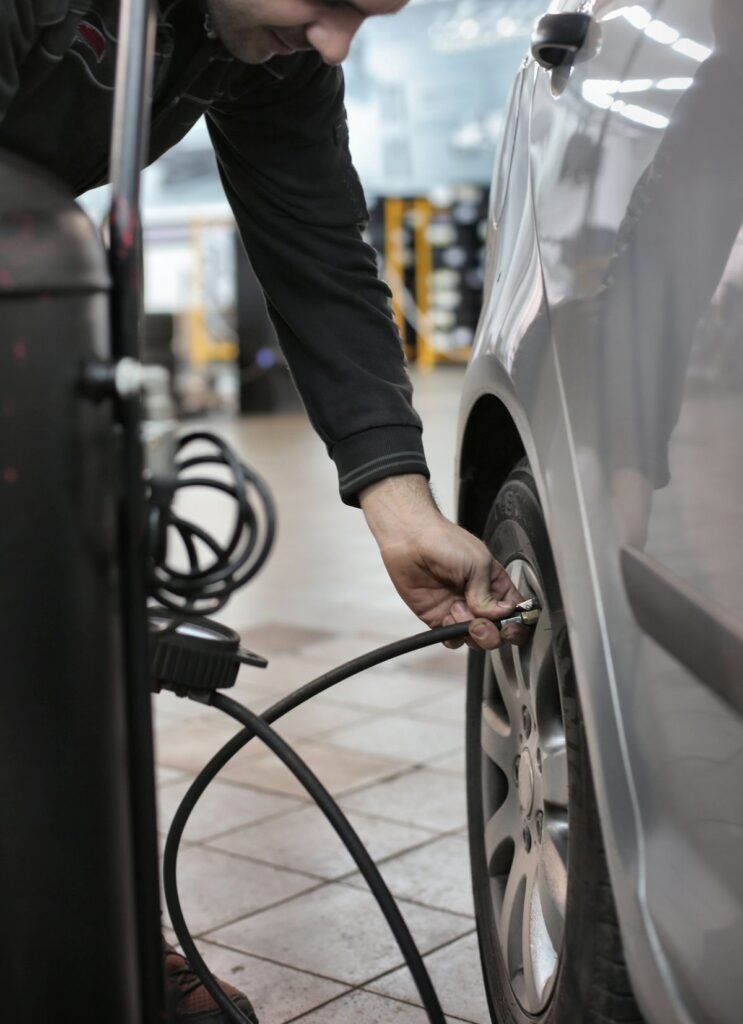
The TPMS light means one or more of your tires has dropped well below its correct pressure, usually by a quarter or more. TPMS stands for tire pressure monitoring system, and the light looks like a horseshoe shape with an exclamation mark inside. In most cases the fix is simple: check all four tires with a gauge, inflate the low one to the pressure on the sticker inside the driver door frame, drive for a few minutes, and the light goes out on its own. If the light flashes for about a minute when you start the car and then stays on, that means something different: the system itself has a fault, most often a sensor with a dead battery.
Solid light and flashing light mean different things
This distinction saves a lot of wasted time. A light that comes on and stays solid is reporting pressure. At least one tire is low, and the car is doing exactly what the system was built to do. A light that flashes for 60 to 90 seconds at start up and then turns solid is reporting a malfunction. The car cannot read one or more of its sensors, so it cannot be trusted to warn you about pressure at all. Adding air will never fix a flashing light, because the problem is the messenger, not the tire.
Cold weather confuses many drivers every autumn. Air contracts as it cools, and tire pressure falls by roughly 1 psi for every drop of 10 degrees Fahrenheit. A tire that was borderline in September can easily be 4 or 5 psi down on the first frosty morning, which is enough to trigger the light. If the light appears on the first cold morning of the year and all four tires read slightly low, that is physics, not a puncture.
Step one: check and set the pressures properly
- Check the tires cold, before driving, or after the car has sat for at least three hours. Driving heats the air inside and raises the reading, which hides how low the tire really is.
- Use the pressure printed on the sticker in the driver door frame, or in the manual. Do not use the maximum pressure moulded into the tire sidewall; that figure is a limit, not a target. Our guide to what the numbers on a tire sidewall mean walks through every marking, including that maximum.
- Check all four tires, not just the one that looks low. A tire has to lose a lot of air before it looks flat, and looks are a poor gauge.
- Do not forget the spare. Many cars monitor the spare tire as well, and a soft spare stored in the trunk is a classic cause of a light that will not go out after the four road tires are perfect.
- Look at each tire while you work: a nail in the tread, a cracked valve stem, or damage on the sidewall explains where the air went.
Air is free or nearly free at most fuel stations, and a decent handheld gauge costs under 15 dollars. It is the best value tool in the glovebox.
Getting the light to go out and resetting the system
On most cars there is nothing to reset by hand. Inflate the tires correctly, drive at normal speeds for five to twenty minutes, and the system sees the new pressures and turns the light off. If your car has a reset button, it usually sits under the steering column or inside the glovebox. With the pressures set correctly and the ignition on, press and hold it until the TPMS light blinks, then drive as normal while the car learns the new baseline.
Only use that button after you have set pressures with a gauge. Resetting the system with a soft tire teaches the car that the wrong pressure is correct, and the warning then stays silent while the tire wears badly. Some cars show individual pressures on the dashboard screen, which makes life easy: you can see exactly which corner is low and watch it come back up. If your dashboard is showing several unfamiliar symbols at once, our guide to car dashboard symbols and their meanings will help you sort out which ones need action today.
When air does not fix it
If the pressure in every tire is correct and the light stays on after a proper drive, or if it flashes at start up, a sensor is the likely culprit. Each wheel has a small sensor attached to the valve stem, powered by a sealed battery that cannot be replaced on its own. Those batteries typically last five to ten years, so sensor failures arrive in waves on older cars.
| Job | Typical cost |
|---|---|
| Single replacement TPMS sensor, fitted and programmed | 50 to 150 dollars |
| Full set of four sensors | 200 to 450 dollars |
| Sensor relearn or programming only | 20 to 60 dollars |
| Diagnostic check at a tire shop | Often free to 40 dollars |
A tire shop can scan each wheel in minutes and tell you which sensor has gone quiet. Because the tire has to come off the rim to swap a sensor, the smart move is to replace sensors when you are already buying new tires. The labor overlaps, and you avoid paying twice. A slow puncture is the other repeat offender: if one tire needs air every week, it is leaking, and no amount of resetting will change that. Get it repaired or replaced.
Can you keep driving with the light on?
With a solid light and pressures you have verified yourself with a gauge, the car is safe to drive normally; you have done the job the system asked you to do, and if the light lingers it is a system issue rather than a tire issue. With a solid light and pressures you have not checked, assume a tire is going down and check it the same day. A genuinely soft tire runs hotter, wears its edges out, uses more fuel, and is far more likely to fail at speed. The flashing light is less urgent for safety but worth booking in, because until it is fixed the car cannot warn you about a real loss of pressure.
Frequently asked questions
Why does my TPMS light come on in cold weather?
Pressure falls as air cools, by roughly 1 psi for every 10 degrees Fahrenheit. Tires that were slightly low in warm weather drop past the warning threshold on cold mornings. Top them up to the door sticker figure and the light should clear.
How long can I drive with the TPMS light on?
Check the pressures first. If they are correct, you can drive normally and book the car in to have the system checked. If a tire is actually low, inflate it the same day and watch it; a tire that keeps losing air has a leak.
Will the TPMS light fail an inspection?
In many US states, yes. A lit TPMS warning can fail a safety inspection because the system is a required safety feature. Factor the sensor cost into your plans if your inspection is due soon.