
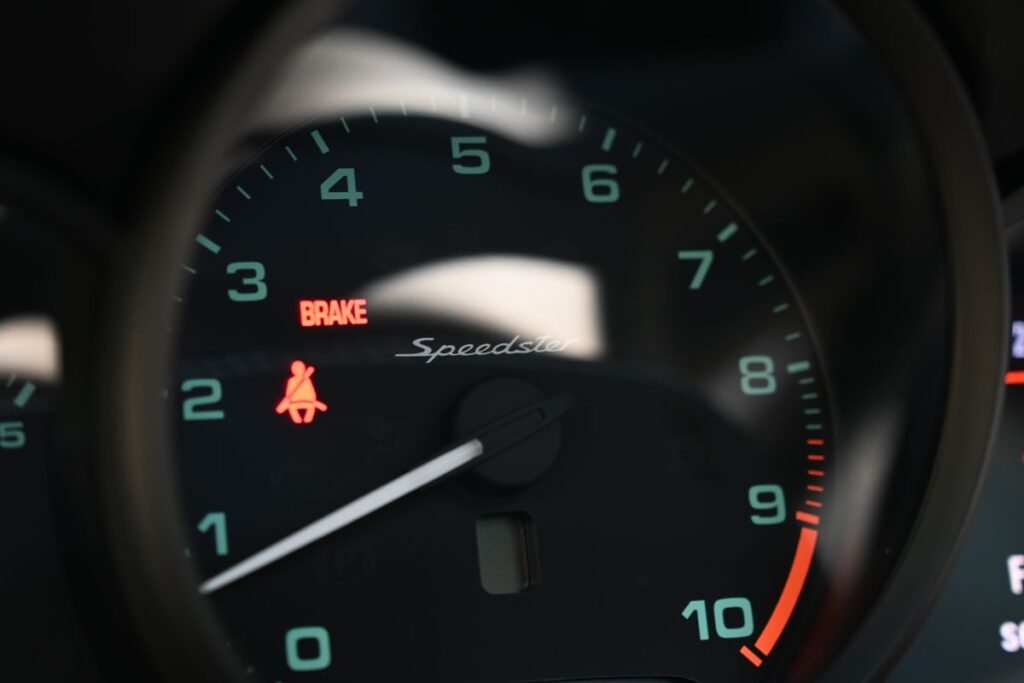
A red brake warning light on your dashboard is one of the few warnings you should never ignore or postpone. The short answer: first check the parking brake, then check the brake fluid level, and if neither explains the light, or if the pedal feels soft or spongy, stop driving and get the car towed to a shop. The light usually means the parking brake is still on, brake fluid is low, brake pads are worn, or the braking system has a fault. Your first decision is not to keep driving to see if it clears. It is to pull over safely and work through the checks below in order.
The brake warning light is usually red and shows the word BRAKE or a circle with an exclamation mark inside it. It is different from the yellow ABS light, which means the anti lock braking system has a fault but the normal brakes may still work. When the red light stays on, the car is telling you that stopping power may be reduced. That is why this light demands action before your next journey, not at the next service.
Step 1: check the parking brake
Pull over safely, switch on hazard lights, and check whether the parking brake is fully released. Even one click of a handbrake lever, or a partially released foot pedal, can keep the light on. Your action: release the parking brake fully, then check whether the light goes out. If it does, and the car drives normally with a firm pedal, you can continue carefully, but still check the brake fluid level at your next stop, because a parking brake switch can also stick and give a false warning.
If your car has an electronic parking brake, try applying and releasing it once while parked, then check the light again. Your action: if the electronic brake feels stuck, makes a grinding noise, or will not release, do not force it. Call a shop, because forcing an electronic brake can damage the calliper motor.
Step 2: check the brake fluid level
With the engine off and the car on level ground, find the brake fluid reservoir near the back of the engine bay, usually on the driver side. Check the level against the minimum and maximum marks, and check the fluid colour. Fresh brake fluid is clear or light amber, while dark fluid is old and due for a change. Your action: if the level is below minimum, top it up only with the exact brake fluid type listed on the reservoir cap or in your manual, such as DOT 3 or DOT 4. Using the wrong type can damage seals and reduce braking performance.
Low fluid has two common causes, and they need different responses. Worn brake pads draw more fluid into the callipers as the pistons extend, which lowers the reservoir level gradually. A leak drops the level faster and keeps dropping after topping up. Your action: after topping up, pump the pedal a few times, recheck the level, and look under the car for wet spots near the wheels or along brake lines. If the level drops again, the pedal feels spongy, or you see fluid, do not drive. Call for a tow.
Step 3: check how the pedal feels
Press the brake pedal with the engine running. A firm pedal that holds its position is a good sign. A pedal that sinks slowly to the floor, feels spongy, or needs pumping to build pressure is a warning of air in the system or a failing master cylinder. Your action: if the pedal feels wrong in any of these ways, stop driving at once, even if the light goes out after topping up fluid. A soft pedal means the car may not stop reliably in an emergency, and that risk is not worth taking for any journey.
Also listen and feel for other brake symptoms: grinding, squealing, vibration through the pedal, or the car pulling to one side when braking. Those signs point to worn pads, damaged discs, or a sticking calliper. For pad costs and what a pad job includes, read our guide on brake pad replacement cost so you can judge whether a pad job is the likely next step.
Other common causes
Worn brake pads and pad wear sensors
Many cars have a wear sensor in the pads that triggers the brake warning light when pad material gets thin. Other cars use a squeal tab that makes noise before the light ever appears. Your action: if the light came on gradually, with squealing or a longer stopping distance beforehand, book a brake inspection promptly. Driving on metal to metal pads damages discs and raises the repair bill sharply.
ABS fault shown with the brake light
If the red brake light and the yellow ABS light are on together, treat it as a braking system fault that needs prompt shop attention. The normal brakes may still work, but anti lock protection may be off, which matters in a hard stop on a wet road. For ABS causes and fixes, read our guide on ABS light meaning, causes and fixes and note whether both lights are on when you call the shop. Your action: drive slowly to a nearby shop only if the pedal feels firm and normal, and avoid hard braking and wet roads on the way. If the pedal feels wrong, tow the car instead.
Sensor, wiring, or low voltage faults
A faulty fluid level sensor, damaged wiring, or low battery voltage can also trigger the light with no real brake fault. Your action: if the fluid level is correct, the parking brake is off, and the pedal feels firm, book a diagnostic scan rather than replacing brake parts. A scan reads fault codes and checks the level sensor, which prevents paying for pads or a master cylinder that were never faulty.
What it costs to fix
Cost depends entirely on the cause, so do not accept a single price before diagnosis. Releasing a parking brake costs nothing. Topping up fluid costs a few dollars for fluid. A pad job on one axle commonly costs $150 to $300 for parts and labour, based on our earlier pad guide. A brake fluid flush, a master cylinder, or a brake line repair costs more, and a shop should quote those only after inspection. Your action: ask the shop to name the cause, show you the worn part or the leak, and quote parts and labour separately before you approve work beyond a basic inspection.
What to avoid
Do not keep topping up fluid for weeks without finding why it dropped. A leak will not heal, and the light will keep returning until the leak is fixed. Do not ignore the light because the car still stops in normal driving. Emergency stopping needs full braking power, and a fault that feels minor in gentle driving can fail under hard braking. Do not disconnect the warning light or ignore a flashing light. Your action: treat a flashing brake light as an urgent stop and tow situation, not as a sensor glitch to check later.
Frequently asked questions
Can I drive with the brake light on
Only if you have checked the parking brake and the fluid level, the pedal feels firm and normal, and you are driving slowly to a nearby shop for inspection. Your action: if any of those checks fails, do not drive. Tow the car, because the cost of a tow is small compared with the risk of a brake failure.
Why did the brake light come on after a pad change
Common causes are a fluid level that changed when calliper pistons were pushed back, a wear sensor that was not refitted correctly, or air in the system after the job. Your action: return to the shop that did the pad job first, and ask them to recheck fluid level, sensor connections, and pedal feel. Do not keep driving with the light on after brake work.
Does low brake fluid always mean a leak
No. Gradual pad wear also lowers the level, because fluid moves into the callipers as pads thin. Your action: check pad thickness at the same time as fluid level. If pads are thin, a pad job explains the low level. If pads are healthy and fluid keeps dropping, suspect a leak and get the lines, callipers, and master cylinder inspected.
A brake light on the dash is a simple message with serious meaning: check the parking brake, check the fluid, check the pedal, and act on what you find. Release a stuck brake, top up only with the correct fluid, and tow the car if the pedal feels soft or fluid keeps dropping. Handled that way, most brake warnings end as a small fix. Ignored, the same warning can end as a brake failure at the worst possible moment.
Pingback: Which Is the Brake Pedal? A Simple Guide for Automatic and Manual Cars
Pingback: Blinking Red Light in Your Car: What to Do First
Pingback: Fog Light Symbol: What It Means and When to Use It