
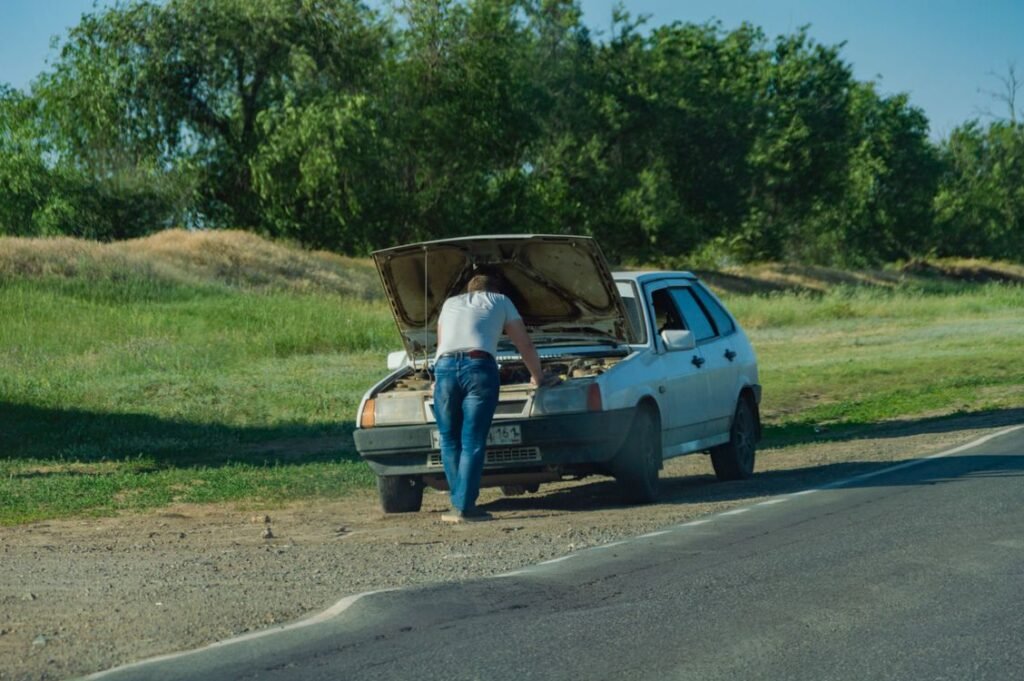
If your car breaks down on a highway, your safety matters more than your car, and your first minutes matter more than your repair. The short answer: switch on hazard lights at once, steer gently to the safest spot you can reach, stay away from moving traffic, and call for help before you try any repair. A highway breakdown is dangerous because other traffic is fast and close, so every decision should reduce your exposure to that traffic first and worry about the car second.
Most highway breakdowns give a warning first: a warning light, a loss of power, a strange noise, steam, smoke, or a smell. Your response in those first seconds should be calm and simple. Ease off the accelerator, do not brake hard, signal, and move toward the hard shoulder, an emergency bay, or an exit if one is close. Hard braking or a sudden swerve at highway speed can cause a crash that is worse than the breakdown itself.
Step 1: get to a safe spot and make the car visible
Your action: switch on hazard lights the moment you feel trouble, even before you slow down much, because hazard lights warn drivers behind you early. Steer smoothly to the leftmost safe area, or to the right hard shoulder where that is the local rule, and stop as far from moving traffic as you can. Turn the steering wheel away from traffic once stopped, so that if the car is nudged it moves away from the road rather than into it.
Once stopped, apply the parking brake, switch on side lights if it is dark or visibility is poor, and place a warning triangle behind the car if you can do so without walking in live traffic. Your action: do not walk along a live highway to place a triangle if the traffic is fast and there is no barrier, because your safety is worth more than extra warning distance. For when and how to use hazard lights correctly, read our guide on hazard lights and note the local rules for your area before your next long journey.
Step 2: get everyone out safely and stay away from traffic
Your action: get all passengers out through the doors away from traffic, move behind a barrier or well away from the road, and keep children and pets with you at all times. Do not stay in the car on a busy highway unless leaving the car would put you in greater danger, such as in extreme weather with no safe place to wait, because a stopped car in live traffic can be hit from behind. If you must stay in the car, keep seat belts fastened and hazard lights on.
Do not open the bonnet while standing in traffic, and do not try to push the car in a live lane. Your action: if the car stopped in a live lane and cannot be moved, switch on hazard lights, stay in the car with seat belts fastened if it is safer than getting out into traffic, and call emergency services at once. If you can move the car to the shoulder, do that first, then get out safely and call for help.
Step 3: call for help with the right information
Your action: call roadside assistance or emergency services and give five pieces of information: your exact location, including direction of travel and the nearest junction or mile marker, the make and colour of your car, the main symptom, how many people are with you, and whether anyone is hurt or in danger. That information helps help reach you faster and with the right vehicle, whether that is a tow truck, a fuel delivery, or an ambulance.
While you wait, keep your phone charged and stay in contact. Your action: do not accept a tow from an unmarked vehicle that stops without being called, and do not leave the car unlocked with valuables visible while you wait away from it. If a stranger offers help, you can ask them to call for help on your behalf without opening your car door fully or getting into their vehicle.
What you can safely check while you wait
Some simple checks are safe once you are away from traffic and the car has cooled. Your action: look for obvious signs such as a flat tyre, steam from the bonnet, a warning light you can photograph, or a loose battery connection, but only if you can do so from the safe side of the car. Do not open a hot radiator cap, because hot coolant can burn badly, and do not crawl under the car on a highway shoulder, because the ground is uneven and traffic is close.
A flat tyre can sometimes be changed safely on a wide shoulder away from traffic, but only if you have a spare, a jack, and a safe flat area, and only if you feel confident. Your action: if traffic is close, the ground is soft or sloping, or you feel unsure, wait for roadside assistance instead. A tyre change is never worth standing beside fast traffic. For battery related stops, read our guide on how to jump a car only after you are in a safe place, because jump starting beside a highway still needs a second vehicle parked safely and clear of traffic. For tyre pressure checks after a tyre change, read our guide on how to check tire pressure before you drive on.
After the tow: what to tell the shop
Your action: when the car reaches a shop, give a clear account of what happened in order: the first warning or symptom, whether power was lost gradually or suddenly, any noise, smell, smoke, or steam, and whether any warning light came on or blinked. That order helps the shop separate a fuel problem from an electrical problem, a cooling problem from a transmission problem, and a tyre problem from a suspension problem.
Ask the shop for a diagnosis before authorising a repair, and ask them to name the faulty part and the cost in parts and labour separately. Your action: if the car stopped suddenly without warning, ask specifically about battery, alternator, fuel pump, and sensor faults, because those are common sudden stop causes. If the car overheated or steamed, ask about coolant level, thermostat, and cooling fan, and do not authorise a long drive home until the cooling system has been checked.
How to reduce the risk next time
Highway breakdowns are less likely when basic checks become a habit. Your action: before a long journey, check tyre pressures and condition, oil level, coolant level, and battery terminals, and note any warning light that is already on. Keep a charged phone, a warning triangle, a high visibility vest, a torch, water, and your roadside assistance number in the car, because those items cost little and matter a lot when you are stopped.
Also keep fuel above a quarter tank on long journeys, because running low can starve the fuel pump and leave you stopped in a dangerous place. Your action: if a warning light comes on during a journey, do not push on to the next town hoping it clears. Pull over safely at the next safe place, check the basics, and call for advice. A planned stop is always safer than a forced stop in a live lane.
Frequently asked questions
Should I stay in the car or get out
Get out through the doors away from traffic and move behind a barrier where possible, because a stopped car can be hit from behind. Your action: stay in the car only when getting out would put you in greater danger, such as fast traffic with no barrier and no safe place to stand, and in that case keep seat belts fastened and hazard lights on while you call for help.
Can I change a tyre on the highway myself
Only on a wide, flat shoulder away from traffic, with a spare, a jack, and confidence in the job. Your action: if traffic is close, the ground is soft or sloping, or you feel unsure, wait for roadside assistance. No tyre change is worth standing beside fast traffic.
What if my car stops in a live lane
Switch on hazard lights at once, keep seat belts fastened if staying in the car is safer than getting out into traffic, and call emergency services immediately. Your action: do not try to push the car in a live lane, and do not walk in live traffic to place a triangle. Help should come to you, and your job is to stay visible and safe until it arrives.
A highway breakdown is frightening, but the right first minutes make it far safer. Hazard lights on, gentle move to safety, everyone out away from traffic, a clear call for help, and no repair that puts you beside fast traffic. Follow that order, and a breakdown stays a tow and a repair, not a second crash.