
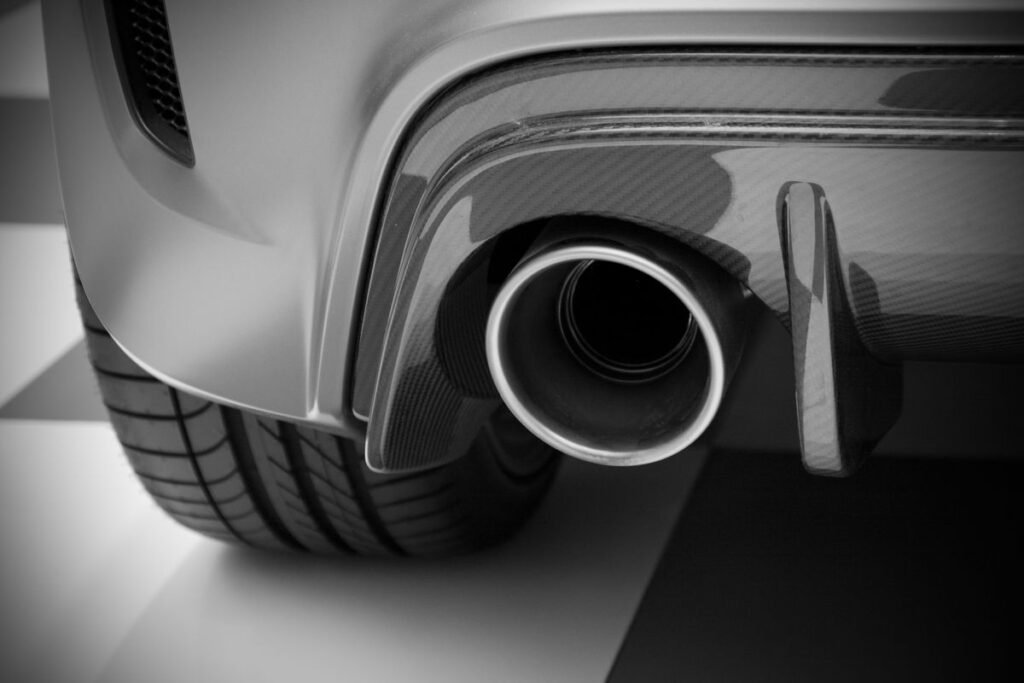
A bad catalytic converter usually warns you through smell, power loss, noise, and the check engine light, often together. The short answer: if your car smells of rotten eggs, feels sluggish when accelerating, rattles underneath, or shows a check engine light with a converter code, book a diagnostic scan promptly, because driving on with a clogged converter can overheat the exhaust and damage the engine. Do not approve a converter replacement until a scan and a basic exhaust check confirm the converter itself is the fault, because misfires and oxygen sensor faults cause the same symptoms for far less money.
The catalytic converter sits in the exhaust system and cleans harmful gases before they leave the tailpipe. It uses precious metals inside a honeycomb structure to turn harmful gases into less harmful ones. When that structure melts, breaks apart, or gets clogged, exhaust cannot flow freely, the engine loses power, and emissions rise sharply. This guide covers the signs in order of reliability, the tests that confirm the fault, and the costs to expect.
The most reliable signs
A rotten egg smell is one of the classic signs. Your action: notice whether the smell appears when accelerating, when the engine is warm, or all the time. A brief sulphur smell on hard acceleration can be normal on some cars, but a strong, persistent rotten egg smell points to a converter that is not processing exhaust gases properly. For smell detail, read our guide on why does my car smell like rotten eggs and compare the smell pattern with the causes listed there.
Loss of power is the sign drivers feel most. Your action: notice whether the car accelerates normally at low speed but feels flat at higher speed, struggles on hills, or will not rev freely. A clogged converter restricts exhaust flow, so the engine feels choked just when it needs to breathe most. If power loss comes with a rattling noise underneath, that combination points strongly to a converter breaking apart inside.
Rattling from underneath is another strong sign. Your action: listen for a metallic rattle when starting the car, when idling, or when tapping the exhaust gently with the engine off and cool. A rattle that comes from the converter area often means the honeycomb inside has broken into pieces. Do not ignore a rattle, because loose pieces can move downstream and block the exhaust further.
The check engine light is the sign that confirms the direction of diagnosis. Your action: get the fault codes read rather than guessing from the light alone. Converter related codes, commonly P0420 and P0430, mean the converter is not cleaning exhaust as efficiently as expected, but they do not by themselves prove the converter is dead, because a faulty oxygen sensor, an exhaust leak, or an engine misfire can trigger the same codes.
Other signs worth checking
Poor fuel economy often appears alongside a bad converter. Your action: compare recent fuel use with your normal use on similar trips, and note whether the car also feels sluggish. A clogged converter forces the engine to work harder, so fuel use rises, but fuel economy alone is a weak sign, because tyres, driving style, and many other faults also affect it. Use it as supporting evidence, not as proof.
Failed emissions test results point to the converter when other items are healthy. Your action: if the car fails on high hydrocarbon or carbon monoxide readings, and the engine runs smoothly with no misfire, ask the shop to check the converter and the oxygen sensors together. A converter that has lost efficiency will often fail emissions while the car still feels almost normal to drive.
Excess heat under the car is a warning that needs prompt action. Your action: if you notice a hot smell from underneath, discoloured exhaust parts, or a glowing converter after driving, stop and get the car checked, because a converter that is overheating can damage nearby parts and, in rare cases, become a fire risk. Never touch exhaust parts after driving, because they stay dangerously hot for a long time.
Hard starting, stalling, and rough running can also appear when a converter is badly clogged. Your action: if the car is hard to start, stalls at idle, or shakes badly, do not assume the converter is the only fault. Read our guide on rough idle and our guide on engine knocking, because misfires and knocking damage converters, and fixing the converter without fixing the misfire will ruin the new converter too.
Tests that confirm a bad converter
A diagnostic scan is the first test. Your action: ask the shop to read the codes, check oxygen sensor readings, and look at fuel trim data. Healthy oxygen sensors should show a clear difference between the sensor before the converter and the sensor after it. When both sensors read almost the same, the converter is probably not cleaning exhaust properly. That sensor comparison is far more useful than a single code.
An exhaust back pressure test is the second test. Your action: ask the shop to measure back pressure, because a clogged converter raises pressure behind it. High back pressure with power loss confirms a restriction, while normal back pressure points away from the converter and toward sensors or engine faults. This test takes little time and prevents an expensive wrong replacement.
A temperature test can support the diagnosis, but it is not proof alone. Your action: let the shop measure exhaust temperature before and after the converter with the engine warm. A working converter usually runs hotter at its outlet than at its inlet, because the cleaning reaction gives off heat. A converter with almost no temperature difference, or one that is far hotter than normal, needs further testing rather than an instant replacement decision.
A visual and physical check also helps. Your action: ask the shop to inspect the converter for dents, damage, rattling internals, and exhaust leaks at its joints. A dented or rattling converter, or one with a cracked casing, is a clear replacement case, while a converter that looks and tests normally should not be replaced on a code alone.
What causes converters to fail
Engine misfires are the leading cause. Your action: fix misfires, oil burning, and rich running promptly, because unburned fuel reaching the converter overheats it and melts the honeycomb. A converter replaced while a misfire continues will often fail again within months, so the shop should check plugs, coils, and injectors before fitting a new converter.
Age and mileage also matter. Your action: expect converter efficiency to fall gradually on high mileage cars, especially when the car has had many short trips that never fully warm the exhaust. Short trips alone rarely kill a converter, but combined with a misfire or oil burning, they shorten its life a lot.
Contamination from coolant or oil can poison the converter. Your action: if the car burns oil, loses coolant internally, or produces blue or white exhaust smoke, tell the shop, because those faults damage converters and must be fixed first. Replacing a converter while oil or coolant still reaches it is wasted money.
What replacement costs
Cost varies hugely by vehicle, because the converter part itself is the main cost. Current repair guides checked during this run put most mainstream converter replacements at roughly 945 to 2475 dollars including parts and labour, with RepairPal averages reported through Edmunds at roughly 2164 to 2483 dollars, and luxury and hybrid models often costing far more. Aftermarket converters are usually cheaper than original equipment parts, but some regions require a certified converter type, so the cheapest part is not always legal for your car. Your action: ask the shop for a quote that names the part type, whether it meets your local emissions rules, and whether oxygen sensors are included, and get a second quote when the first quote is far above the ranges above.
What to avoid
Do not buy a converter cleaner or additive expecting it to fix a melted or broken converter, because cleaners cannot repair physical damage, and at best they help only a mildly contaminated converter. Do not ignore a misfire to save money, because the misfire will destroy the new converter. Do not fit an uncertified or incorrect converter to save money, because it can fail an emissions test and may be illegal in your region. Do not drive for months with a clogged converter, because back pressure strains the engine, raises fuel use, and can cause overheating.
Frequently asked questions
Can I drive with a bad catalytic converter
For a short trip to a shop when power is still reasonable and there is no overheating smell, usually yes, but avoid long trips and hard acceleration. Your action: stop and call for help if power drops sharply, the car stalls, or you smell burning from underneath, because a badly clogged converter can strand the car or damage the engine.
Will the check engine light always come on for a bad converter
Usually, but not always at first. A converter can lose efficiency gradually before it triggers a code, and a rattling or clogged converter can appear before the light. Your action: do not wait for the light when power loss, rattling, and rotten egg smell appear together, because those signs together are enough to book a scan.
Can a bad oxygen sensor mimic a bad converter
Yes, and this is the most common expensive mistake. A faulty oxygen sensor can trigger the same converter efficiency codes and cause similar running problems. Your action: insist on sensor readings and a back pressure test before approving a converter, because a sensor costs far less than a converter.
Is it worth replacing a converter on an old car
It depends on the car value, the repair cost, and whether the engine fault that damaged the converter is fixed. Your action: compare the full quote, including sensors and the misfire fix, with the car value and with local emissions test rules, because a car that cannot pass emissions may not be road legal without the repair, even when the car itself still drives.
A bad converter announces itself through smell, power loss, rattling, and the check engine light. Get a scan, check oxygen sensor readings and back pressure, fix any misfire first, and only then approve a replacement, because that order is what separates a correct converter job from an expensive guess.