
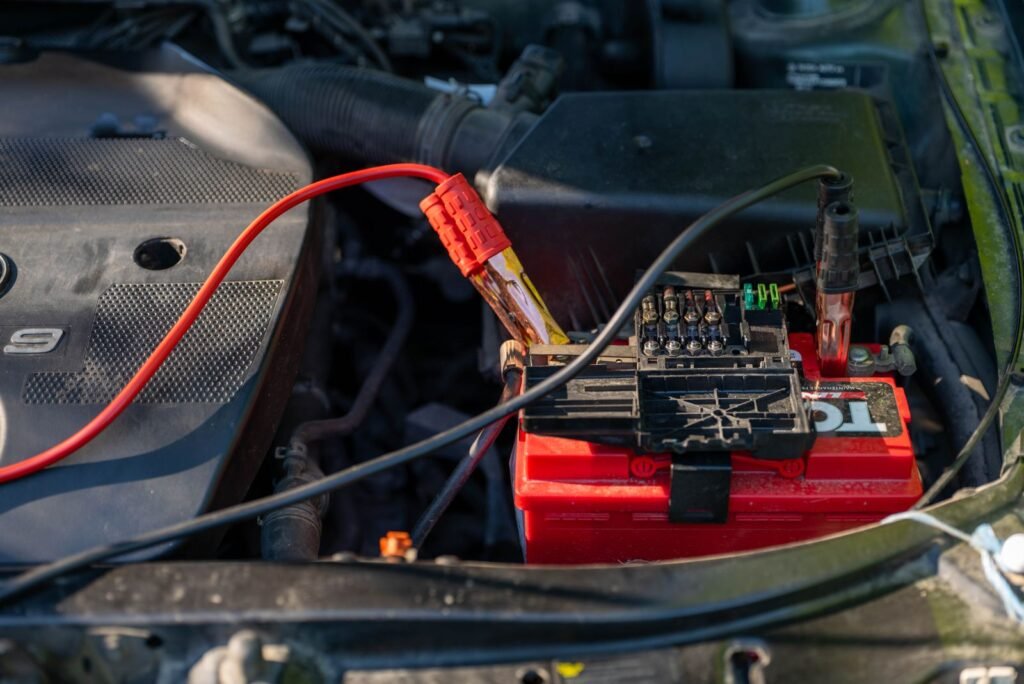
The clearest car battery problem signs are slow cranking, a clicking sound when you turn the key, dim headlights, weak electronics, a battery warning light, and a battery that needs jump starts again and again. If you notice two or more of these failing battery signs together, get a free battery test at a parts store before you buy anything.
Most car batteries last 3 to 5 years, according to AAA, and most weak car battery symptoms appear in the last few months of that life. Catch them early and you choose the time and the price of the fix.
Slow Cranking and Clicking When You Turn the Key
Slow cranking is the most common of all car battery problem signs. You turn the key or press the start button and the engine turns over slowly, with a tired dragging sound, instead of starting briskly. Cold weather makes it worse, because cold thickens engine oil and a weak battery has less power to push through it.
A single slow start after the car has sat for a week may only mean the battery needs a good drive to recharge. Slow cranking on most mornings is a failing battery sign. If the battery is past 3 years old, test it the same week. A fast clicking sound with no cranking usually means the battery has too little charge to turn the starter at all, while a single loud click points more often to the starter. Do not keep turning the key. Try a jump start once, drive for at least 30 minutes, then get the battery tested. If it needs another jump start within a few days, plan a replacement.
Dim Lights and Weak Electronics
Dim headlights, a dim dashboard, slow power windows, and a radio that cuts out are classic weak car battery symptoms. The battery powers these systems when the engine is off, so they show weakness before the engine refuses to start. Check this at night, with the engine off and the headlights on. If the lights brighten when you start the engine, the battery was low and the alternator is now helping.
Watch for electronics that reset themselves. A clock that loses time or radio presets that disappear can mean voltage is dropping too low. Short trips under 15 minutes do not give the alternator enough time to recharge the battery, so take a steady 30 minute drive at least once a week. Do not buy a new battery on this sign alone, because a loose cable or a failing alternator can cause the same dimming.
The Battery Warning Light and Dashboard Clues
The battery warning light, a small battery symbol on the dashboard, means the charging system is not working as it should. It does not always mean the battery itself is dead. It can mean the alternator is not charging, a belt is slipping, or a cable is loose. Treat this light as a prompt to act the same day.
If the light comes on while you are driving, turn off the air conditioning and any phone chargers to reduce the load, and drive to a parts store or a mechanic without switching the engine off, because the car may not restart. If it appears only at startup and goes out after a few seconds, that is normal. If it stays on or flickers, book a charging system test right away.
Swollen Case, Corrosion and Bad Smell
Pop the hood and look at the battery itself. A healthy battery case is flat and square, the terminals are clean metal, and there is no smell. A swollen or bulging case, a cracked case, or a case that feels hot after a short drive means the battery is damaged inside. Do not try to charge it or jump start the car again and again. Book a replacement, because a damaged case is a safety problem and it will not recover.
Corrosion looks like white, green, or blue crust around the terminals. It adds resistance, so less power reaches the starter, and it can mimic a dead battery. Check the terminals every three months. Clean them with a wire brush and a warm water and baking soda solution, wearing gloves and eye protection, and tighten each clamp by hand. If corrosion returns within a few weeks, ask a mechanic to inspect the cables. A strong rotten egg smell is also a warning sign. Stop charging it and get help.
Age, Cold Mornings and Repeated Jump Starts
Battery age is the simplest clue of all. Check the date code sticker on the top or side of the battery. Under 3 years old, a battery should usually start the car well if it is charged and the terminals are clean. Past 3 years old, test it at least once a year, because AAA suggests annual testing from the third year onward. Past 5 years old, plan for a replacement soon, even if it still starts the car.
Cold mornings expose a weak battery first, because cold reduces the power a battery can deliver while the engine needs more power to turn over. If the car starts fine in summer but struggles on the first cold morning, test the battery before winter. A battery that needs a jump start twice in a few weeks, or that goes flat overnight, is not holding charge. Get a free load test, and if it fails, replace the battery. Read our guide on car battery draining overnight if the battery goes flat while parked, because a drain can kill even a healthy new battery.
Battery, Starter or Alternator: How to Tell the Difference
These three parts fail in similar ways, so use the test, not a guess, to decide. A weak battery usually gives slow cranking, dim lights, and weak electronics, and the car often starts with a jump. A bad starter usually gives a single loud click, a grinding sound, or no sound at all, even when the lights are bright. A failing alternator usually gives a battery warning light while driving and a battery that goes flat even after a jump start and a long drive.
Check the voltage if you own a multimeter. A rested battery that reads about 12.6 volts with the engine off is fully charged, a reading near 12.4 volts means it is about three quarters charged, and a reading near 12.0 volts means it is about half charged. Voltage alone does not prove the battery is healthy, because a worn battery can still read 12.6 volts and fail under load, so ask for a load test as well. That test is free at AutoZone, O’Reilly Auto Parts, and Advance Auto Parts. If the battery tests healthy but the car still will not start, read our guide on bad starter symptoms before you book a repair.
| Part | Typical signs | Typical cost | Best next step |
|---|---|---|---|
| Battery | Slow cranking, dim lights, repeated jump starts | 45 dollars to 250 dollars for the battery alone, according to Kelley Blue Book | Free load test, then replace if it fails |
| Starter | Single loud click, grinding, no crank with bright lights | 565 dollars to 796 dollars installed, according to RepairPal | Test battery first, then test the starter |
| Alternator | Battery light while driving, battery goes flat after a long drive | 809 dollars to 1088 dollars installed, according to RepairPal | Charging system test before any part is replaced |
What to Do Next: Test First, Then Decide
Follow this order and you will spend money only on the part that is actually failing. First, look at the battery age, the case, and the terminals, and clean any corrosion. Second, get a free battery and charging system test at a parts store, and keep the printed result. Third, act on the result. If the battery passes, look for a drain, a loose cable, or a starter fault. If it fails, replace it.
Do not buy a battery based on age alone, or on a single slow start. Age plus a failed load test is the decision point. If the battery is past 5 years old, cranks slowly, and fails the test, replace it now. If it is young, passes the test, and still goes flat, read our guide on car battery maintenance, then ask a mechanic to test for a drain.
What a Replacement Costs and When to Book a Mechanic
A new 12 volt battery alone usually costs about 45 dollars to 250 dollars according to Kelley Blue Book, depending on size, power, and quality. A shop supplied and installed replacement is higher, with RepairPal putting its national estimate at 449 dollars to 486 dollars in September 2026, including parts and labor. AGM batteries for cars with start stop systems cost more. Get a quote for your exact year, make, and model before you buy.
Book a mechanic at once if you see a swollen or cracked case, smell rotten eggs, or the battery warning light stays on while driving. Book a mechanic soon if the battery fails a load test or needs jump starts repeatedly. Book a mechanic before you replace the battery if the test shows the alternator is not charging, because a new battery will not fix a charging fault. You can fit a battery yourself if you are confident and it is easy to reach. Remove the negative cable first and reconnect it last. If you are unsure about the cable order, let a shop or a parts store fit it.
Frequently asked questions
How do I know if my car battery is failing or just flat?
Charge it fully, then get a free load test. If it reads about 12.6 volts at rest and passes the test, it was flat, so fix the cause, such as short trips or a light left on. If it fails the test, needs jump starts repeatedly, or is past 5 years old with slow cranking, replace it.
Can a weak battery cause dim lights and warning lights?
Yes. A weak battery can cause dim headlights, slow power windows, a radio that resets, and warning lights that appear when voltage drops. Get a free battery and charging system test first, because a failing alternator can cause the same signs.
How long does a car battery last?
Most car batteries last 3 to 5 years, according to AAA. Test it once a year after its third birthday, and plan for a replacement soon once it passes 5 years old.
Should I replace my battery or try charging it first?
Try charging it first if it went flat once for a clear reason, such as a light left on, then get a free load test. Replace it if it fails the test, needs a jump start more than once in a few weeks, or has a swollen or cracked case.
Pingback: Car Battery Replacement Cost: How Much Should You Pay?
Pingback: How to Change a Car Battery: A Simple Guide in Easy Steps
Pingback: Car Battery Positive or Negative: Which Terminal Is Which?