
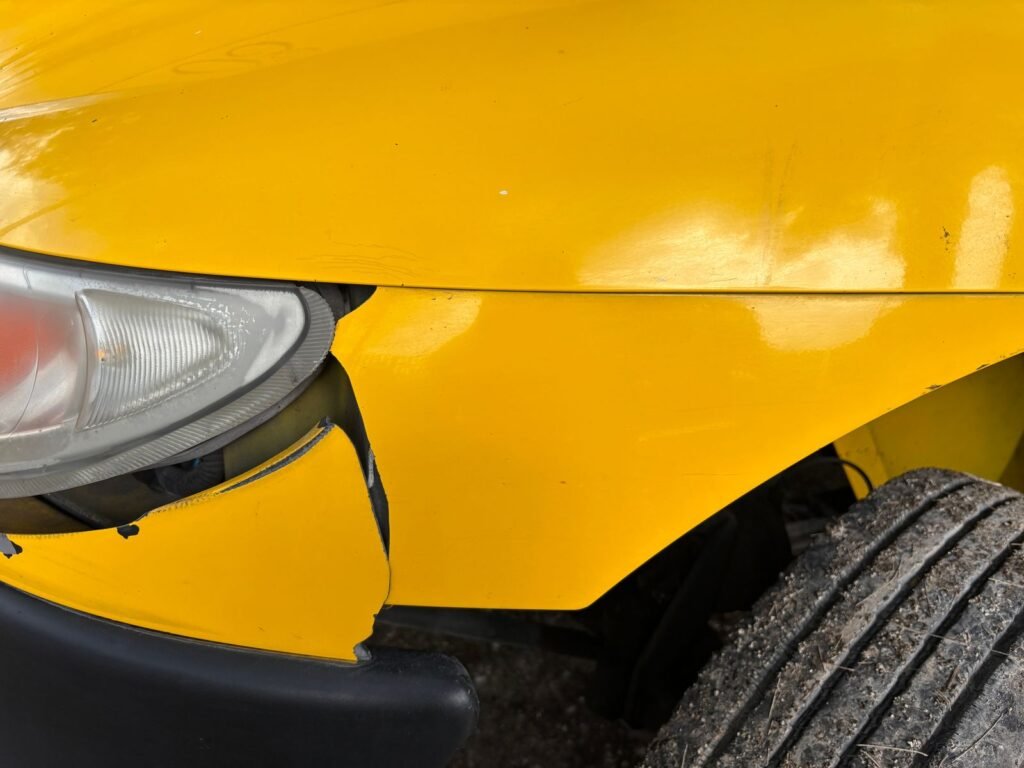
A collision and repair cost usually lands between 500 dollars and 7,000 dollars for a typical repairable crash, and it can pass 10,000 dollars when the frame, airbags, or safety sensors are involved. CCC Intelligent Solutions reported that the average total cost of repair across its repairable claims was approaching 4,800 dollars in 2025, and the Insurance Information Institute reported that the average auto collision claim in the United States exceeds 4,700 dollars. Your own bill depends on the damage level, the parts your car needs, local labor rates, and whether sensors need calibration after the work.
Ask for a written car collision repair estimate before you agree to any work, and ask the shop to break it into parts, labor, paint and materials, frame work, and calibration.
What Collision Repair Costs by Damage Level
Minor damage usually means a scuffed bumper, a small dent, or a scratch with no bent metal underneath and no warning light on the dash. EngineerFix puts minor cosmetic work at about 500 dollars to 2,500 dollars, while a single panel repair and repaint commonly runs a few hundred dollars to around 1,000 dollars or more per panel, according to a San Bernardino body shop guide. Paintless dent repair is often the lowest cost option here, with Red River Collision Center listing 75 dollars to 350 dollars depending on dent size. If the paint is unbroken, ask about paintless repair before you agree to filler and a repaint.
Moderate damage usually means several panels, a cracked bumper, a broken headlight, or a bent fender, plus paint blending into nearby panels. EngineerFix puts this tier at about 2,500 dollars to 7,000 dollars, while the San Bernardino guide puts it at about 1,500 dollars to 5,000 dollars. A bumper repair or replacement with paint often falls around 500 dollars to 1,500 dollars, and a full bumper replacement can run 1,000 dollars to 2,000 dollars or more, according to AutoBodyPrices. If your bumper is cracked, read our guide on car bumper repair cost to see when repair makes sense and when replacement is better.
Major damage usually means bent frame rails, suspension damage, deployed airbags, or damage to several systems at once. EngineerFix reports that severe structural damage routinely exceeds 10,000 dollars and can approach the value of the car. If the repair cost reaches 60 percent to 100 percent of the car actual cash value, depending on your state, the insurer may declare it a total loss. Ask the shop and your insurer to confirm the threshold in your state before you approve a large repair.
| Damage level | Typical cost range | What it usually includes | Your next step |
|---|---|---|---|
| Minor | 500 dollars to 2,500 dollars | Small dents, scratches, scuffed bumper | Ask about paintless dent repair first |
| Moderate | 1,500 dollars to 7,000 dollars | Several panels, bumper replacement, headlight, paint blending | Compare parts and labor line by line |
| Major | 10,000 dollars or more | Frame work, suspension, airbags, sensors, calibration | Ask for a measurement report |
Parts: The First Big Driver of the Bill
Parts often make up the largest share of an accident repair cost. Original equipment parts from the car maker usually cost the most, but they fit as designed. Aftermarket parts usually cost less and can be a sound choice for a bumper cover, a fender, or a mirror on an older car. Keep original equipment parts for sensors, airbags, and structural parts. Never accept a used or repaired airbag, because a deployed airbag must be replaced with a new unit that meets the maker standard.
Labor: Why Shop Rates Vary So Much
EngineerFix reports body shop labor rates from about 75 dollars to over 150 dollars per hour across the United States, with higher rates in cities and in areas with a higher cost of living. A dealer collision center usually charges more than an independent shop. Ask how many labor hours the estimate includes for body work, paint, mechanical work, and frame work. A low hourly rate does not always mean a low final bill, so compare the total labor cost, and ask the shop to call you before it adds hours that were not in the first estimate.
Paint and Blending: More Than a New Coat
Paint work costs more than most drivers expect because a good repair is mostly preparation: sanding, filling, priming, matching the color, spraying the panel, and blending into nearby panels. Kelley Blue Book puts the average around 4,000 dollars for a mid tier sedan repaint, according to AutoBodyPrices, while a basic respray can run 1,000 dollars to 1,500 dollars and quality work can reach 10,000 dollars. Ask whether the estimate includes blending, because metallic and pearl colors are harder to match without it. If your damage is mainly a dent with the paint still intact, read our guide on car dent repair cost to compare paintless repair with a traditional filler and repaint job.
Frame and Structural Damage: The Cost That Changes Everything
LegalClarity lists minor frame repairs at about 200 dollars to 1,500 dollars, moderate frame straightening at about 1,500 dollars to 5,000 dollars, and major structural repair at about 4,500 dollars to 12,000 dollars or more. Do not drive a car with suspected frame damage until a shop has measured it. Check for doors that do not close cleanly, uneven gaps between panels, a steering wheel that sits off center, and a car that pulls to one side. Ask for a printed measurement report before and after the repair. A standard four wheel alignment usually runs 100 dollars to 200 dollars, according to Premier Coach Auto Collision, so ask the shop to include alignment after any frame or suspension work.
Sensors, Cameras, and Calibration: The Hidden Line Item
Modern cars carry cameras, radar, and parking sensors in the bumper, grille, windshield, and mirrors, and a crash can move them even when the outside damage looks small. After the part is fitted, the sensor must be aimed again, and that step is called calibration. CCC Intelligent Solutions reported that calibration appeared in 28.3 percent of repairable estimates in 2025, and the average calibration fee reached about 486 dollars. FixMyRideAI lists about 250 dollars to 500 dollars for a single sensor or camera calibration, while a full or multi system calibration can run 500 dollars to 1,500 dollars or more. Ask the shop to list every calibration it plans to do and to give you a scan report after the work. If the windshield or its camera was touched, read our guide on car windshield repair cost to see how glass work and camera calibration fit together.
Airbags: A Single Deployment Can Add Thousands
AutoZone lists about 1,000 dollars to 1,500 dollars for a driver side airbag and about 1,200 dollars to 2,000 dollars for a passenger side airbag, while a full system replacement can run 3,000 dollars to over 6,000 dollars depending on how many airbags deployed. RepairPal component estimates, reported by MechanicBase, list 485 dollars to 532 dollars for an airbag crash sensor and 865 dollars to 939 dollars for an airbag control module, as separate parts, not a total for a full repair. Ask the shop to list every airbag, sensor, module, and seat belt pretensioner that must be replaced. Do not let a shop fit a used or counterfeit airbag, because the National Highway Traffic Safety Administration has warned that substandard replacement airbag inflators have caused deaths and serious injuries.
How to Read an Estimate and Handle Insurance
A good estimate lists each part, each labor operation, the paint and materials charge, and any scan or calibration line. Check for missing lines first, because a missing scan, calibration, alignment, or blending line can return later as a surprise charge or as a safety system that was never reset. Ask whether the estimate may grow after teardown, and ask the shop to get your approval and your insurer approval for any supplement before it proceeds. If you have collision coverage, your insurer usually pays above your deductible, and a typical deductible runs 500 dollars to 1,000 dollars, according to published repair guides. A small repair near your deductible may be cheaper to pay yourself, so check your policy and claim history before you file. If the car is declared a total loss, check the insurer valuation against Kelley Blue Book and recent local sales before you accept it.
How to Keep the Bill Down Without Cutting Safety
Get two or three written estimates from certified shops, and ask each shop the same questions about parts, calibration, and warranty. Ask about an aftermarket part for a cosmetic panel, and ask whether a dent can be fixed without a repaint or a scratch can be buffed instead of repainted. Do not skip a scan, a calibration, an alignment, or a structural measurement to save money, because those steps protect the safety systems and the way the car drives. Ask for a written warranty on the workmanship and the paint, and keep the estimate, the final invoice, the measurement report, and the scan report together.
Frequently asked questions
How much does collision repair cost on average?
CCC Intelligent Solutions reported that the average total cost of repair across its repairable claims was approaching 4,800 dollars in 2025. A minor repair may run 500 dollars to 2,500 dollars, a moderate repair may run 1,500 dollars to 7,000 dollars, and a major structural repair can exceed 10,000 dollars, so get a written estimate for your car before you budget.
What makes a car collision repair estimate go up after the first quote?
Hidden damage found after teardown is the most common cause, followed by calibration, scans, frame measurement, and parts that need replacement once the panel is removed. Ask the shop to call you before it adds work, ask for a written supplement, and ask your insurer to approve it before the shop proceeds.
Do I need ADAS calibration after a minor crash?
You need it when a camera, radar, or sensor was moved, removed, replaced, or affected by the repair, even if the outside damage looks small. A single sensor calibration typically costs about 250 dollars to 500 dollars, and a full or multi system calibration can run 500 dollars to 1,500 dollars or more, according to FixMyRideAI.
When is a car a total loss after a crash?
An insurer may declare a car a total loss when the repair cost reaches a state set share of the car actual cash value, typically 60 percent to 100 percent depending on the state, according to EngineerFix. Check the threshold in your state and compare the repair estimate with the car value before you accept a total loss offer.