
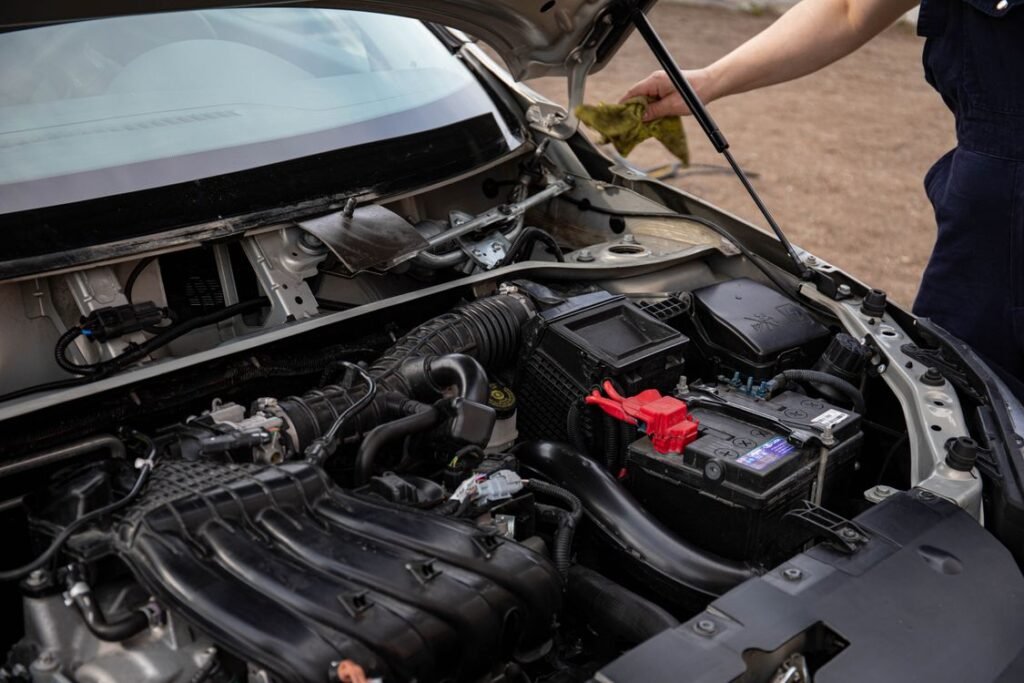
The red terminal with the plus sign is positive and the black terminal with the minus sign is negative. That holds for nearly every car on the road. Positive is red, marked with a plus sign, and usually the larger of the two terminals. Negative is black, marked with a minus sign, and its cable runs to the car body, where it acts as the ground.
Mixing the two up is one of the easiest mistakes in car care, and also one of the most expensive, because reversed cables can blow fuses and damage electronics. This guide shows you how to tell the terminals apart, which one to disconnect first, which one to connect first, and how to disconnect car battery terminals safely and refit them. If your battery is already giving trouble, start with our guide to car battery problem signs before you touch a wrench.
How to Tell Positive From Negative in Seconds
Open the hood and look at the top of the battery before you touch anything. Check three clues, and trust the symbol first. The positive terminal carries a plus sign stamped into the case or molded into the cover, and it is usually red. The negative terminal carries a minus sign and is usually black. If the colors are worn away, wipe the top clean and look for the symbol.
Size is your second clue. On most top post batteries the positive post is slightly larger than the negative post, so a positive clamp will not fit snugly on the negative post. If a clamp slides on loosely or will not close, stop and check that you have the right post. Cable routing is the third clue: the thick red cable runs from the positive terminal toward the starter and the fuse box, while the black cable runs from the negative terminal to a bolt on the body.
Some cars place the battery in the trunk or under a seat, so check your owner manual if you cannot see it under the hood. Never guess from position alone, because the positive terminal sits on the left in some cars and on the right in others.
Why Positive Is Red and Negative Is Black
The color code is a safety standard, not a decoration. Red means live power and danger, so your eye is drawn to the terminal that needs care, while black marks the ground side that connects to the car body. Every mechanic and every jumper cable set uses the same code, so once you learn it, it works on any car you will ever own. Red always goes to positive, black always goes to negative.
The negative terminal connects to the car body as ground, which means the whole metal body of the car is part of the return path for the current. That is the reason the order of connecting and disconnecting matters so much.
Which Battery Terminal to Disconnect First
Always disconnect the negative terminal first. This is the single most important rule in this guide, so learn it before you pick up a wrench. When you remove the black cable first, you break the ground connection, and the whole car body stops being part of the circuit. After that, a slipped wrench on the positive side cannot short anything.
If you remove the positive terminal first instead, the negative cable is still attached, and the car body is still live ground. One slip of the wrench between the positive terminal and any metal part under the hood creates a short circuit. So the rule for any battery disconnect is simple: black off first, red off second, as our guide to how to change a car battery shows.
When Connecting a Battery Which Terminal First
When connecting a battery, the order reverses: always connect the positive terminal first and the negative terminal last. Fit the red cable onto the positive post, tighten it firmly, and only then fit the black cable onto the negative post. While the negative cable is still off, a slipped wrench cannot short anything.
Once the positive cable is tight, connect the negative cable last and tighten it firmly as well. Then give each clamp a gentle tug to confirm it cannot move on the post. A loose clamp causes hard starting and flickering lights, so a firm connection is part of the job. If the clamp will not tighten, check that it is on the correct post, because a positive clamp will sit loose on the smaller negative post.
How to Disconnect a Car Battery Step by Step
Park on flat ground, switch the engine off, remove the key, and switch off the lights, the radio and anything else that draws power. Put on eye protection and gloves, because battery acid burns skin and eyes. Find the battery, note which terminal is red and positive and which is black and negative, and take a phone photo of the layout.
Loosen the bolt on the negative clamp with the correct size wrench, usually 10 millimeter, and lift the black cable off the post. Tuck the cable end to one side so it cannot spring back and touch the terminal. Then loosen the positive clamp and lift the red cable off its post. Never let a wrench touch both terminals at once, and never lay a metal tool across the top of the battery.
If a clamp is stuck, do not pry it with a screwdriver, because you can crack the battery case or break the post. Wiggle it gently side to side while you lift, or use a proper terminal puller. If the terminals are covered in white or blue green crust, clean them with a wire brush and a baking soda and water mix before you refit the cables. Unbolt the hold down clamp before you lift the battery out, because a battery is heavy and a dropped battery can crack and leak acid.
How to Connect a Car Battery Step by Step
Set the new or charged battery in the tray the right way round, so the positive post sits on the same side as the red cable, then refit the hold down clamp before you connect anything, so the battery cannot shift while you work. Check that the terminals are clean and dry, and clean them with a wire brush if they are dull or crusty, because clean contact carries the starting current.
Connect the positive terminal first. Slide the red clamp over the positive post, push it down firmly, and tighten the bolt until the clamp cannot move, then tug it to confirm. Connect the negative terminal last, tighten it the same way, and tug it to confirm. A thin smear of petroleum jelly or terminal grease on the outside of the clamps helps keep corrosion away, but never put grease between the clamp and the post, because that breaks the electrical contact. Start the car and check that it cranks normally. If you need to replace the whole battery, read our guide to car battery replacement cost first so you know what a fair price looks like before you buy.
What Happens If You Connect the Cables the Wrong Way
Reversing the cables sends current through the car electrical system in the wrong direction, and the damage can be instant. The most common result is blown fuses. More serious damage can hit the alternator, the starter, the engine control unit and other electronics. If you realize you have reversed the cables, do not try to start the car. Disconnect both cables, negative first, then check the fuses and get the car inspected before you drive it.
Sparks, smoke, a burning smell or a melted clamp all mean something is already wrong, so stop immediately, step back, and do not touch the battery with bare hands. Let the battery cool, then call a mechanic or roadside help. A battery that has been shorted can be hot, cracked or leaking, and acid burns skin and damages paint.
Jump Starting With Jumper Cables: Which Cable Goes Where
Jump starting follows the same color rule, with one extra safety step. Connect the red clamp to the positive terminal of the dead battery, then the other red clamp to the positive terminal of the good battery. Connect the black clamp to the negative terminal of the good battery, then attach the last black clamp to a bare metal bolt on the engine block of the dead car, away from the battery, never to its negative terminal. That keeps any spark away from the battery.
Start the good car, let it run for a few minutes, then try the dead car. Once it starts, remove the cables in reverse order: black clamp off the engine block first, then black off the good battery, then red off the good battery, then red off the dead battery. Drive the car for at least 20 to 30 minutes so the alternator can recharge the battery, and get the battery tested soon.
When to Stop and Get Help
Stop and call a mechanic if the battery case is cracked, swollen or leaking, if you smell rotten eggs around the battery, or if the battery is hot to the touch, because these are signs of internal damage and a battery in this state can be dangerous to handle. Stop too if the clamps will not come off, or if your car needs a radio code after a battery disconnect and you do not have it. Check your owner manual before you start, and if anything surprises you, let a shop do the job.
Frequently asked questions
Is the red terminal positive or negative on a car battery?
Red is positive. The red terminal is marked with a plus sign, and it is usually the larger terminal. Black is negative, marked with a minus sign, and its cable runs to the car body as ground.
Which battery terminal do I disconnect first?
Disconnect the negative terminal first. Removing the black cable first breaks the ground connection, so the car body is no longer part of the circuit, and a slip of the wrench on the positive side cannot cause a short.
When connecting a battery, which terminal goes on first?
Connect the positive terminal first and the negative terminal last. Fit and tighten the red cable first, then the black cable. This order keeps the car body out of the circuit until the live side is safely connected.
What happens if I connect the positive and negative cables the wrong way round?
Reversed cables can blow fuses and damage the alternator and the engine control unit. If you reverse the cables, do not start the car, disconnect both cables, negative first, and have the car inspected before you drive it.