
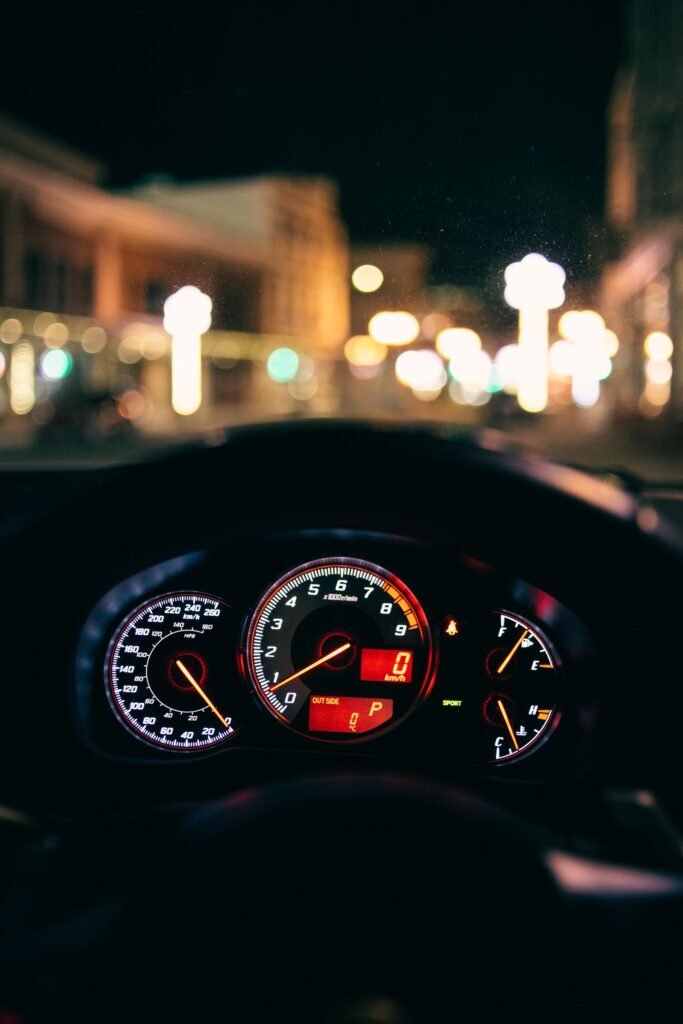
You are driving home on a dark road late at night, the road ahead is almost black, and then a small blue light appears on your dashboard. Your heart jumps a little, because any new light on the dashboard can feel like a warning, and you are not sure if you should pull over, switch something off, or just keep driving. This guide will explain exactly what that blue light means, how to control it with the stalk beside your steering wheel, and when to use your high beams and when to dim them, so you can drive with confidence on the darkest roads. But here is the question that catches many drivers out, and it is worth answering before you drive at night again. How far ahead should your lights reach, and how close is too close for the driver coming toward you?
The direct answer to what the high beam symbol means is simple and reassuring. The high beam symbol is a blue icon on the dashboard that lights up whenever your high beams are on, and it tells you that your brightest headlights are shining down the road ahead of you. It is not a warning that something is broken, and it is not a fault light. It is an indicator, a clear message from your car that the high beams are active right now. If you see it, your high beams are on. If you do not see it, your high beams are off. That one fact answers the worry most drivers feel the first time they notice the blue glow.
If the sight of a blue light on your dashboard made you nervous, that feeling is completely normal, because every driver learns that dashboard lights can mean trouble, and nobody wants to ignore a light that matters. The good news here is that this blue light is on your side. It is there to help you remember that your brightest lights are on, so you can dim them in good time for other drivers, and so you never drive with your high beams on by accident for mile after mile. Once you know what it looks like and how to switch it on and off, it becomes one of the most useful lights on your dashboard, not one to fear.
The high beam symbol works together with your headlights, your low beams, and the stalk beside your steering wheel. Learning how those parts work together takes only a few minutes, and it makes night driving safer for you and for everyone else on the road. The sections below walk through each part in order, what the symbol looks like, how it differs from the low beam symbol, how to turn your high beams on and off, when to use them, when to dim them, why fog changes everything, and how automatic high beams work on newer cars. Read through to the end, and the next time that blue light appears you will know exactly what to do. And the first step is learning to spot the symbol at a glance.
What the High Beam Symbol Looks Like
The high beam symbol is a blue icon shaped like a headlamp with straight horizontal lines pointing forward from it. The headlamp shape sits on the left of the icon and the straight lines stretch out to the right, showing light shining forward down the road. The colour is the key to recognising it quickly. Blue is the standard colour for this symbol on almost every car, and that blue colour sets it apart from the green low beam symbol. When you glance at your dashboard at night, blue means high beams, and that colour alone tells you the answer before you study the shape.
The symbol lights up on your instrument cluster, the panel behind your steering wheel where your speed and fuel gauge sit. On some cars it sits near the top of the cluster, on others it sits near the other headlight symbols, but the blue colour and the straight lines always make it easy to find once you know what to look for. It appears the moment your high beams switch on, and it goes out the moment they switch off. That direct link is what makes it so useful. You never have to guess whether your high beams are on, because the dashboard tells you in plain sight.
Take a moment to find the symbol in your own car before your next night drive. Sit in the driver seat, switch your headlights on, and push the turn signal stalk away from you to switch the high beams on, then look for the blue icon. Pull the stalk back toward you to switch them off again, and watch the blue icon go out. Doing this once in your driveway, while the car is parked, teaches your hands and your eyes at the same time, so you will not have to hunt for the control on a dark road. That small practice run is the best way to learn the control, and it leads straight into the next question, which is how this blue symbol differs from the green one beside it.
High Beam Symbol and Low Beam Symbol Side by Side
Your car has two main headlight settings, low beams and high beams, and each one has its own dashboard symbol. The low beam symbol is green, and it shows a headlamp with lines pointing down and forward, showing light aimed down toward the road close in front of your car. The high beam symbol is blue, and it shows a headlamp with straight horizontal lines pointing forward, showing light aimed straight ahead and far down the road. The colour and the angle of the lines tell the story. Green and downward means low beams, blue and straight ahead means high beams.
Low beams are the lights you use most of the time at night. They light the road about 200 feet ahead of your car, which is far enough to drive safely at normal speeds in town and on lit roads, and their beam is aimed down so it does not shine into the eyes of drivers coming toward you. High beams are the brighter setting, and they light the road about 350 feet ahead, which is much farther, and that extra reach is why they are so useful on dark roads with no street lights. The trade off is clear. High beams reach farther, but they can dazzle other drivers, so you must dim them when other traffic is near.
Learning the two symbols together helps you check your lights in one glance. If you see a green headlight symbol, your low beams are on. If you see a blue headlight symbol, your high beams are on. If you see both, your high beams are on and your low beams are working as well, because high beams work with the low beam circuit on many cars. Check the colour first, then check the lines. That quick check takes less than a second, and it tells you exactly which lights are shining right now. Read our guide on what DRLs are and how they differ from your headlights if you want to understand the daytime lights on your car as well, because daytime running lights are a separate system from your low beams and your high beams. Once you can tell the two symbols apart, the next step is learning the stalk that controls them.
| Feature | High beam symbol | Low beam symbol |
|---|---|---|
| Colour | Blue | Green |
| Shape | Headlamp with straight horizontal lines pointing forward | Headlamp with lines pointing down and forward |
| What it means | High beams are on | Low beams are on |
| How far the light reaches | About 350 feet ahead | About 200 feet ahead |
| When to use it | Dark roads with no street lights and no other traffic near you | Most night driving, in town and on lit roads |
| What to watch for | Dazzling other drivers if you forget to dim | Less reach on dark open roads |
Use this table when you want the difference in one look, and keep the two numbers in mind as you drive. Low beams reach about 200 feet, high beams reach about 350 feet, and that extra 150 feet of light is the reason high beams feel so much brighter on a dark road. The extra reach gives you more time to see a bend, an animal, a pedestrian or a hazard in the road ahead, and more time to react to it. That is the benefit, and the risk is just as clear. The same bright light that helps you see farther can blind the driver coming toward you, which is why the next section, how to switch the beams on and off, matters so much. But how do you work the stalk without taking your eyes off the road?
How to Turn On High Beams and How to Turn Off High Beams
On almost every car, you control the high beams with the turn signal stalk, the lever on the left side of the steering column that you also use for your indicators. Push the turn signal stalk away from you to switch high beams on, and the blue high beam symbol will light up on your dashboard to confirm it. Pull the stalk toward you to switch them off again, and the blue symbol will go out. That push away and pull toward you is the whole control on most cars, and once you have done it a few times it becomes natural, like switching your indicators on and off.
Pulling the stalk toward you also has a second use, and it is worth learning separately. If you pull the stalk toward you and let it spring back, you flash your high beams for a brief moment, and the blue symbol will flash on and then go out again. Drivers use this flash to warn another driver, to signal that they are there, or to get the attention of a driver who may not have seen them. The flash is brief, it does not leave the high beams on, and it is a useful tool when you need to be seen quickly. Learn the difference by feel. A push away locks the high beams on, a quick pull toward you and release only flashes them.
Some cars use a slightly different control, so check your own car if the stalk does not behave as described here. A small number of cars use a rotary switch or a button, and some newer cars use an automatic setting on the stalk that lets the car switch the beams for you. Your car handbook will show the exact control for your model, and it is worth checking it once so you are not guessing on a dark road. If the stalk feels loose, or if the blue symbol does not light up when you push the stalk away, have the stalk and the headlight circuit checked, because a control that does not respond is a repair to book, not a problem to ignore. But for most drivers the stalk works exactly as described, push away for on, pull toward you for off, and the blue light confirms each change. Now that you know how to switch them, the next question is when you should switch them on.
When to Use High Beams
Use high beams on dark roads with no street lights and no other traffic near you. That is the core rule, and it covers most of the situations where high beams help. On a dark country road, a rural lane, or an open road with no lighting, your low beams only reach about 200 feet ahead, and at speed that can leave you very little time to react to what appears in the road. High beams reach about 350 feet ahead, and that extra distance gives you more time to see a bend, a parked car, a pedestrian, an animal or debris in your path, and more time to slow down or steer around it.
Think about the road ahead before you switch the high beams on. Ask yourself three quick questions. Is the road dark, with no street lights? Is there no oncoming traffic in sight? Is there no car ahead of you that you are following? If the answer to all three is yes, switch the high beams on and enjoy the extra light. If the answer to any one of them is no, stay on low beams for now, and switch to high beams later when the road clears. That three question check takes only a second, and it keeps you safe while giving you the extra light when you truly need it.
High beams are also useful on dark roads where the road ahead is hard to read, for example where the road bends sharply, where the surface is uneven, or where road signs are hard to see from a distance. The extra reach helps you read the road ahead sooner, which helps you choose the right speed for the bend and the right position on the road. On a straight, well lit road in town, you do not need that extra reach, and your low beams are the right choice. Use high beams as a tool for dark open roads, not as a default for every night drive. That habit keeps your night driving safer, and it leads to the rule that matters most of all, knowing exactly when to dim.
When to Dim Your High Beams and Why the Distance Matters
Dim to low beams when an oncoming vehicle is within 500 feet, and when you follow another vehicle within 300 feet. These two distances are the key numbers to remember, and they come from state vehicle codes that set clear limits on when high beams must be dimmed. Dimming in good time is not just polite, it is a safety duty, because high beams shining into another driver eyes can leave that driver unable to see the road for several seconds, and those seconds are when crashes happen. Dim early, dim every time, and never wait until the other driver flashes their own lights at you.
Here is a real example that shows how seriously the law treats this duty. California Vehicle Code 24409 sets 500 feet for oncoming traffic and 300 feet for following, so a driver in California must dim to low beams when an oncoming vehicle comes within 500 feet, and when following another vehicle within 300 feet. Wisconsin law sets 500 feet for both, so a driver in Wisconsin must dim when an oncoming vehicle is within 500 feet and when following another vehicle within 500 feet. The numbers differ slightly from state to state, so check the rule in the state where you are driving, but the message is the same everywhere. Dim early, dim at a clear distance, and never leave your high beams on when another driver is close.
Judging 500 feet and 300 feet on a dark road takes practice, so use simple markers to help you. Five hundred feet is about one and a half football fields, or about the length of a long city block, and you can often see oncoming headlights long before the other car reaches that distance. Three hundred feet is about one football field, or about the distance you can see clearly in your own headlights on a dark road. If you can see the other car headlights clearly, or if you can see the car ahead of you in your lights, you are probably within the distance where you should dim. When in doubt, dim sooner rather than later, because dimming early costs you nothing and dazzling another driver can cost a great deal. The habit to build is simple. See headlights ahead, dim to low beams. See tail lights ahead, dim to low beams. That habit keeps every driver on the road safer, and it brings us to the one weather condition where high beams should never be used at all.
Why You Should Never Use High Beams in Fog, Heavy Rain or Snow
Do not use high beams in fog, heavy rain or snow, because the light reflects off the precipitation and makes visibility worse. This is one of the most common mistakes drivers make, because it feels natural to switch on your brightest lights when you cannot see well, yet in fog, rain or snow that bright light bounces back off the tiny drops and flakes in the air and creates a white wall of glare in front of your car. Instead of seeing farther, you see less, and the road ahead disappears behind the reflected light. The brighter the light, the worse the glare, which is why high beams are the wrong choice in these conditions.
Use your low beams in fog, heavy rain or snow, and slow down to match what you can actually see. Low beams are aimed down toward the road, so less of their light reflects back into your eyes, and they let you see the road surface and the lane markings more clearly. If your car has fog lights, switch them on as well, because fog lights are designed to shine low and wide under the fog, and they help you see the edges of the road without adding glare. Read our guide on the fog light symbol and when to use your fog lights if you are not sure which symbol to look for or when fog lights help, because using the right lights in fog makes a real difference to what you can see.
Slow down in fog, rain and snow, and increase the distance between your car and the car ahead, because your stopping distance grows when the road is wet and your visibility shrinks when the air is full of precipitation. If the fog is so thick that you cannot see the road ahead clearly even on low beams, pull over in a safe place, switch your hazard lights on, and wait for the fog to lift rather than pressing on with lights that cannot help you see. That decision, to stop rather than to push on, is the safest choice you can make in thick fog, and it is far better than switching to high beams and hoping the extra light will help, because it will not. The next section looks at the cars that try to make this choice for you.
Automatic High Beams and How to Take Control Back
Many newer cars have automatic high beams that switch between high and low beams on their own when they sense other traffic. A camera or a sensor, usually mounted near the top of the windscreen, watches the road ahead for the headlights of oncoming cars and the tail lights of cars ahead of you, and when it senses other traffic it dims the lights to low beams for you, then switches back to high beams when the road clears. That system can be very helpful on a long dark drive, because it dims the lights at the right moment even if you are tired or distracted, and it switches them back on when it is safe to do so.
Automatic high beams do not remove your duty as the driver. You still need to watch the road, watch for other traffic, and take control when the system gets it wrong. The driver can usually override them with the stalk, by pushing it away or pulling it toward you in the normal way, and that override lets you dim the lights sooner if you see traffic the sensor has not yet seen, or switch the high beams back on if the system has dimmed them too early. Learn how the override works on your car before you rely on the automatic system, and check your car handbook for the exact control, because the override can differ from one model to another.
Automatic high beams can be fooled by bends, hills, reflective signs and bright lights that are not cars, so do not assume the system will always dim at the right time. If you see headlights ahead and the system has not dimmed yet, dim the lights yourself with the stalk. If you are following another car and the system has not dimmed, dim them yourself. The system is a helper, not a replacement for your judgement, and the safest driver is the one who uses the system and still watches the road. That same care applies to the legal duty behind the blue symbol itself, which is the subject of the next section, and it is a duty every driver should know.
What the Law Requires and the Mistakes to Avoid
The beam indicator is required by law, and the dashboard light must be lit whenever the high beams are in use. That legal rule exists for a clear reason. The indicator reminds you that your high beams are on, so you remember to dim them for other drivers, and it lets a driver check at a glance whether the brightest lights are active. If the blue symbol does not light up when your high beams are on, have the dashboard and the headlight circuit checked, because a missing indicator means you could drive with your high beams on without realising it, and that puts other drivers at risk.
The most common mistake drivers make with high beams is forgetting to dim them. It happens easily on a long dark drive, when the road is empty for miles and then another car appears suddenly around a bend, and the driver is slow to react. Build the habit of checking your dashboard every time you see headlights ahead, and dim as soon as you see them. The second common mistake is using high beams in fog, rain or snow, as described above, where the reflected light makes things worse. The third common mistake is driving with high beams on in town, where street lights already light the road and the extra beam only dazzles other drivers and pedestrians.
Avoid those three mistakes and you will already be a safer night driver than most. Check your lights before you set off at night, make sure your low beams and high beams both work, and make sure the blue high beam symbol lights up when you switch the high beams on. Keep your headlights clean, because dirt on the lenses dims the light and scatters it, and check that your headlight bulbs are working on both sides. If one side is dim or out, have it fixed soon, because uneven lights make it harder for you to see and harder for other drivers to judge your position. Read our guide on how to change a front light on your car if a bulb has failed and you want to understand what the job involves before you book it or try it yourself. Those simple checks take only a few minutes, and they make every night drive safer, which brings us to the questions drivers ask most about this blue symbol.
Frequently asked questions
What does the high beam symbol mean?
The high beam symbol is a blue icon on the dashboard shaped like a headlamp with straight horizontal lines pointing forward, and it means your high beams are on. It is not a fault warning, it is an indicator that tells you your brightest headlights are active right now, and it goes out when you switch the high beams off. If you see the blue symbol, your high beams are on, and you should dim them when other traffic comes near.
How do I turn off high beams?
Pull the turn signal stalk toward you to switch high beams off, and the blue high beam symbol will go out to confirm it. On most cars, pushing the stalk away from you switches high beams on, and pulling it toward you switches them off, while a quick pull toward you and release only flashes them briefly. If your car uses a different control, check your car handbook for the exact method for your model.
When should I use high beams?
Use high beams on dark roads with no street lights and no other traffic near you, because they light the road about 350 feet ahead, while low beams reach about 200 feet. Dim to low beams when an oncoming vehicle is within 500 feet, and when you follow another vehicle within 300 feet, following the rule in your state. Do not use high beams in fog, heavy rain or snow, because the light reflects off the precipitation and makes visibility worse.
Why is the high beam symbol blue?
The high beam symbol is blue because blue is the standard colour for this indicator, which sets it apart from the green low beam symbol at a glance. The blue colour and the straight horizontal lines pointing forward tell you in one look that your high beams are on, while the green symbol with lines pointing down tells you that your low beams are on. The beam indicator is required by law, so the blue light must be lit whenever the high beams are in use.