
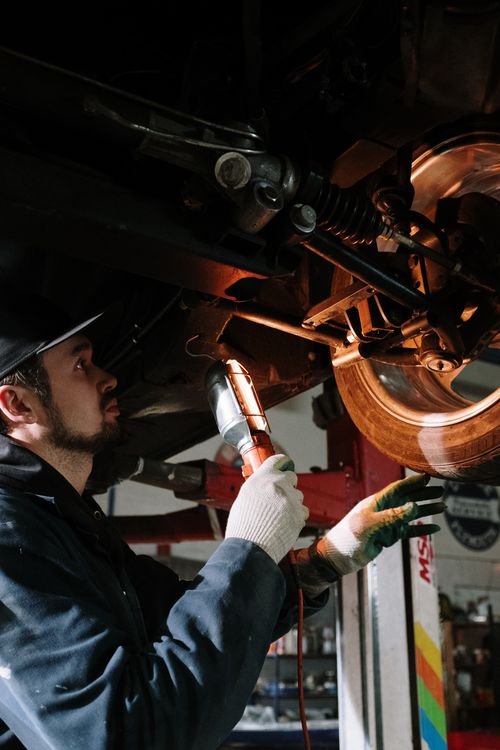
Bouncing over every bump, leaning hard in turns, and tires wearing in strange patterns are signs that your suspension is no longer doing its main job, which is keeping your tires on the road. The short answer: suspension repair costs depend on the part that failed. A pair of front struts usually costs $500 to $1,200 with alignment, a pair of rear shocks usually costs $200 to $600, sway bar links usually cost $100 to $250 a pair, and a full overhaul of all four corners can cost $1,500 to $3,500 or more. The first decision is which part actually failed, because guessing and replacing parts one by one is how a suspension bill grows.
Your suspension is a system, not one part. Springs hold the car up and set ride height. Shocks and struts control how the car moves after a bump, so it settles instead of bouncing. Control arms, ball joints, and bushings locate each wheel and let it move while staying aligned. Sway bar links reduce body roll in turns. When one part wears, the others work harder, tires wear unevenly, and braking distances grow.
Signs your suspension needs repair
The clearest signs are bouncing that continues after a bump, a nose that dives when you brake, a rear that squats when you speed up, and body roll that feels much worse than it used to. Clunks or rattles over bumps point to links, bushings, or mounts. Uneven tire wear, especially wavy or patchy wear, points to worn shocks or struts. A car that drifts, pulls, or feels vague in crosswinds needs inspection promptly. Your action: do a simple bounce test at each corner. Push down firmly and let go. A healthy corner should settle in one or two bounces. If it keeps bouncing, that damper is weak. Then check tires for uneven wear and look under the car for fluid on a shock or strut, which means its seal has failed.
Some suspension signs overlap with steering and tire problems, so do not replace parts on sound alone. A shop should lift the car, check each joint for play, and show you the worn part before you approve a repair. If steering feels heavy or loose as well, read our guide on why your steering wheel is hard to turn to separate a steering problem from a suspension problem.
Average costs at a glance
Most suspension parts are replaced in pairs on the same axle, left and right, so quotes usually cover a pair even when only one side feels bad. That keeps handling even and avoids a second visit soon after.
| Job | Parts | Labor | Typical total |
|---|---|---|---|
| Front strut pair with alignment | $300 to $700 | $200 to $500 | $500 to $1,200 |
| Rear shock pair | $100 to $300 | $100 to $300 | $200 to $600 |
| Coil spring, one | $150 to $400 | $100 to $300 | $250 to $700 |
| Control arm, one | $100 to $350 | $100 to $300 | $200 to $650 |
| Ball joint, one | $50 to $150 | $100 to $250 | $150 to $400 |
| Sway bar link pair | $40 to $100 | $60 to $150 | $100 to $250 |
| Full overhaul, all four corners | $800 to $2,000 | $700 to $1,500 | $1,500 to $3,500 plus |
Your action: ask whether the quote covers one part, a pair, or all four corners, and whether alignment is included. A quote that looks cheap because it covers one strut only will not match a quote for a pair with alignment, and comparing them directly will mislead you.
Which part is usually the culprit
Shocks and struts are the most common suspension wear items, and they usually last 50,000 to 100,000 miles depending on roads and driving. Springs rarely fail unless they break or sag, but a broken spring is a safety problem and needs prompt replacement. Control arm bushings crack with age and cause clunks and vague steering. Ball joints wear slowly and then suddenly feel loose, and a severely worn ball joint can separate, so it should never be ignored. Your action: ask the shop to rank the worn parts by safety, not just by price. Fix a broken spring or a loose ball joint first, even if a noisy link is more annoying.
What makes the price go up or down
Quick strut versus separate parts
A quick strut is a complete assembly with a new strut, spring, and mount in one unit. It costs more in parts but saves labor and avoids reusing an old spring or mount. Building a strut from separate parts can be cheaper in parts but takes longer and can reveal a worn mount halfway through the job. Your action: on a car with high mileage, a quick strut is usually the better value because the spring and mount are already old.
Luxury and adaptive suspension
Cars with adaptive dampers, air suspension, or electronic controls cost far more to repair, and some parts alone can cost $1,500 to $2,600 before labor and calibration. Your action: if your car has adaptive or air suspension, get a specialist quote and ask whether a standard part can be fitted safely. Do not let a general shop guess at calibration steps it does not know.
Rust and access
Rust, seized bolts, and tight access can add hours to a suspension job, especially on older cars and trucks. Your action: ask whether the quote assumes normal hardware or includes extra time for seized parts, so a rusty car does not surprise you with a much larger final bill.
Repair now or wait
Some suspension problems can wait a short time, and some cannot. A noisy sway bar link is annoying but usually not urgent. A broken spring, a loose ball joint, a leaking strut that lets the car bounce, and uneven tire wear that is getting worse should be fixed promptly, because they affect braking, steering, and tire life. Your action: if braking feels longer, steering feels vague, or the car bounces after bumps, book an inspection this week. If the car only clunks softly over bumps and handling feels normal, you can get a quote and plan the repair, but do not ignore it for months. For how suspension wear shows up as shaking, read our guide on car shaking while driving before you decide how urgently to act.
DIY or workshop
Sway bar links and rear shocks are approachable for a home mechanic on some cars, and they can save $100 to $300 in labor. Struts are harder because the spring is under high tension and needs a proper spring compressor, and a mistake there is dangerous. Your action: if you DIY, use a proper spring compressor and replace parts in pairs. If the job needs a strut, a ball joint press, or an alignment afterward, a shop is the safer choice, and the alignment alone is worth paying for.
Frequently asked questions
How long do shocks and struts last
Most last 50,000 to 100,000 miles, with rough roads, heavy loads, and potholes shortening that life. Your action: have them inspected at 50,000 miles and at every tire change after that, even if the ride still feels fine, because wear is gradual and you adapt to it without noticing.
Do I need an alignment after suspension work
Yes, in most cases, especially after struts, control arms, or ball joints. Suspension parts set wheel angles, and changing them changes those angles. Your action: get an alignment after the repair and keep the printout, because it proves the angles are correct and protects your new tires from uneven wear.
Can I replace only one shock or strut
You can, but you should not, because a new damper on one side and a worn damper on the other side makes handling uneven, especially in braking and in turns. Your action: replace dampers in pairs on the same axle, and only replace a single part when it is a link, a bushing, or a ball joint that does not affect damping.
Suspension repair is a job where diagnosis decides the bill. Find the exact worn part, confirm whether the quote covers a pair or all four corners, ask about alignment, and fix safety parts first. Handled promptly, it restores braking, steering, and tire life. Ignored, it wears tires, lengthens braking, and turns a single part repair into a full overhaul.
Pingback: Engine Splash Shield: What It Does, Signs of Damage and Replacement Cost