
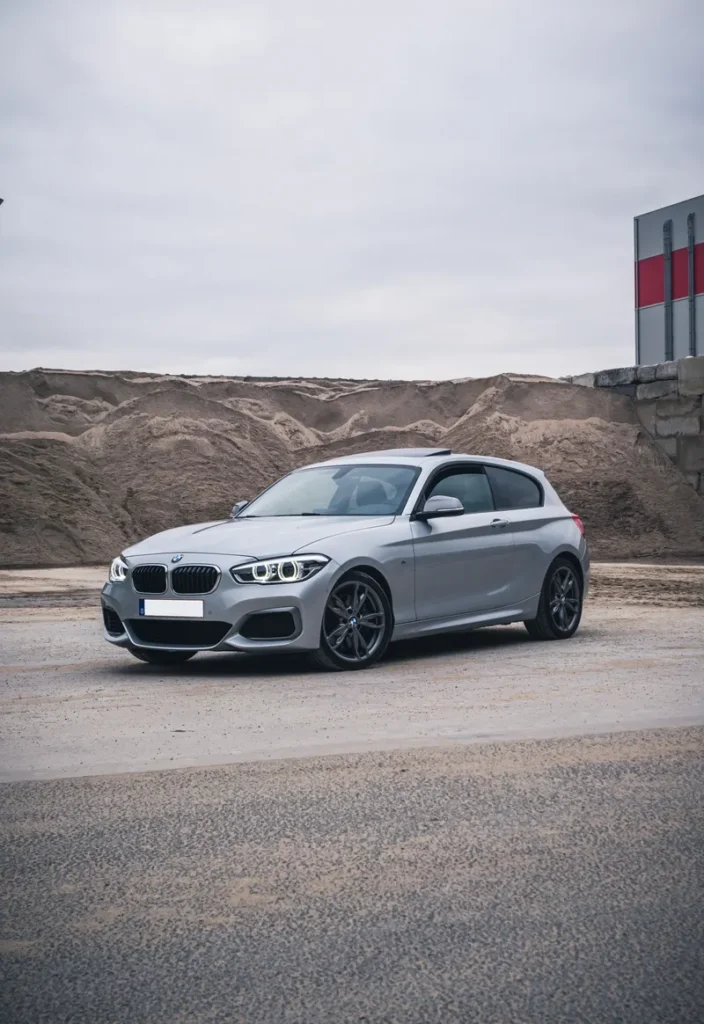
The BMW 1 Series is the premium hatchback for drivers who actually enjoy driving. On sale since 2004, it started life as the only rear wheel drive car in its class, then switched to front wheel drive in 2019, and every generation has sold on the same promise: BMW handling and badge appeal in a compact, easy to live with hatchback.
So who does it suit? Drivers who want a premium badge without moving to a bigger car. Commuters who want a comfortable hatchback that is still fun on a good road. Used buyers who want one of the deepest pools of second hand stock in the class. And automatic buyers in particular, because the 1 Series has offered some of the best automatic gearboxes in the class in every generation. This page covers every generation in one place: the dimensions, the engines worth having, real fuel consumption figures, the automatic gearboxes, and which generation to buy.
One thing to know before you read on: the coupe and convertible versions of the first generation later became the BMW 2 Series, so this page covers the hatchback line, which is what nearly every buyer is looking for.
BMW 1 Series at a glance
The quick facts first. The 1 Series has always been a hatchback first, so if you need a sedan boot, look at the 2 Series Gran Coupe instead.
| Item | Details |
|---|---|
| Generations and years | E87, F20, F40 and F70, on sale since 2004 and still in production today |
| Body styles | 3 and 5 door hatchbacks in early generations, 5 door hatchback only in recent generations, plus coupe and convertible in the first generation |
| Main engines | Petrols from 1.5 to 3.0 litres, including three cylinder, four cylinder and six cylinder engines, plus 1.5 and 2.0 litre diesels and mild hybrids in the current car |
| Gearboxes | Manuals from 5 to 6 speeds depending on generation, plus ZF automatics, Steptronic automatics and a 7 speed dual clutch in the current car. The current F70 has no manual option. |
| Drive | Rear wheel drive in the E87 and F20, front wheel drive in the F40 and F70, with all wheel drive xDrive offered on performance and some regular models |
| Seats | 5 |
| Fuel tank | 52 litres in the F20, 42 to 50 litres in the F40 depending on version |
| Boot space | 360 litres in the F20, 380 litres in the F40, and 1,200 litres with the seats folded in both |
Generations and dimensions
The 1 Series grew gently over 20 years, because BMW kept it compact on purpose. Length rose from about 4,227 mm in the E87 to 4,361 mm in the current F70, and the wheelbase stretched from 2,660 mm to 2,690 mm in the F20 before settling at 2,670 mm in the current car. That restraint is the point: this car stayed easy to park while its rivals grew into family cars.
| Generation | Years | Wheelbase | Length | Width | Height |
|---|---|---|---|---|---|
| E87 | 2004 to 2013 | 2,660 mm | 4,227 to 4,380 mm | 1,748 to 1,803 mm | 1,420 to 1,430 mm |
| F20 | 2011 to 2019 | 2,690 mm | 4,324 mm | 1,765 mm | 1,421 mm |
| F40 | 2019 to 2024 | 2,670 mm | 4,319 mm | 1,799 mm | 1,434 mm |
| F70 | 2024 to present | 2,670 mm | 4,361 mm | 1,800 mm | 1,459 mm |
What does this mean when you shop? If rear legroom matters, start at the F20, because its 2,690 mm wheelbase is the longest of any 1 Series and its back seat is the roomiest. If you park in tight streets, the E87 is the sweet spot: the smallest car here but still a proper BMW. And if you want the newest safety kit and the most modern cabin, the F70 is the one to buy, with the tallest body and the most headroom of any 1 Series.
Engines that matter
The early cars were the purist choice. The E87 ran 1.6 to 2.0 litre four cylinder petrols, 3.0 litre six cylinder petrols including turbo versions, and a 2.0 litre diesel, all driving the rear wheels. These engines are honest and the six cylinder cars are genuinely special, but they are older now, so buy an E87 for character and check its history carefully.
The F20 is where the range gets clever. Alongside 1.5 litre three cylinder and 1.6 to 2.0 litre four cylinder petrols it offered the 3.0 litre six cylinder in the M135i and M140i, plus 1.5 to 2.0 litre diesels. The 118i with 170 hp is the balanced buy here: strong mid range pull with small engine fuel bills. The M135i with 320 hp is the one enthusiasts hunt for, and it remains one of the great compact performance cars.
The F40 changed the formula. The switch to front wheel drive brought 1.5 litre petrols and diesels, 2.0 litre petrols and diesels, and the M135i xDrive with 306 hp and all wheel drive. The 118i with 140 hp is the standout everyday engine, and the 116d with 116 hp is the economy king of the range. The 120d with 190 hp is the pick for drivers who cover big miles and want diesel pace.
The current F70 simplified the range around 1.5 litre three cylinder petrols including a mild hybrid, 2.0 litre four cylinder petrols and 2.0 litre diesels including a mild hybrid. The 120 with the mild hybrid is the default engine, and it does the job well. Drivers who want real performance should look at the M135 xDrive instead.
Automatic gearboxes deserve their own mention, because so many 1 Series buyers want one. The E87 offered a 6 speed ZF automatic plus a 7 speed dual clutch in performance cars. The F20 brought the superb 8 speed ZF automatic, which is widely regarded as one of the best gearboxes in any car at any price, and it is the automatic to hunt for. The F40 used 7 and 8 speed Steptronic automatics depending on version, and the F70 uses a 7 speed dual clutch automatic only, with no manual offered at all. Whatever the generation, an automatic car needs its gearbox service history checked, and our guide on how often to change transmission fluid explains why that service history matters so much. On any automatic car you consider, ask for proof the gearbox service was done, and walk away if the seller cannot show it.
Fuel consumption and performance
Real figures beat brochure claims, so here are documented consumption and performance numbers for representative 1 Series trims. Use them to compare engines, not as a promise for your exact car, because driving style and condition move the numbers.
| Trim | Combined consumption | 0 to 100 km/h | Top speed |
|---|---|---|---|
| F20 118i, 170 hp, manual | 5.8 to 5.9 litres per 100 km | 7.4 seconds | 225 km/h |
| F20 118i, 170 hp, Steptronic automatic | 5.6 to 5.8 litres per 100 km | 7.5 seconds | 222 km/h |
| F20 M135i, 320 hp, Steptronic automatic | 7.5 litres per 100 km | 4.9 seconds | 250 km/h |
| F21 facelift 118i, 136 hp, manual | 5.0 litres per 100 km | 8.5 seconds | 210 km/h |
| F40 116d, 116 hp | 3.8 litres per 100 km | 10.3 seconds | 200 km/h |
| F40 118i, 140 hp | 5.0 litres per 100 km | 8.5 seconds | 213 km/h |
| F40 M135i xDrive, 306 hp, automatic | 7.1 litres per 100 km | 4.8 seconds | Not listed for this trim |
The lesson in that table is simple. The diesel is the economy king: the 116d uses roughly half the fuel of the M135i while still doing the job. The 118i is the balanced choice, giving near diesel economy on a run with petrol simplicity, and the automatic version is barely thirstier than the manual, which is rare. And the M135i cars are the performance bargain of the range, giving genuine sports car pace for family hatchback fuel bills.
What should you check on a test drive? Drive the car cold from the start and watch the temperature gauge settle, because cooling faults show up early. Feel for smooth automatic shifts with no jerking at low speed. Listen for timing chain noise on cold start in the diesel cars. And if the car has a temperature warning or the heater blows cold at idle, take it seriously, because that is classic cooling system territory and our guide to why a car overheats covers what to look for.
Which BMW 1 Series should you buy
On a tight budget, look at a late F20 118i. You get the roomiest 1 Series, the superb 8 speed ZF automatic if you want one, and prices that have already done most of their falling. The 116d is the pick in this price band if you cover big miles.
In the middle ground, a 2019 to 2024 F40 118i is the best all round used 1 Series. You get the modern cabin, the widest safety kit before the current car, and the 140 hp engine that does everything well. Pick the manual for the lowest costs or the Steptronic automatic for town driving, as long as the gearbox service is documented.
If the budget stretches to a nearly new car, the F70 120 with the mild hybrid is the default right answer. It is the quietest, safest and most refined 1 Series ever made. Drivers who want real performance should look at the M135 xDrive instead. Note that the F70 has no manual gearbox at all, so if you love changing gear yourself, buy an F40 or earlier.
Years to be careful with are the very early cars if you need modern safety kit, and any automatic car without a gearbox service record. The late cars of each generation are always the safer buy, because BMW fixed the early faults by then.
Whatever the generation, run through this checklist before you hand over money:
- Ask for proof of the automatic gearbox fluid and filter service on any automatic car.
- Listen for timing chain noise on cold start in the diesel cars.
- Check the coolant level and the temperature gauge behaviour on a cold start drive.
- On a diesel, ask about diesel particulate filter warnings and short trip history.
- Check every recall is closed by running the VIN through the BMW recall checker.
- Look at all four tyres for uneven wear, which points at alignment or suspension wear.
- Test every electric item, because window regulators and parking sensors are common faults on older cars.
Running and repair costs
Running costs are higher than a mainstream hatchback, because this is a premium car, but they vary sharply by engine, so budget by the car you actually buy, not by the badge. Parts are sold everywhere and every independent BMW specialist knows these engines. Our breakdown of brake pad replacement cost shows what one of the most common jobs involves.
Petrol cars are the cheapest to keep. Servicing is straightforward, there is no diesel particulate filter to worry about, and the 1.5 litre engines are gentle on fuel. Diesel cars reward high mileage drivers with much lower fuel bills, but they punish short trip use: a diesel that only does town runs will clog its filter, and that repair wipes out the fuel savings. Automatic cars add one cost the manual cars never have, the scheduled gearbox service, so confirm it in the history before you buy.
The expensive faults to avoid are all checkable before purchase. An automatic without service history can need expensive gearbox work. A diesel with chain noise can need a chain replacement. A diesel with filter warnings can need a new filter. Every one of these shows up in the checks above, which is why the checklist matters more than the price haggling.
Questions and answers
What is the best BMW 1 Series generation to buy used?
For value, a late F20 118i is the consensus pick: roomiest cabin, superb 8 speed automatic option, and prices that have already fallen. For the lowest fuel bills, the F40 116d is unbeatable. For a nearly new car, the F70 120 with the mild hybrid is the best 1 Series ever made for everyday use.
Is the BMW 1 Series reliable?
Yes, with the right history. The 118i petrols and the 2.0 litre diesels all have strong records when serviced on schedule. The weak points are specific and avoidable: automatic cars without gearbox service history, diesels with timing chain noise, and diesels used only for short trips. Buy the right car with records and it is superb.
Which 1 Series automatic is the best?
The F20 with the 8 speed ZF automatic is the one to hunt for, because it is smooth, quick and durable, and it barely costs any extra fuel over the manual. The F40 Steptronic automatics are also excellent. The F70 only comes as an automatic, with a 7 speed dual clutch, so automatic buyers are well served there too, as long as the service history is complete.
Should I buy a rear wheel drive or front wheel drive 1 Series?
Buy the rear wheel drive F20 if you enjoy driving and want the classic BMW feel, because it is the last generation with that layout and it shows in the handling. Buy the front wheel drive F40 or F70 if you want more cabin space, better traction in poor weather, and the newest safety kit. Both are good cars, so let your priorities decide, not the badge on the boot.