
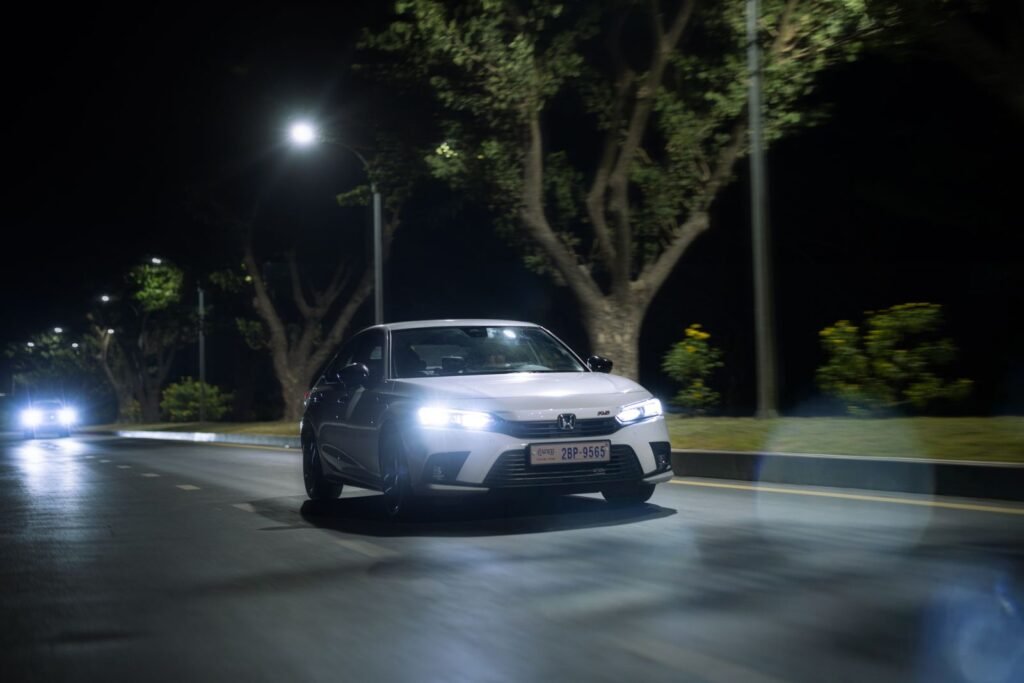
The eleventh generation Civic is the car that finally made the Civic feel grown up without losing the fun that made it famous. Revealed as a prototype in November 2020 and on sale in North America from June 2021 as a 2022 model year car, the FE generation arrived with cleaner styling, a longer wheelbase, a much better cabin and, from 2025, a hybrid that is the most powerful non Type R Civic ever built. It keeps the fuel economy, resale value and reliability that sell hundreds of thousands of Civics every year.
So who does it suit? Commuters who want a car that sips fuel and asks for nothing, and first time buyers who want modern safety kit without a premium price. Drivers who still want a manual gearbox can choose the Si, the only manual car in the regular range besides the Type R. Our Honda Civic model guide compares every generation side by side.
This page covers the eleventh generation Civic from 2022 to the present: the engines, the gearboxes, the documented recalls and problems, which years to buy used, and what the car costs to run.
Honda Civic 2022 to present at a glance
| Item | Details |
|---|---|
| Generation and years sold | Eleventh generation, FE sedan and FL hatchback. Produced since 2021, on sale in North America as a 2022 model year car, still in production today. |
| Body styles | 4 door sedan and 5 door hatchback liftback in the United States. No coupe in this generation, the first Civic since the second generation without one. |
| Main engines | 2.0 litre petrol with 158 hp at launch, later 150 hp on regular 2025 cars. 1.5 litre turbo with 180 hp at launch, Si with 200 hp. 2.0 litre hybrid with 200 hp combined from the 2025 model year. |
| Gearboxes | CVT standard on most cars, 6 speed manual on Si and on some hatchback trims, eCVT style hybrid transmission on hybrid cars. |
| Drive | Front wheel drive only. |
| Seats | 5 |
| Boot space | Sedan about 14.8 cubic feet, hatchback about 24.5 cubic feet behind the rear seats. Check the exact car you buy, because trim choices change the figure slightly. |
| Safety kit | Honda Sensing is standard: collision mitigation braking, road departure mitigation, adaptive cruise control and lane keeping assist, with an updated suite from the 2025 facelift. |
| Fuel economy highlights | Hybrid cars return up to about 50 mpg city in EPA estimates. Regular 2.0 cars return about 33 mpg combined, turbo cars slightly less in spirited driving. |
Engines and specs that matter
The 2.0 litre engine is the one to get if you are buying on price. At launch it made 158 hp with 138 lb ft of torque, paired with a CVT, and on regular 2025 cars it is rated at 150 hp with 133 lb ft in Atkinson cycle form. It is simple, smooth and proven, and it suits buyers who drive gently and value purchase price over performance.
The 1.5 litre turbo is the smart buy on launch cars. It made 180 hp with 180 lb ft of torque, paired with a CVT on EX and Touring cars, and it feels much livelier than the 2.0, especially at motorway speeds and on hills. Check the oil change history carefully, because turbo engines reward fresh oil more than naturally aspirated engines. Our guide to how often to change your oil explains the service habit that keeps these engines healthy.
The hybrid is the hero of the range from 2025. It pairs a 2.0 litre Atkinson cycle engine with two electric motors for 200 hp combined and 232 lb ft of torque, with up to about 50 mpg city in EPA estimates, and it is available as a sedan and a hatchback in Sport and Sport Touring trims. Buy the hybrid if you do mixed or town driving, because the fuel saving pays back quickly and the hybrid holds its value best.
The Si is the enthusiast pick. It uses a 1.5 litre turbo with 200 hp and 190 lb ft of torque, paired only with a 6 speed manual, with stiffer suspension and firmer dampers. Buy the Si only with a manual gearbox in mind, because there is no automatic Si, and check the clutch and tyre history on any used Si.
Which engine suits you? Do mostly town driving and want the lowest fuel bills, take the hybrid from 2025. Want the liveliest launch car without hybrid prices, take a 1.5 turbo EX or Touring. Want a manual gearbox and real fun, take the Si.
Common problems of this generation
This is a reliable car with a short list of documented issues, every one of them checkable before you buy. Recalls are the headline, so run the VIN through the Honda recall checker on any car you consider, especially a 2022 to 2025 car.
Steering gearbox recall on 2022 to 2025 cars
Honda recalled about 1.7 million Honda and Acura vehicles in the United States, including 2022 to 2025 Civic sedans and hatchbacks, for a defective steering gearbox component. An improperly produced steering gearbox worm wheel could swell during use, reducing the grease film between the worm wheel and worm gear, increasing steering effort and making steering feel sticky or difficult. Honda replaces the part free of charge. On any 2022 to 2025 car, confirm with the VIN that this recall is closed, and test the steering through its full range at low speed, feeling for stickiness or notchiness.
Fuel pump module recall expansion
Certain 2022 Civic cars were included in a fuel pump module recall expansion, where the fuel pump inside the tank could fail and stall the engine. Dealers replace the fuel pump module free of charge. Confirm it is closed by VIN before money changes hands.
CVT fluid, brakes and tyre wear
The smaller issues cluster around servicing. The CVT needs its fluid serviced at the interval Honda specifies for your driving pattern, and a car with missed CVT services is a car to price with a full service included. Hybrid rear brake discs can corrode if the car is used gently, because regenerative braking barely uses the friction brakes, so look at the rear discs on any hybrid. Our guide on brake pad replacement cost shows what that common job typically involves.
Infotainment and driver assistance glitches
Early cars had occasional infotainment glitches, mostly sorted by software updates, so test the touchscreen, phone pairing, reversing camera and every Honda Sensing feature thoroughly on your test drive.
Should you buy this generation
This Civic suits reliability first buyers who want modern tech. If you want a car that starts every morning and costs little to run, the eleventh generation Civic is one of the strongest used buys in the class. Commuters doing big miles should look hard at the hybrid from 2025.
Who should skip it? If you need all wheel drive, Honda does not offer it on this Civic in the United States. If your budget only stretches to the earliest cars, 2022 models carry the steering and fuel pump recall history, which demands the VIN check described above.
The good buys are the 2023 and newer cars, with the hybrid from 2025 as the cleanest modern pick. A 2025 hybrid is the economy pick, and a 2022 to 2024 Si with a manual is the enthusiast pick. Years to be careful with are 2022 cars, where you must verify the recalls are closed.
Whatever the year, run through this checklist before you hand over money:
- Run the VIN through the Honda recall checker and confirm the steering gearbox and fuel pump recalls are closed.
- Check the engine oil level yourself and ask the seller directly if the car uses oil between services.
- On a turbo car, ask for full oil change history and check for service gaps.
- On a hybrid, ask for a battery health check printout from a Honda dealer and test the 12 volt battery.
- Test the steering through its full range at low speed for stickiness or notchiness.
- Look at the rear brake discs for heavy corrosion, a common hybrid issue.
- Test every screen, camera and Honda Sensing feature before you buy.
- Insist on full service records; a car with missing history is not worth the small saving.
Running and repair costs
Cheap running costs are the main reason people buy this car. Parts are everywhere, and the hybrid system needs no more servicing than petrol cars in normal use. Typical US prices look like this:
| Job | Typical cost in US dollars |
|---|---|
| Front brake pads, fitted | 150 to 300 |
| Four tyres, fitted | 500 to 900 |
| 12 volt battery, fitted | 150 to 250 |
| Major service at an independent garage | 300 to 600 |
| CVT fluid service at a specialist | Ask for a quote before you buy, because prices vary by shop and fluid |
The hybrid adds almost nothing to the servicing bill in normal use. Verify the recalls are closed.
Questions and answers
Is the 2022 to present Honda Civic reliable?
Yes. The engines, gearboxes and hybrid system have strong records, and 2023 and newer cars are among the most dependable compacts on sale. The weak points are specific and avoidable: the steering gearbox recall on 2022 to 2025 cars, the fuel pump recall on some 2022 cars, and minor electrical niggles on early builds. Buy the right year with the recalls closed and it is superb.
Should I buy the Civic hybrid or the 1.5 turbo?
Buy the hybrid if most of your driving is in town or mixed, because it is quicker, quieter and much more economical in town, and it holds its value better. Buy the 1.5 turbo if you want a launch year car with strong motorway pace and do not want hybrid prices, because it is still superb on long runs.
What is the Civic steering gearbox recall?
It is a safety recall covering about 1.7 million Honda and Acura vehicles in the United States, including 2022 to 2025 Civic sedans and hatchbacks, where an improperly produced steering gearbox worm wheel could swell and increase steering effort. Honda replaces the part free of charge. If you are considering a 2022 to 2025 car, run the VIN through the Honda recall checker and confirm the work is done before you buy.
Which is the best Civic eleventh generation year to buy used?
A 2025 hybrid is the cleanest modern buy: the most powerful non Type R Civic, with up to about 50 mpg city and the updated Honda Sensing suite. The Si is the pick for drivers who want a manual, and a 2023 or 2024 turbo car is the pick for value. A 2022 car can still be a fine buy at the right price, but only with written proof that both recalls are closed.