
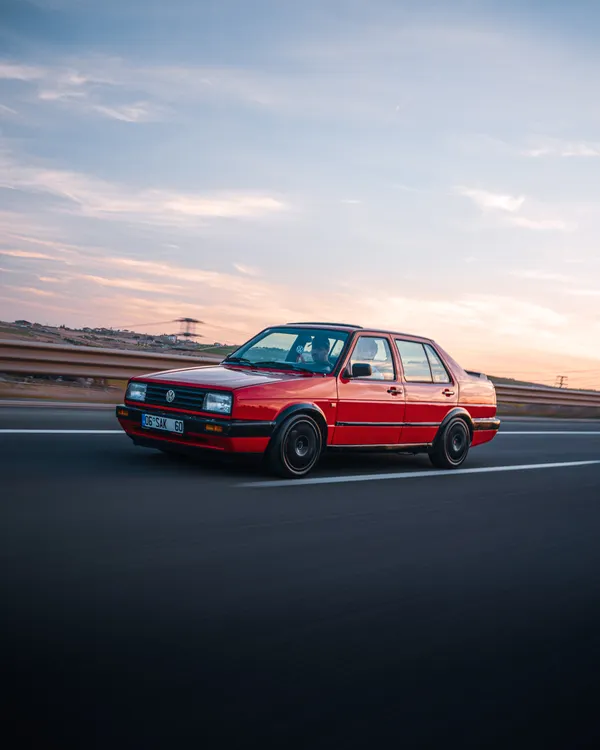
The Volkswagen Jetta is the sedan for buyers who want Golf engineering with a proper boot. On sale since 1979, it has grown from a small three box sedan into a full size feeling compact car, and every generation has sold on the same promise: solid German build, sensible running costs, and engines that suit both commuters and enthusiasts.
So who does it suit? Commuters who want a comfortable sedan with a big boot and low fuel bills. Used buyers who want one of the deepest pools of second hand stock in the class. Drivers who like a diesel for long miles or a turbo petrol with real pace. This page covers every generation in one place: the dimensions that show how much the car grew, the engines worth having, real fuel consumption figures, and which generation to buy.
One thing to know before you read on: the Jetta has been sold under other names in other markets, including Bora, Vento and Sagitar, but the cars underneath are the same generations. This page uses the Mk numbers, which are unambiguous.
Volkswagen Jetta at a glance
The quick facts first. The Jetta has always been a sedan first, so if you need a hatchback, look at the Golf instead.
| Item | Details |
|---|---|
| Generations and years | Mk1 to Mk7, on sale since 1979 and still in production today |
| Body style | 4 door sedan in every generation, plus a wagon in the Mk4 and Mk5 years |
| Main engines | Four cylinder petrols from 1.1 to 2.5 litres, VR6 and five cylinder engines in older cars, and TDI diesels from the Mk4 onward. The current car uses 1.4 and 1.5 litre turbo petrols, plus a 2.0 litre in the GLI. |
| Gearboxes | Manuals from 4 to 6 speeds depending on generation, plus conventional automatics and DSG twin clutch gearboxes from the Mk5 onward |
| Drive | Front wheel drive in every generation, with four wheel drive offered on some early cars |
| Seats | 5 |
| Fuel tank | 55 litres in recent generations |
| Boot space | About 470 litres in the Mk2, rising to about 510 litres in recent cars |
Generations and dimensions
The Jetta grew in every direction over 45 years. Length rose from 4,270 mm in the Mk1 to 4,702 mm in the Mk7, and the wheelbase stretched from 2,400 mm to 2,686 mm. That growth is the whole story of the car: each generation added rear legroom and boot space, which is why a late Jetta feels like a class above an early one.
| Generation | Years | Wheelbase | Length | Width | Height |
|---|---|---|---|---|---|
| Mk1 | 1979 to 1984 | 2,400 mm | 4,270 mm | 1,600 mm | 1,410 mm |
| Mk2 | 1984 to 1992 | 2,470 mm | 4,346 to 4,385 mm | 1,680 mm | 1,410 mm |
| Mk3 | 1992 to 1999 | 2,515 mm | 4,409 mm | 1,735 mm | 1,485 mm |
| Mk4 | 1999 to 2005 | 2,510 mm | 4,380 mm | 1,730 mm | 1,440 mm |
| Mk5 | 2005 to 2010 | 2,580 mm | 4,554 mm | 1,781 mm | 1,460 mm |
| Mk6 | 2010 to 2018 | 2,650 mm | 4,628 to 4,644 mm | 1,778 mm | 1,453 to 1,482 mm |
| Mk7 | 2018 to present | 2,686 mm | 4,702 mm | 1,799 mm | 1,459 mm |
What does this mean when you shop? If rear legroom matters, skip the Mk1 to Mk3 cars and start at the Mk5, because the wheelbase jump from 2,510 mm to 2,580 mm is where the back seat becomes genuinely adult sized. If you park in tight streets, the Mk4 is the sweet spot: nearly as roomy as the Mk5 but 174 mm shorter. And if you carry tall passengers often, the Mk7 is the one to buy, with the longest wheelbase of any Jetta ever made.
Engines that matter
The early cars were simple. The Mk1 ran 1.1 to 1.8 litre petrols plus a 1.6 diesel, and the Mk2 stretched that range to a 2.0 litre petrol. These engines are honest and easy to fix, but they are slow by modern standards, so buy an early Jetta for character, not pace.
The Mk4 is where the range gets interesting. Alongside 1.4 to 2.0 litre petrols it offered the 1.8 litre turbo, the VR6 engines, and the 1.9 litre TDI diesel that made the Jetta a long distance legend. If you want a classic Jetta with real performance, the 1.8 turbo is the engine to hunt for. If you want cheap long miles, the 1.9 TDI is the one, and it remains one of the most durable diesels Volkswagen ever built.
The Mk5 modernised everything. The petrol range ran from a 1.4 litre TSI to a 2.5 litre five cylinder, and the diesels moved to common rail TDI engines from 1.6 to 2.0 litres. The 1.4 TSI is the clever buy here: strong mid range pull with small engine fuel bills. The 2.5 five cylinder is the smooth, simple choice if you dislike turbos, but it drinks more.
The Mk6 gave buyers the widest choice of any Jetta. Petrols from 1.2 to 2.5 litres, including the 1.4 TSI, the 1.8 TSI and the 2.0 TSI, plus 1.6 and 2.0 TDI diesels and even a 1.4 TSI hybrid. The 2.0 TDI with 150 hp is the standout for high mileage drivers, and the 1.8 TSI with 170 hp is the pick for drivers who want pace without GLI prices. The Mk7 simplified the range again around 1.4 and 1.5 litre turbo petrols, with the 2.0 litre reserved for the GLI, which is the right call for most buyers because the small turbos do the job.
Gearboxes deserve a mention because they change the ownership experience. Early cars used 4 and 5 speed manuals plus simple automatics. The Mk5 introduced DSG twin clutch gearboxes alongside 5 and 6 speed manuals, and the Mk6 and Mk7 kept that pattern. A DSG car feels quicker and more modern, but it needs its fluid and filter service on schedule, and our guide on how often to change transmission fluid explains why that service history matters so much. On any DSG car you consider, ask for proof the gearbox service was done, and walk away if the seller cannot show it.
Fuel consumption and performance
Real figures beat brochure claims, so here are documented consumption and performance numbers for representative Jetta trims. Use them to compare engines, not as a promise for your exact car, because driving style and condition move the numbers.
| Trim | Combined consumption | 0 to 100 km/h | Top speed |
|---|---|---|---|
| 1994 Jetta III 1.8, 90 hp | 7.8 litres per 100 km | 12.5 seconds | 180 km/h |
| 2006 Jetta V 1.4 TSI, 140 hp, DSG | 6.4 litres per 100 km | 9.8 seconds | 220 km/h |
| 2007 Jetta V 1.4 TSI, 122 hp, DSG | 6.3 litres per 100 km | 9.8 seconds | 199 km/h |
| 2014 Jetta VI 2.0 TDI, 150 hp | 4.2 litres per 100 km | 8.9 seconds | 220 km/h |
| 2014 Jetta VI 1.8 TSI, 170 hp | 8.1 to 8.4 litres per 100 km | Not listed for this trim | Not listed for this trim |
The lesson in that table is simple. The diesel is the economy king: the 2.0 TDI uses roughly half the fuel of the 1.8 TSI while matching it for pace. The 1.4 TSI is the balanced choice, giving near diesel economy on a run with petrol simplicity. And the old 1.8 is honest but thirsty, so buy it for charm, not for fuel bills.
What should you check on a test drive? Drive the car cold from the start and watch the temperature gauge settle, because cooling faults show up early. Feel for smooth DSG shifts with no jerking at low speed. Listen for timing chain rattle on start up in the TSI cars. And if the car has a temperature warning or the heater blows cold at idle, take it seriously, because that is classic cooling system territory and our guide to why a car overheats covers what to look for.
Which Volkswagen Jetta should you buy
On a tight budget, look at a Mk5 1.4 TSI or a Mk6 2.0 TDI. The Mk5 gives you modern size and the clever small turbo engine at the lowest prices, while the Mk6 TDI is the car for drivers who cover big miles and want the lowest fuel bills in the class.
In the middle ground, a 2014 to 2018 Mk6 is the best all round used Jetta. You get the roomiest cabin before the current car, the widest engine choice, and prices that have already done most of their falling. Pick the 1.4 TSI for balanced costs, the 2.0 TDI for motorway miles, or the 1.8 TSI if you want pace.
If the budget stretches to a nearly new car, the Mk7 1.5 TSI is the default right answer. It is the biggest, quietest and safest Jetta ever made, with the longest wheelbase and the most modern safety kit. Drivers who want real performance should look at the GLI with the 2.0 litre engine instead.
Years to be careful with are the very early cars if you need modern safety kit, and any DSG car without a gearbox service record. The late cars of each generation are always the safer buy, because Volkswagen fixed the early faults by then.
Whatever the generation, run through this checklist before you hand over money:
- Ask for proof of the DSG fluid and filter service on any twin clutch car.
- Listen for timing chain rattle on cold start in the TSI cars.
- Check the coolant level and the temperature gauge behaviour on a cold start drive.
- On a TDI, ask about diesel particulate filter warnings and short trip history.
- Check every recall is closed by running the VIN through the Volkswagen recall checker.
- Look at all four tyres for uneven wear, which points at alignment or suspension wear.
- Test every electric item, because window regulators and central locking faults are common on older cars.
Running and repair costs
Running costs are the main reason people buy this car, but they vary sharply by engine, so budget by the car you actually buy, not by the badge. Parts are sold everywhere and every independent garage knows these engines. Our breakdown of brake pad replacement cost shows what one of the most common jobs involves.
Petrol cars are the cheapest to keep. Servicing is straightforward, parts are cheap, and there is no diesel particulate filter to worry about. Diesel cars reward high mileage drivers with much lower fuel bills, but they punish short trip use: a TDI that only does town runs will clog its filter, and that repair wipes out the fuel savings. DSG cars add one cost the manual cars never have, the scheduled gearbox service, so confirm it in the history before you buy.
The expensive faults to avoid are all checkable before purchase. A DSG without service history can need a new mechatronic unit. A TSI with a rattling chain can need a chain replacement. A TDI with filter warnings can need a new filter. Every one of these shows up in the checks above, which is why the checklist matters more than the price haggling.
Questions and answers
What is the best Volkswagen Jetta generation to buy used?
For value, a 2014 to 2018 Mk6 is the consensus pick: roomy, wide engine choice, and prices that have already fallen. For the lowest fuel bills, the Mk6 2.0 TDI is unbeatable. For a nearly new car, the Mk7 1.5 TSI is the best Jetta ever made for everyday use.
Is the Volkswagen Jetta reliable?
Yes, with the right history. The 1.9 TDI, the 2.0 TDI and the 1.4 TSI all have strong records when serviced on schedule. The weak points are specific and avoidable: DSG cars without gearbox service history, TSI cars with timing chain rattle, and TDI cars used only for short trips. Buy the right car with records and it is superb.
Which Jetta engine gives the best fuel economy?
The 2.0 TDI diesel, by a clear margin. The documented 2014 2.0 TDI with 150 hp returns 4.2 litres per 100 km combined, roughly half the consumption of the 1.8 TSI petrol. If you do not cover high miles, the 1.4 TSI is the smarter buy, because it gives near diesel economy on a run without any diesel filter worries.
Should I buy a Jetta with a DSG gearbox?
Yes, if the service history proves the fluid and filter changes were done on schedule. A serviced DSG is smooth, quick and durable. A DSG without that history is a gamble, because mechatronic faults are expensive. If the seller cannot show the gearbox service, either negotiate the price down to cover it or buy a manual instead.