
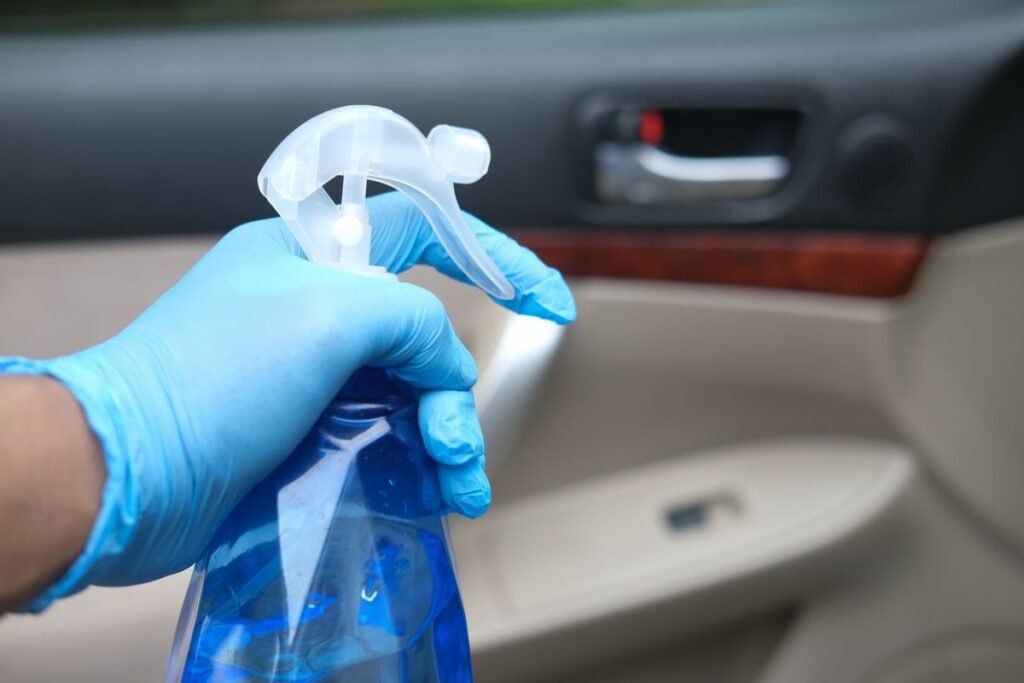
The reliable way to remove bad smells from a car is to find the source, clean it properly, and only then deal with the odor left in the fabrics. Air freshener alone never works for long, because it only masks the smell while the cause keeps producing it. Whether your car smells of smoke, spilled milk, mildew or old food, this guide on how to remove bad smells walks through the steps in the right order.
Step one: find where the smell actually lives
Odors cling to soft surfaces and hide in forgotten corners. Before you buy a single product, empty the car completely and hunt for the source:
- Check under every seat for old food, bottles and forgotten gym clothes
- Lift the floor mats and feel the carpet for damp patches
- Open the trunk and check the spare wheel well for standing water
- Sniff the air vents with the fan running, since mildew often grows in the air conditioning system
- Look for stains on the seats and headliner, which hold smells for months
One warning belongs here. A fuel smell is not a cleaning problem at all. If your car has a petrol or gasoline odor, read our guide on why your car smells like gas and have it checked, because fuel vapors point to a leak that needs a mechanic, not a deodorizer.
Step two: deep clean the hard and soft surfaces
Vacuum everything first, including under the seats, in the seams and in the trunk, using a brush attachment to lift ground in dirt. Then wash hard surfaces like the dashboard, door cards and console with a mild all purpose cleaner. For fabric seats and carpets, a carpet or upholstery cleaner worked in with a soft brush lifts the grime that carries odor. Leather seats should be cleaned with a proper leather cleaner and then conditioned, since household sprays can dry leather out.
Baking soda is the cheapest serious tool in this job. Sprinkle it generously over carpets and fabric seats, leave it for several hours or overnight, then vacuum it up thoroughly. It absorbs odor instead of covering it, and it costs almost nothing.
Step three: deal with the air conditioning smell
That sour, locker room smell when the fan starts usually comes from mildew and bacteria on the air conditioner evaporator. Fixes include:
- Replace the cabin air filter, which is cheap, often behind the glovebox, and frequently overdue
- Use an air conditioning cleaner spray that is applied through the vents or the evaporator drain
- Run the fan on high with the air conditioning off for the last minute of each drive, which dries the system and discourages new growth
How to get cigarette smell out of car interiors
Smoke is the toughest common odor because tar and nicotine settle into every surface, including the headliner and the inside of the vents. Owners asking how to get cigarette smell out of car cabins need a full routine, not a single product:
- Wash every hard surface, including the glass, since smoke film coats the windows
- Shampoo the seats, carpets and headliner, and vacuum with baking soda left overnight
- Wipe the seat belts fully extended, an easily missed smoke trap
- Replace the cabin air filter, no exceptions
- Leave bowls of white vinegar or activated charcoal in the closed car overnight to absorb what remains
- Repeat the baking soda and charcoal steps over a week rather than expecting one pass to finish it
An ozone generator treatment, offered by many detailers for roughly $75 to $200, is the heavy option and genuinely works on smoke. Ozone must be used with care: the car has to air out completely afterwards, and nobody should sit inside during treatment.
Common smells and their best fixes
| Smell | Likely source | Best fix |
|---|---|---|
| Cigarette smoke | Tar in fabrics, vents and headliner | Full deep clean, new cabin filter, ozone treatment |
| Mildew and damp | Water leak, wet carpet, air conditioning | Dry the car fully, fix the leak, clean the system |
| Sour milk or food | Spill soaked into seat foam | Enzyme cleaner, repeated applications |
| Pet odor | Hair and oils in fabric | Deep vacuum, upholstery shampoo, enzyme cleaner |
| Stale, stuffy air | Dirty cabin filter, closed car | New filter, interior clean, regular airing |
Enzyme cleaners deserve a special mention for organic spills like milk, food and pet accidents. They break down the proteins causing the smell rather than masking them, and they often need a second application a day later.
Once the car smells clean again, our companion guide on how to freshen car interior covers keeping it that way with simple weekly habits.
What not to do
- Do not rely on strong air fresheners over a dirty interior, the mix smells worse
- Do not soak fabrics with water and close the car, which grows mildew fast
- Do not use bleach or harsh chemicals on upholstery, which stains and weakens fabric
- Do not ignore a damp carpet: find the water leak or the smell always returns
Frequently asked questions
How long does it take to get a smell out of a car?
A simple stale smell can be gone in an afternoon of cleaning. Smoke and mildew usually take several sessions across a week, because odor trapped deep in seat foam and vents fades gradually as you repeat the absorb and clean steps.
Does baking soda really remove car odors?
Yes, for surface odors it works well because it absorbs odor molecules instead of masking them. It needs contact time, ideally several hours or overnight, and a thorough vacuum afterwards. Deep soaked in smells still need cleaning first.
When should I pay a professional detailer?
If you have cleaned thoroughly twice and the smell survives, a detailer brings extraction machines and ozone treatment that home tools cannot match. Interior deep cleans typically run from $100 to $300, and prices vary by car model and region.
Every bad car smell has a source, and every source can be cleaned. Work in order, source first, surfaces second, air last, and your car will smell like a car again instead of a memory of everything it has carried.