
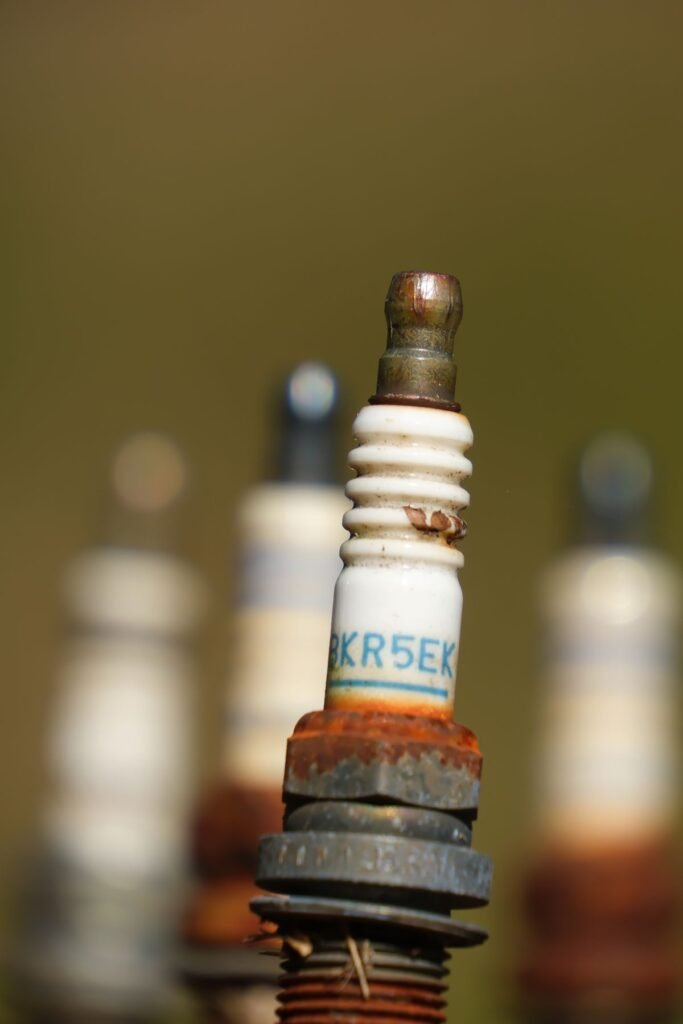
Rough idling, hard starting, misfires, and worse fuel economy often point to the same small part: worn spark plugs. The short answer: spark plug replacement at a shop usually costs $288 to $399 in total, based on RepairPal national estimates, with parts at $104 to $129 and labour at $184 to $270. Simpler four cylinder cars can cost less, while V6 and V8 engines with hard to reach rear plugs can cost more. Your first decision is whether your car is due by mileage and plug type, or whether a misfire code points to a coil or another fault instead, because replacing plugs will not fix a failing coil.
A spark plug creates the spark that ignites the fuel and air mixture in each cylinder. Over thousands of miles, the electrodes wear, the gap widens, and the spark weakens. A weak spark means incomplete combustion, which shows up as a rough idle, hesitation under acceleration, and fuel that is burned less efficiently. That is why spark plugs are a scheduled maintenance item, not a fix only when the car breaks down.
When to replace spark plugs
Check your owner manual first, because intervals vary by car and plug type. As a general guide, traditional copper plugs last around 30,000 miles, platinum plugs last around 60,000 miles, and iridium plugs last 60,000 to 100,000 miles or more. Your action: if your car is near or past its interval, replace the plugs even if it still runs acceptably. Worn plugs stress the ignition coils, and a failed coil costs more than a set of plugs.
Watch for symptoms too. Misfires, a flashing check engine light, rough running at idle, trouble starting when cold, and a noticeable drop in fuel economy are all reasons to get the plugs checked promptly. A flashing check engine light means an active misfire that can damage the catalytic converter, so your action in that case is to drive gently to a shop at once, or stop and arrange a tow if the car runs very badly.
Average costs at a glance
| Job | Parts | Labour | Typical total |
|---|---|---|---|
| National estimate, most cars | $104 to $129 | $184 to $270 | $288 to $399 |
| Four cylinder, easy access | $80 to $120 | $70 to $130 | $150 to $250 |
| V6, some rear plugs hard to reach | $100 to $180 | $200 to $350 | $350 to $500 plus |
| V8, eight plugs or more | $120 to $240 | $230 to $360 | $350 to $600 |
| DIY, parts only | $30 to $150 | Your time | $30 to $150 |
Your action: when you compare quotes, ask whether the quote includes removing intake covers or an intake plenum to reach rear plugs, and whether new boots or seals are included if your car uses coil on plug ignition. A quote that leaves those out can grow once the work starts.
Plug types and what they mean for your wallet
Copper plugs
Copper plugs are the cheapest per plug, often $3 to $5 each, and they give a strong spark, but they wear fastest and last around 20,000 to 30,000 miles. Your action: choose copper only if your car maker specifies copper, or if you accept more frequent changes. For most modern cars, copper is a false saving because you pay labour again sooner.
Platinum plugs
Platinum plugs cost around $6 to $10 each, resist erosion better than copper, and typically last around 60,000 miles. Your action: platinum is a solid middle choice for many daily drivers, especially when the maker lists platinum as the original specification. Do not downgrade a car built for platinum or iridium to copper without checking the manual.
Iridium plugs
Iridium plugs cost around $8 to $30 each, last 100,000 miles or more in many cars, and suit modern direct injection engines and high performance engines. Your action: if your car came with iridium plugs, replace like with like. The higher part price is repaid by a longer interval and steadier ignition over time. For plug material detail, read our guide on iridium spark plugs before you choose a cheaper alternative.
Why the price varies so much
Access is the biggest factor. On many four cylinder engines, the plugs sit on top of the engine and the job takes under an hour. On many V6 engines, the rear plugs sit against the firewall, and the shop may need to remove intake parts to reach them, which adds labour time and cost. Your action: ask how many labour hours the quote allows, not just the total. Two quotes can differ by $100 for the same parts simply because one shop allows realistic access time and the other does not.
Plug count matters too. A four cylinder car needs four plugs, a V6 needs six, and a V8 needs eight, while some V8 designs use two plugs per cylinder, which doubles the part count. Labour rates also vary by city and by shop type, with dealers usually highest, independents in the middle, and small local shops often lowest. Your action: get two or three quotes for a V6 or V8 job, and favour a shop that has done your engine type before over the cheapest quote from a shop that rarely does that job.
Signs your spark plugs are worn
Learn the signs so you can act before a misfire damages other parts. For a full symptom checklist, read our guide on signs of bad spark plugs and compare what you are feeling with the list there. Your action: if you notice two or more of these signs, book the job rather than waiting for the next service. Rough idle, hesitation, hard starting, higher fuel use, and a check engine light for a misfire code are all prompts to act, not to monitor for months.
Also check the plug condition if a shop removes one during another job. A healthy plug has a light tan or grey insulator tip. A black, oily, or heavily worn plug tells a story about oil consumption, rich running, or overdue replacement, and your action is to ask the shop to explain what the old plugs show before they fit new ones.
DIY or workshop
Changing spark plugs is a popular DIY job on engines with easy access, and parts alone cost $30 to $150 for a set. You need a spark plug socket, a torque wrench, and the correct gap specification, and you must work on a cold engine. Your action: only DIY if you can reach every plug without forcing tools, you know the correct torque, and you can avoid dropping a plug or cross threading it. A dropped iridium plug can suffer hidden damage, and a cross threaded plug can damage the cylinder head.
Leave the job to a shop if rear plugs need intake removal, if a plug feels seized, or if you have a misfire code that has not been diagnosed. A seized plug can break in the head, and that turns a routine job into a costly extraction. Your action: if a plug will not turn with sensible force, stop and let a shop handle it with the right penetrating treatment and tools.
Should you replace coils at the same time
Not automatically. Coils sit on top of the plugs on many modern cars, and a failing coil causes a misfire on one cylinder. Your action: replace only the coil that tests bad, unless your car has very high mileage and several coils are already failing. Replacing all coils as a precaution adds hundreds of dollars for parts that may still have years of life left. Ask the shop to show you the misfire code and the coil test result before you approve coil work.
Frequently asked questions
Should I replace all spark plugs at once
Yes. Plugs wear at a similar rate, and replacing them as a set keeps combustion even across all cylinders. Your action: replace the full set in one visit, even if only one plug looks bad, because the others are close behind it.
Will new spark plugs improve fuel economy
They can, if the old plugs were worn. Fresh plugs restore a strong, well timed spark, which helps complete combustion. Your action: do not expect a dramatic saving from new plugs on a car whose plugs were still healthy. The real saving is avoiding misfires, coil damage, and catalytic converter damage.
Can I drive with a misfiring spark plug
Only gently and briefly to a shop, and not at all if the check engine light is flashing or the car shakes badly. A misfire sends unburned fuel into the exhaust, which can overheat and damage the catalytic converter. Your action: reduce speed, avoid hard acceleration, and get the car checked the same day.
Spark plugs are small, cheap parts with an outsized effect on how your car runs. Replace them on the maker interval, use the plug type your engine was built for, replace the full set at once, and get a misfire checked the same day. Done that way, a spark plug job stays a routine maintenance bill, not the start of a coil and converter repair.
Pingback: Car Jerks When Accelerating: Causes, Checks and What to Fix First
Pingback: Rough Idle: Causes, Checks and What to Fix First