
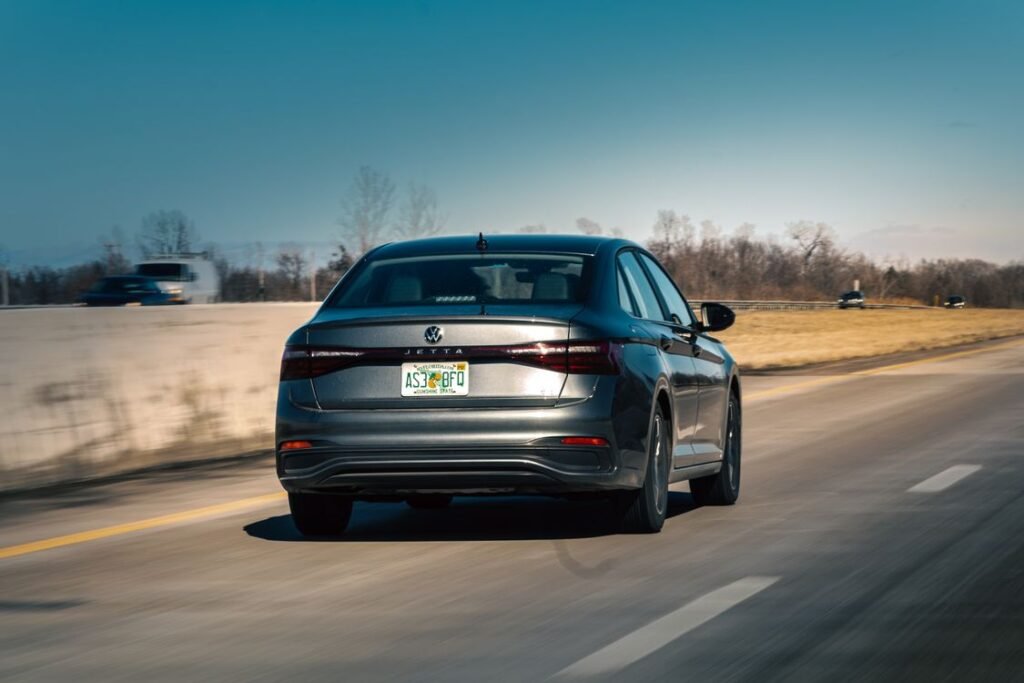
The Volkswagen Jetta is a compact sedan that started life as a Golf with a trunk, and that simple idea still sums it up today. You get a car that feels solid and grown up on the highway, a back seat that adults can use, and a trunk that swallows family luggage without a fight. In the US it has been a steady seller for decades because it offers a European feel at a price that undercuts most European badges.
It suits commuters, small families and anyone who covers long highway miles in a small car. If you want a hatchback, buy the Golf. If you want a sedan that feels a class above its price, the Jetta is the one to look at.
As a used buy it is often the value pick among compact sedans. A Jetta of the same age and mileage as a Honda Civic or Toyota Corolla usually costs less to buy, yet it gives you strong turbo torque and a roomy cabin. The catch is that the engine and the year matter a lot, and this page explains which ones to pick.
One naming note before we start. The Jetta name is used differently in other markets. In China the current car is sold as the Volkswagen Sagitar, in parts of South America it is called the Vento, and in China the Jetta name has even become a brand of its own. Everything below is about the US market car.
Volkswagen Jetta at a glance
The short version first, covering the cars most buyers will actually meet.
| Item | Details |
|---|---|
| Generations and years sold in the US | Seven generations in total. The cars covered here are the A4 from 1999 to 2005, the A5 from 2005 to 2010, the A6 from 2011 to 2018 and the A7 from 2019 to present |
| Body styles | Four door sedan. A wagon was also offered on the A4 car in the early 2000s |
| Main engines | 2.0 petrol, 2.5 five cylinder petrol, 1.8 and 2.0 turbo petrol, 1.4 and 1.5 turbo petrol, 2.0 TDI diesel to 2015, and the 2.0 turbo petrol in the GLI |
| Gearboxes | Five and six speed manual, six and eight speed automatic, and a dual clutch automatic on the GLI and some earlier turbo cars |
| Drive | Front wheel drive on every US car |
| Seats | Five |
| Boot space | Large for a compact sedan. The A6 boot is the biggest of the recent cars and the A7 boot is a little smaller, but both take family luggage with ease |
Generations explained
Four generations matter if you are shopping today, and they feel quite different from behind the wheel.
| Generation | Years | What changed |
|---|---|---|
| A4 | 1999 to 2005 | Rounder styling, plus 1.8T and VR6 petrol options, a TDI diesel and a wagon version |
| A5 | 2005 to 2010 | Bigger and more upmarket, with a multi link rear suspension and the 2.5 five cylinder as the main engine |
| A6 | 2011 to 2018 | Built to a lower price for North America, with a larger back seat and turbo engines taking over late in the run |
| A7 | 2019 to present | Moves to the MQB platform, with one small turbo engine for the standard car and the Golf GTI engine in the GLI |
The A6 car, sold from 2011 to 2018, was designed for North America first. It is no longer a Golf with a trunk, as it has its own larger body, and it is built in Puebla, Mexico. Volkswagen simplified the cabin and the rear suspension on early cars to hit that price, so base models feel plainer than the A5 before them. The trade is space, as rear legroom is generous. The 2.5 five cylinder carried over at first, then a 1.8 turbo petrol replaced it in most trims for 2014, and the independent rear suspension came back at the same time. A facelift followed in 2015, and a 1.4 turbo petrol became the base engine for 2016.
The A7 car arrived for 2019 on the MQB platform and is still the current model. It is larger again, with a calmer ride and a much newer cabin. The only standard engine at launch was the 1.4 turbo petrol. A facelift for 2022 brought the 1.5 turbo petrol, and a second refresh for 2025 added sharper styling and standard driver assistance kit. From 2025 the manual gearbox left the standard car, and only the GLI kept it.
Generations in detail
- Volkswagen Jetta 2011 to 2018: Specs, Problems and Costs
- Volkswagen Jetta 2019 to Present: Specs, Problems and Costs
- Volkswagen Jetta Specs: Dimensions, Engines, Fuel Consumption and Which One to Buy
Engines and specs that matter
The Jetta has worn a lot of engines, but five stories cover almost every car you will find for sale.
The 2.5 five cylinder is the old workhorse of the A5 and early A6 cars. It makes about 170 hp and pulls cleanly, with no turbo hardware to worry about. It drinks more fuel than the turbo cars and feels lazy if you rush it, but it is simple, tough and cheap to keep. For a budget used buy, this is the engine most mechanics would point you to.
The 1.4 turbo petrol took over as the main engine in the late A6 and the first A7 cars, with 147 hp in the A7. Its torque arrives early, so the car feels brisk in town and relaxed on the highway. The 1.5 turbo petrol replaced it in the 2022 facelift with 158 hp and the same easy going character. Both are the economy picks of the range, and both use a timing belt, which matters for running costs later. If you commute or cover long distances on a budget, these are your engines.
Older A6 buyers will also meet the smooth 1.8 turbo petrol that replaced the 2.5 in most trims from 2014, plus the slow 2.0 petrol in early base cars, which is best avoided unless the price is very low.
The TDI diesel chapter ran from the A4 through the A6, ending after the 2015 model year when Volkswagen stopped selling diesel cars in the US in the wake of its emissions scandal. The 2.0 TDI was loved for its torque and its calm, frugal highway running. Buy with care, check the recall and emissions fix paperwork, and know that some owners have reported high pressure fuel pump failures on these cars, which are expensive when they happen.
The GLI is the performance version. A6 GLI cars use a 2.0 turbo petrol with up to about 210 hp, and the A7 GLI uses the Golf GTI version of that engine with 228 hp, a choice of a six speed manual or a dual clutch automatic, and on the A7 a multi link rear suspension and a limited slip differential at the front. It is a proper drivers sedan that still seats five and takes a trunk load, but it costs more to buy, more to fuel and more to maintain than the standard car.
Common problems by generation
This is the section that decides whether a used Jetta is a bargain or a bill. The pattern is clear. Most serious problems belong to one engine or one gearbox, not to the whole range.
On A5 cars, the ABS control module is known for failing with age. The symptoms are an ABS warning light, a traction control light, and the loss of anti lock braking. Some owners also report tired window regulators and blocked sunroof drains, and a clogged drain can let water soak the carpets. On 2006 to 2009 cars with the early 2.0 turbo petrol, cam follower wear and timing chain trouble are the reasons these years get such a poor name, and they are best avoided.
On A6 cars with turbo engines, the water pump and thermostat housing are the known weak point. The housing is plastic, and on many 2012 to 2018 cars it warps or cracks with age. Symptoms you can spot are a falling coolant level, a sweet smell after a drive, pink crusty residue around the pump area, and a temperature gauge that starts to climb. Ignore it and the engine can overheat, so budget for this job on any turbo A6 without proof it has been done.
The 2.0 turbo petrol in the A6 GLI also carries a timing chain tensioner risk on cars from around 2008 to 2014. A worn tensioner can let the chain slip, and the result can be a wrecked engine. A rattle from the engine on a cold start is the warning sign to walk away from, unless the seller has paperwork for the updated tensioner.
Gearbox behaviour needs a careful test drive. Some owners of dual clutch cars from around 2010 to 2014 report shuddering, hesitation and hard shifts at low speed, and owners of 2012 and 2013 automatics have reported rough shifting as well. On the conventional automatic, tired fluid makes shifts worse, so it pays to learn how to check the transmission fluid before you judge a car. Any Jetta that jerks, hunts for gears or grinds on a gentle drive needs a specialist inspection before money changes hands.
The A7 has two things to check. Some owners of 2019 cars reported a grinding noise and rough shifts from the eight speed automatic, and fixes and software updates were applied to many cars, so ask for the history. Some owners of 2022 to 2024 cars also report rear brake pads wearing out early, which is cheap to fix but worth a look at the service record. Minor infotainment glitches are reported too, and those are annoying rather than serious.
Finally, a symptom that scares buyers on every generation. A slow crank or a single click when you turn the key is most often a weak battery or dirty terminals, not a dead starter motor. Work through the common reasons a car will not start in order and you will usually find a cheap cause before an expensive one.
Which Volkswagen Jetta should you buy
On a tight budget, buy an A6 with the 2.5 five cylinder from 2011 to 2014. The cabin feels plain, but the engine is the toughest in the range and the cars are cheap because buyers chase newer shapes. Service history matters more than trim, so a tidy base car with records beats a loaded car with gaps.
With a mid range budget, look at a 2016 to 2018 A6 with the 1.4 turbo, or move to an A7 from 2020 onward. The 2020 and 2021 cars skip the first year production issues of the 2019 launch cars, and they feel a full class newer than the A6. If you want the newest car your money reaches, the 2022 onward cars with the 1.5 engine are the sweet spot of the current range.
Be careful with 2006 to 2009 cars with the 2.0 turbo petrol, with any 2019 automatic that has no record of transmission work, and with any TDI that lacks its emissions recall paperwork. A cheap price on those cars is usually cheap for a reason.
Use this checklist on any used Jetta.
- Ask for full service records, with oil changes on time and the correct oil used
- Start the engine from cold and listen for a rattle on 2.0 turbo cars
- Check the coolant level and look for crusty residue near the water pump
- Drive for at least fifteen minutes and feel for shudder or jerky shifts at low speed
- Test every window, the sunroof and every warning light on the dash
- Scan the car for stored fault codes, or pay for an inspection that includes a scan
- Confirm open recalls are done, including the emissions paperwork on a TDI
- Check rear brake pad wear on 2022 to 2024 cars
Running and repair costs
A Jetta is not an expensive car to run, but it is not the cheapest either. The 1.4 and 1.5 engines use a timing belt rather than a chain, so a belt service is a planned cost as the car ages, and it is worth checking what a timing belt replacement costs before you agree a price on an older turbo car. Chain engines skip that bill, but on the 2.0 turbo the tensioner history matters instead, as the problems section explains.
| Job | Typical US cost |
|---|---|
| Front brake pads and rotors | $300 to $550 |
| Battery, supplied and fitted | $180 to $320 |
| Timing belt service on 1.4 and 1.5 cars | $700 to $1,200 |
| Water pump and thermostat housing | $800 to $1,200 |
| Major service with plugs and filters | $450 to $800 |
These are typical independent shop ranges, and prices move with your region and the parts you choose. Against the Japanese rivals, most Jetta parts cost a little more and fewer general shops know the cars well. Consumables like tires, pads and filters are close in price, so the sensible plan is to budget slightly more per year than you would for a Corolla, and to keep the difference aside for the jobs in the table.
Questions and answers
Is the Volkswagen Jetta reliable
It depends on the engine and the year more than on the badge. The 2.5 five cylinder cars and the later 1.4 turbo cars have the best record, while the early 2.0 turbo cars and the first A7 year need more care. A well maintained Jetta with records is a sound buy, and a neglected one of any year is not.
What is the best Volkswagen Jetta year to buy used
For value, a 2011 to 2014 car with the 2.5 engine is hard to beat. For a newer car, a 2020 to 2023 car with the 1.4 turbo gives you the modern cabin and safety kit without the question marks that hang over the 2019 launch year.
How much fuel does a Volkswagen Jetta use
The 1.4 and 1.5 turbo cars are the frugal ones, and most turbo models will pass 30 mpg on a highway run while still feeling strong in town. The 2.5 five cylinder uses noticeably more, the TDI uses the least on long trips, and the GLI sits at the thirsty end of the range.
Is the Volkswagen Jetta GLI worth it
Yes, if you enjoy driving. The A7 GLI gives you the Golf GTI engine with 228 hp, a manual gearbox option, stronger brakes and better suspension, yet it still works as a family sedan every day. If your driving is a calm commute, the standard car does the same job for less money to buy and less money to run.