
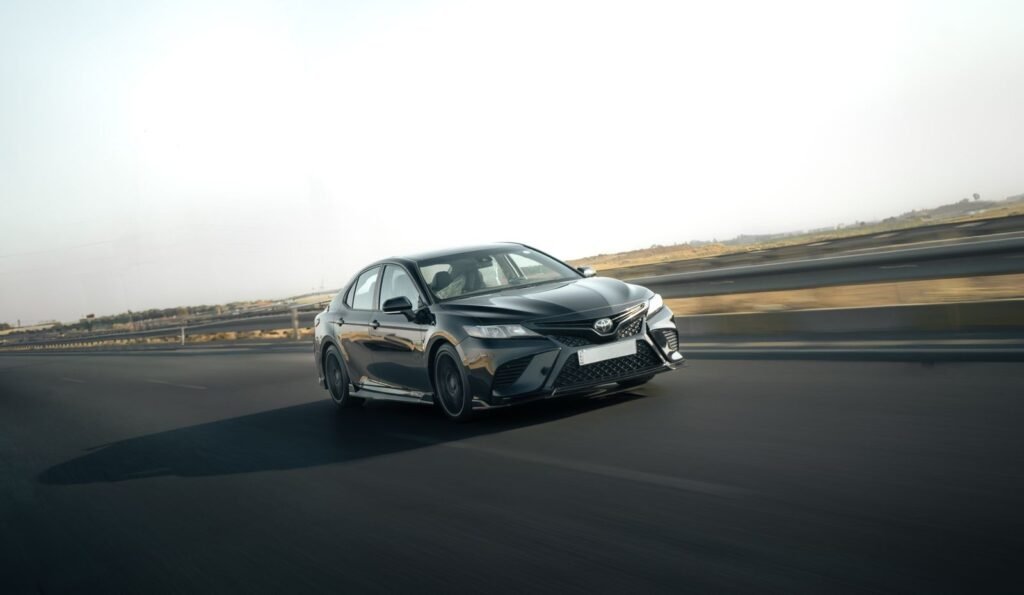
The Toyota Camry is the car for people who have better things to worry about than their car. On sale since 1982 and a best seller in America for decades, it has built its reputation the unglamorous way: by starting every morning, asking for nothing but servicing, and lasting long enough to become a family heirloom.
So who does it suit? Commuters who want a comfortable sedan with low running costs. Families who need five proper seats and a big boot without the bulk of an SUV. Used buyers who want the deepest pool of reliable second hand stock in the class.
People search for the Camry because it is always on the shortlist next to the Accord. One thing to know before you read on: sources number the generations differently, so this page uses Toyota’s XV codes, which are unambiguous. This page covers the generations from 2001 onward, the engines worth having, the problems owners actually report, the years to buy, and what the car costs to run.
Toyota Camry at a glance
The quick facts first. From 2001 onward the Camry has been a sedan only car, so if you need a wagon or a hatchback, look elsewhere.
| Item | Details |
|---|---|
| Generation count and years sold | XV30 to XV80, on sale since 2001 in this series and still in production today |
| Body styles | 4 door sedan only |
| Main engines | 2.4 and 2.5 litre four cylinders, 3.0, 3.3 and 3.5 litre V6s in older cars, and hybrid versions from 2006 onward. The current car is hybrid only in most markets. |
| Gearboxes | 4 to 8 speed automatics depending on generation, plus eCVT on the hybrids. No manual since the XV50. |
| Drive | Front wheel drive. All wheel drive returned in 2020 on the XV70, the first since the early 1990s. |
| Seats | 5 |
| Boot space range | About 490 to 525 litres in recent generations, measured to the Australian standard |
Generations explained
Five generations cover the Camry from 2001 onward. Each one has a distinct personality to buy used, because the signature faults move from one to the next.
| Generation | Years | What changed |
|---|---|---|
| XV30 | 2001 to 2006 | The early 2000s Camry. Simple 2.4 four and V6s. Watch for the head bolt thread fault on the 2.4. |
| XV40 | 2006 to 2011 | Bigger and plusher, with the first Camry hybrid and the strong 3.5 V6. The 2.4 has the famous oil consumption issue. |
| XV50 | 2011 to 2017 | The first Camry with no manual. The 2.5 four is a gem, but early cars have the torque converter shudder. The 2015 refresh is the one to buy. |
| XV70 | 2017 to 2024 | Built on the TNGA platform, sharper to drive, with the last V6 at 301 hp and all wheel drive from 2020. Early 8 speed gearbox teething. |
| XV80 | 2024 to present | Hybrid only in most markets, 225 hp front wheel drive or 232 hp all wheel drive. Too new for long term verdicts. |
The XV50 car, sold from 2011 to 2017, is the used buy most people will meet first and it is a genuinely strong one once you know which years to pick. The 2.5 litre four with 178 hp is one of Toyota’s toughest modern engines, and the 2015 refresh fixed the early torque converter shudder and sharpened the whole car. The hybrid from this generation is a brilliant used buy too, with 200 hp combined and excellent economy. This is the generation the buying guides call the sweet spot for budget buyers.
The XV70 car ran from 2017 to 2024 and is the best Camry to drive. The TNGA platform made it stiffer and lower, the 2.5 four grew to 203 hp, and the 3.5 V6 with 301 hp was the last of its kind. All wheel drive returned in 2020 for the first time since the early 1990s. The early cars from 2018 to 2019 had 8 speed gearbox software teething troubles, sorted by updates, so the late cars from 2021 to 2024 are the ones the guides recommend.
Generations in detail
- Toyota Camry 2018 to 2024: Specs, Problems and Costs
- Toyota Camry 2025 to Present: Specs, Problems and Costs
Engines and specs that matter
The four cylinder engines are the heart of the Camry story. The 2.4 litre in the XV30 and early XV40 makes 154 to 158 hp and is a calm, simple engine, but it carries the two famous faults of this era, which the problems section covers in detail. The 2.5 litre that replaced it, first with 169 to 179 hp in the late XV40 and then 178 hp in the XV50, is one of Toyota’s best engines: smooth, strong enough for the car, and famously durable. The current 2.5 in the XV70 and XV80 makes 203 to 208 hp and is the engine in most of the cars you will see. For most buyers, a 2.5 Camry is the default right answer.
The V6s are for drivers who want effortless pace. The 3.0 and 3.3 V6s in the XV30 made 190 and 210 hp, the 3.5 V6 in the XV40 and XV50 made 268 hp, and the final 3.5 in the XV70 made 301 hp. These engines pull hard and quietly, and they have strong reliability records. The trade off is fuel economy. Buy a V6 if you love the smoothness and do not mind the fuel bills; the four cylinder does the same job for less money.
The hybrids are the smart money. The XV40 hybrid paired a 2.4 four with an electric motor for 188 hp combined, the XV50 hybrid made 200 hp combined, the XV70 hybrid made 208 hp, and the current XV80 hybrid makes 225 hp with front wheel drive or 232 hp with all wheel drive. Toyota’s hybrid system is one of the most proven in the industry, and real world economy is excellent. A used Camry hybrid is one of the best value cars on the road.
Gearboxes deserve a mention because they changed a lot. The XV30 used 4 and 5 speed automatics with a manual option, the XV40 moved to 5 and 6 speed units, the XV50 used a 6 speed automatic, and the XV70 got an 8 speed. The hybrids all use the eCVT. The 6 speed in the early XV50 and the 8 speed in the early XV70 each had documented teething troubles, both sorted with later build years and software updates, which is another reason to prefer the late cars of each generation.
Which engine suits you? Want the safest used buy with the lowest running costs, take a 2015 to 2017 XV50 2.5 petrol or hybrid. Do big miles and want the best economy, the hybrid in any generation is superb. On a tight budget, a well kept 2004 to 2006 XV30 is honest cheap transport. And if a car you test drive shudders lightly under gentle throttle around town speeds, take it seriously, because that is the classic torque converter symptom and our guide on how often to change transmission fluid explains why gearbox maintenance history matters so much on these cars.
Common problems by generation
The Camry’s reputation is deserved, but it is not fault free, and the faults are specific enough that you can check for every one of them. These are the issues that come up again and again in owner reports, technical bulletins and buying guides.
XV30, 2001 to 2006
The stripped head bolt threads on the 2.4 litre engine are the fault that defines this generation. Toyota’s own technical bulletin covers 2002 to 2006 cars: the cylinder head bolt threads in the aluminium block can fail, and the fix is steel thread inserts. The symptoms are coolant loss, overheating and misfires, which is exactly the territory our guide to why a car overheats covers. On a test drive, check the coolant level is correct and ask directly whether the head bolt repair has been done. The 2002 and 2003 cars also have owner reports of transmission hesitation and rough shifting, so drive at town speeds and feel for it.
XV40, 2006 to 2011
Excessive oil consumption on the 2.4 litre engine is the headline fault here. Toyota’s bulletin covers 2007 to 2011 cars: low tension piston rings let oil into the combustion chamber, and owners report topping up every 500 to 2,000 miles. The worst years are 2007 to 2009. On any car you consider, check the oil level on the dipstick yourself and ask the seller directly whether the car uses oil between services. The same generation is widely reported for sticky, melting and cracking dashboards on 2007 to 2011 cars, for which Toyota ran a warranty enhancement.
XV50, 2011 to 2017
Torque converter shudder on 2012 to 2014 cars is the documented fault of this generation. Toyota’s bulletin and warranty enhancement describe a brief intermittent shudder under light throttle at town speeds, fixed by torque converter replacement plus a software update. On your test drive, drive gently at low speeds and feel for a faint shudder when the car is barely accelerating. The 2015 refresh resolved this, which is why the guides say the 2015 to 2017 cars are the clean ones.
XV70, 2017 to 2024
Early 8 speed automatic shift quality is the thing to check. Owners of 2018 to 2019 cars report hesitation, jerky shifts and gear hunting, and Toyota issued several software update bulletins that largely sorted it by 2020. Feel for smooth shifts on a long test drive that includes town and highway. Separately, the 2018 to 2020 cars were part of the Denso low pressure fuel pump recall, where pump failure can cause stalling, so confirm the recall work is done on any car you buy. The late cars from 2021 to 2024 are the ones the guides recommend, with the software sorted and standard Toyota Safety Sense.
Which Toyota Camry should you buy
On a tight budget, look at a 2013 to 2017 XV50 with the 2.5 petrol. The buying guides call this the sweet spot for budget buyers: the bulletproof 2.5 engine, the torque converter issue resolved from 2015, modern equipment and falling prices. The hybrid from these years is an even smarter buy if you can find one with records.
In the middle ground, a 2021 to 2024 XV70 is the best late generation choice. You get the sharper TNGA driving experience, the sorted 8 speed gearbox, strong safety kit and your choice of the 2.5, the hybrid or the last of the V6s. Drivers who want all weather ability should look for the all wheel drive version from 2020 onward.
Years to be careful with are 2007 to 2009 for the oil consumption on the 2.4, 2012 to 2014 for the torque converter shudder, and 2018 as the first year of the 8 speed with its teething troubles. The late cars of each generation are always the safer buy.
Whatever the generation, run through this checklist before you hand over money:
- Check the engine oil level yourself and ask the seller directly if the car uses oil between services.
- Check the coolant level and look for residue, leaks or overheating history.
- On an XV30 2.4, ask for proof of the head bolt thread repair.
- On an XV50 from 2012 to 2014, feel for torque converter shudder at light throttle.
- On an XV70 from 2018 to 2019, feel for hesitant or jerky shifts from the 8 speed.
- On a hybrid, ask for a battery health check printout from a Toyota dealer.
- Check every recall is closed, including the fuel pump recall on 2018 to 2020 cars, by running the VIN through the Toyota recall checker.
- Look at the dashboard for stickiness, melting or cracking on 2007 to 2011 cars.
- Look at all four tyres for uneven wear, which points at alignment or suspension wear.
Running and repair costs
Cheap running costs are the main reason people buy this car. Parts are sold everywhere and every independent garage knows the engines. Our full breakdown of brake pad replacement cost shows what one of the most common jobs involves. Typical US prices for the common jobs look like this:
| Job | Typical cost in US dollars |
|---|---|
| Front brake pads, fitted | 150 to 300 |
| 12 volt battery, fitted | 150 to 250 |
| Four tyres, fitted | 400 to 800 |
| Major service at an independent garage | 300 to 600 |
| Torque converter replacement, XV50 | 1,000 to 2,000 |
The torque converter row is there for a reason: it is the one expensive fault in the modern generations, and it is exactly why the buying advice keeps pointing you at 2015 and later cars. Everything else is cheap and predictable, and fuel economy from the hybrids is excellent.
Questions and answers
Is the Toyota Camry reliable?
Yes, and it is one of the most reliable sedans ever built. The 2.5 litre engines and the hybrids have outstanding records, and the late cars of each generation are the strongest. The weak points are specific and avoidable: the 2007 to 2009 2.4 oil consumption and the early XV50 torque converter shudder. Buy the right year with records and it is superb.
Which is the best Camry year to buy used?
For value, a 2015 to 2017 XV50 with the 2.5 petrol or hybrid is the consensus sweet spot: sorted, modern and affordable. If the budget stretches further, a 2021 to 2024 XV70 is the best Camry ever made, with the sharpest driving experience and the strongest safety kit. On the smallest budget, a well kept 2004 to 2006 XV30 is honest cheap transport.
Should I buy the Camry hybrid or the petrol?
Buy the hybrid if most of your driving is in town or mixed, because the economy advantage is biggest there and Toyota’s hybrid system is proven over decades. Buy the petrol if you mostly cruise highways, because the price is lower and the 2.5 is superb on a run. Either way, get a battery health check on a used hybrid before you commit.
What is the torque converter shudder on the 2012 to 2014 Camry?
It is a documented fault where the car shudders briefly under light throttle at town speeds, caused by the torque converter in the 6 speed automatic. Toyota issued a technical bulletin and a warranty enhancement covering replacement plus a software update, and the 2015 refresh resolved it. If you are considering a 2012 to 2014 car, feel for the shudder on a gentle test drive and ask for proof the fix was done.