
Checking your engine oil takes about five minutes, needs no tools beyond a rag, and can catch low oil or dirty oil before it turns into engine damage. The short answer: park on level ground, wait for the engine to cool slightly, pull the dipstick, wipe it clean, push it fully back in, pull it out again, and read the level between the minimum and maximum marks. If the level is below minimum, top it up with the exact oil grade listed in your owner manual. If the oil looks very dark, gritty, or smells burnt, book an oil change rather than simply topping it up. Your first decision is when to check, because a reading taken on a slope or right after hard driving will mislead you.
Engine oil does three jobs at once. It lubricates moving parts, carries heat away from hot surfaces, and holds small particles of dirt and soot until the next oil change. When the level drops too low, parts run with less protection and the remaining oil works harder and gets hotter. When oil gets old, it thickens with soot, loses its cleaning power, and can form sludge in narrow passages. That is why a regular dipstick check matters even on a modern car with an oil level warning. A warning light often appears only after the level is already low, while a monthly check catches a slow drop early.
When and where to check
Check oil at least once a month and before a long trip, and check it more often on an older car, a car that burns oil, or a car that has recently had a leak repaired. Park on flat ground, switch the engine off, and wait about five to ten minutes so oil drains back into the oil pan. Checking immediately after switching off can show a low reading because oil is still sitting in the upper engine. Checking on a slope can show a high reading on one side and a low reading on the other, so level ground matters more than perfect timing. Your action: make the check part of a monthly routine, ideally in the morning before the first drive of the day, when the engine is cold and the oil has fully settled.
Some newer cars have no dipstick and show oil level on the dashboard or through an electronic menu instead. If your car has no dipstick, follow the screen procedure in the owner manual exactly, because electronic checks often require a warm engine, level ground, and a set waiting time. Your action: if the electronic reading looks odd or changes sharply between checks, check it again under the same conditions before deciding to add oil, and ask a shop to verify the level if the readings keep disagreeing.
Step 1: find the dipstick and read it correctly
Open the hood and find the dipstick. It usually has a bright yellow or orange loop handle and sits near the top of the engine, often marked with an oil can symbol. Pull it out slowly, wipe the end clean with a lint free rag or paper towel, push it fully back into its tube, then pull it out again and hold it flat so oil does not run along the stick and blur the reading. Your action: read the second pull only. The first pull is unreliable because oil splashes up the tube while driving.
Look for two marks near the tip, often dots, lines, or the words minimum and maximum, or low and full. The oil film should sit between those marks. If it sits at or above maximum, the engine is overfilled, which can cause foaming, leaks, and extra pressure on seals. If it sits below minimum, the engine needs oil now. If it sits near minimum but still above it, top it up soon and watch it weekly until you understand how fast your car uses oil. Your action: note the level and the date in your phone, because a pattern over several months tells you far more than one reading alone.
Step 2: judge the oil condition, not just the level
Level is only half the story. Fresh oil is amber and fairly clear, and it feels smooth between your fingers. As it ages it darkens, which is normal, because good oil collects soot and holds it in suspension. Very dark, thick, or gritty oil, oil that smells strongly burnt, or oil with a milky cream colour on the dipstick needs attention. Milky oil can mean coolant is mixing with oil, which is a serious problem that needs a shop diagnosis promptly. Metal particles or a glittery look in the oil also mean internal wear and need prompt inspection. Your action: if the oil is only dark but the level is fine and the car is not due for a service, note it and check again in two weeks. If it is gritty, burnt smelling, milky, or glittery, book a shop visit and do not wait for the next scheduled service.
Also check under the car and around the engine for fresh oil spots. A small drip from a drain plug, a valve cover gasket, or an oil filter seal can become a steady leak. Your action: if you see a new spot on your driveway, check the level twice a week until the leak is fixed, and keep a litre of the correct oil in the car for topping up on longer trips.
Step 3: top up with the right oil
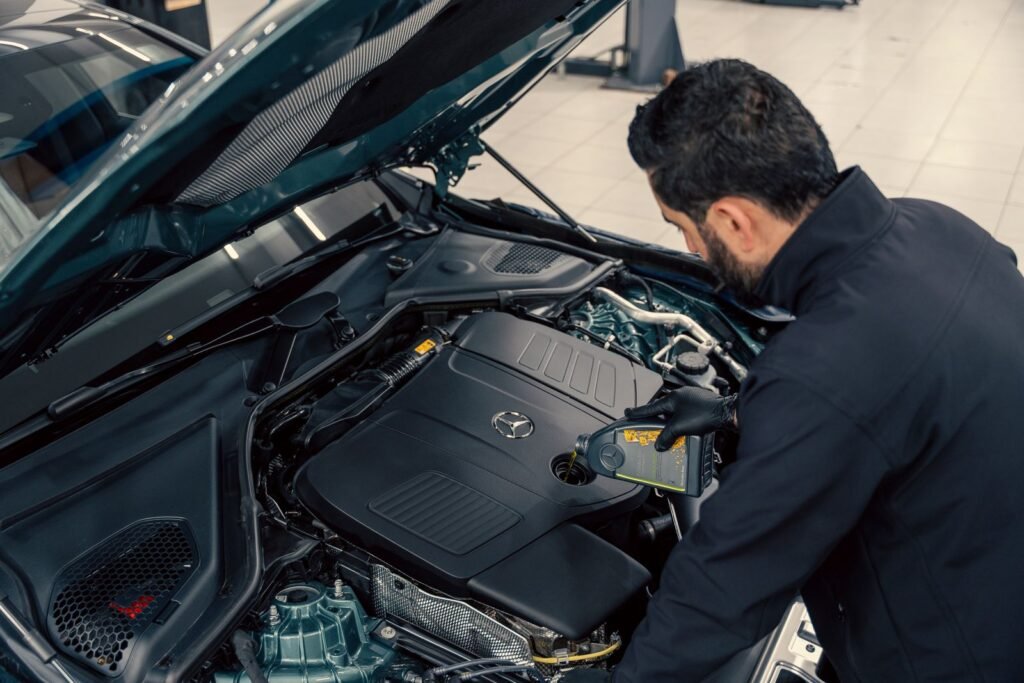
Never guess the oil grade. Your owner manual lists the viscosity, such as 5W30, and the performance standard your engine needs. Using the wrong viscosity can hurt fuel economy, cold starting, and protection at high temperature, and on some engines it can affect variable valve timing. Find the oil filler cap on top of the engine, remove it, and add oil in small amounts, about a quarter of a litre at a time, then wait a minute and recheck with the dipstick. The gap between minimum and maximum is usually about one litre, but check your manual for your car. Your action: add slowly and recheck after each small pour. Overfilling is easy to do and harder to fix than underfilling by a small amount, because excess oil usually has to be drained.
Use clean oil from a sealed container, and keep the filler area clean so dirt does not fall into the engine. Replace the filler cap tightly and wipe any spills, because spilled oil on a hot exhaust can smoke and smell. Your action: after topping up, drive normally and recheck the level after a few days. If the level drops again quickly, you have a consumption or leak problem, not a one time low reading. For how often a full change is due, read our guide on how often should you change your oil and compare its intervals with your manual, because driving style and oil type change the right interval for your car.
What a falling level really means
Some oil use is normal, especially on high mileage engines and on cars driven hard, but a steady fall of more than about one litre between oil changes deserves investigation. Common causes are worn piston rings, worn valve seals, a leaking gasket, a faulty crankcase ventilation valve, or oil passing a turbo seal on a turbocharged engine. Blue smoke from the exhaust on startup often points to valve seals, while blue smoke under acceleration often points to piston rings. Your action: if you need to top up every few weeks, book a diagnosis and tell the shop how much oil you are adding and how often, because that history helps them find the cause faster than a single low reading.
A sudden large drop, a new oil warning light, or oil pressure problems are different from slow use. If the oil pressure light comes on, stop as soon as it is safe, switch the engine off, and check the level. Driving with low oil pressure can seize an engine in minutes. For what that light means and what to do first, read our guide on oil pressure light on, what to do before you restart the car. Your action: never ignore an oil pressure warning in the hope that topping up later will fix it. Stop, check, and call for help if the level is very low or the light stays on after topping up.
Common mistakes to avoid
Do not check oil on a steep driveway and trust the result. Do not read the first dipstick pull. Do not mix very different oil grades just because a bottle is already open, unless your manual allows that grade. Do not top up with the wrong grade to save a trip to the shop, because the wrong oil can do more harm than a short delay with a correct top up. Do not assume a car that has just had an oil change cannot lose oil, because a loose drain plug or filter can leak from day one. Your action: check the level again a week after any oil change or leak repair, to confirm the work held and the level is stable.
Frequently asked questions
How often should I check my engine oil
At least once a month and before every long trip, more often on older cars or cars that use oil. Your action: set a monthly phone reminder and pair the check with another monthly job, such as checking tire pressure, so it becomes routine rather than a job you remember only when a warning appears.
Can I check oil when the engine is hot
You can, but wait five to ten minutes after switching off so oil drains back to the pan, and take care around hot parts. Your action: for the most consistent reading, check in the morning when the engine is cold and the car is on level ground, and use the same conditions each time so readings are comparable.
What should I do if the oil level keeps dropping
Top up with the correct grade, record how much and how often, and book a diagnosis if you are adding oil every few weeks or if you see blue smoke, new leaks, or an oil warning light. Your action: do not keep topping up for months without finding the cause, because steady oil loss usually points to a leak or internal wear that will get more expensive the longer it runs.
Checking oil is a five minute habit that protects the most expensive part of your car. Park level, wait a few minutes, read the second dipstick pull, judge both level and condition, and top up only with the correct grade. Done monthly, that simple check catches leaks and oil use early, keeps your next oil change on schedule, and gives you a clear record to show a shop when something changes.
Pingback: Flooded Car Inspection Service: What It Checks, What It Costs and When to Walk Away
Pingback: How Much Does Oil Leak Repair Cost?
Pingback: Honda Civic Car Maintenance: A Complete Owner Guide