
Your car bounces too much after every bump, it leans in corners, and the quote from the shop mentions struts, but the last shop said shocks, and now you are not sure which part you are paying for. This guide will clear that up in plain language, show you how to tell which one your car has, and help you spot a worn part before it costs you tyres, brakes or a failed safety check. But here is the question most guides skip, and it decides the whole bill. Can one car have both?
The short answer to struts vs shocks is simple. A shock absorber only controls spring movement, while a strut does that job and also holds up part of the car and helps set the steering and wheel angles. Every strut contains a damper, so every strut does the work of a shock absorber, but a shock absorber on its own is never a strut. If that quote left you worried about paying for the wrong part, you are not alone, and that worry is sensible, because strut work usually costs more and usually needs a wheel alignment after it.
Here is a real example that makes the difference concrete. A Toyota Camry from the XV70 generation, built from 2018 to 2022, uses MacPherson struts at the front and separate shock absorbers at the rear, according to Toyota technical material summarised by Repco parts guides. One car, both parts, in different places. That is why a shop can be right about front struts and right about rear shocks on the same car, and why the price can change a lot depending on which axle needs work. Keep that Camry in mind as you read, because it shows that the question is not which part is better in general, it is which part sits at each corner of your car.
What a Shock Absorber Does
A shock absorber is a damper, nothing more and nothing less. It is a tube filled with oil and a piston that moves through that oil, and its job is to slow down the spring after a bump. Without it, the spring would keep bouncing up and down, the tyres would lose contact with the road, and the car would feel floaty and hard to control. With a healthy shock absorber, the car settles after one movement and the tyre stays pressed to the road.
A shock absorber does not hold the car up. The coil spring, the leaf spring or the air spring carries the weight, and the shock absorber only controls how that spring moves. It also does not set the wheel angles on its own, and removing it will not make the wheel fall off or change the steering geometry in the way removing a strut would. That is the key test to remember. If the part only damps movement, it is a shock absorber.
On many cars, the rear suspension uses separate shock absorbers, often on trucks, older cars and many SUVs, and on some cars the front does too, usually where a double wishbone or multi link layout carries the load through a separate arm. The shock absorber bolts in at the top and at the bottom, and a mechanic can usually swap a pair in one to two hours of labour per axle, according to EngineerFix. That simpler fitting is one reason rear shock jobs often sit at the cheaper end of the price range. Check your own car before you book anything, though, because the layout at the front and the layout at the rear can be different, just as they are on the Camry above. So what happens when the damper, the spring and the steering pivot are all packed into one unit?
What a Strut Does
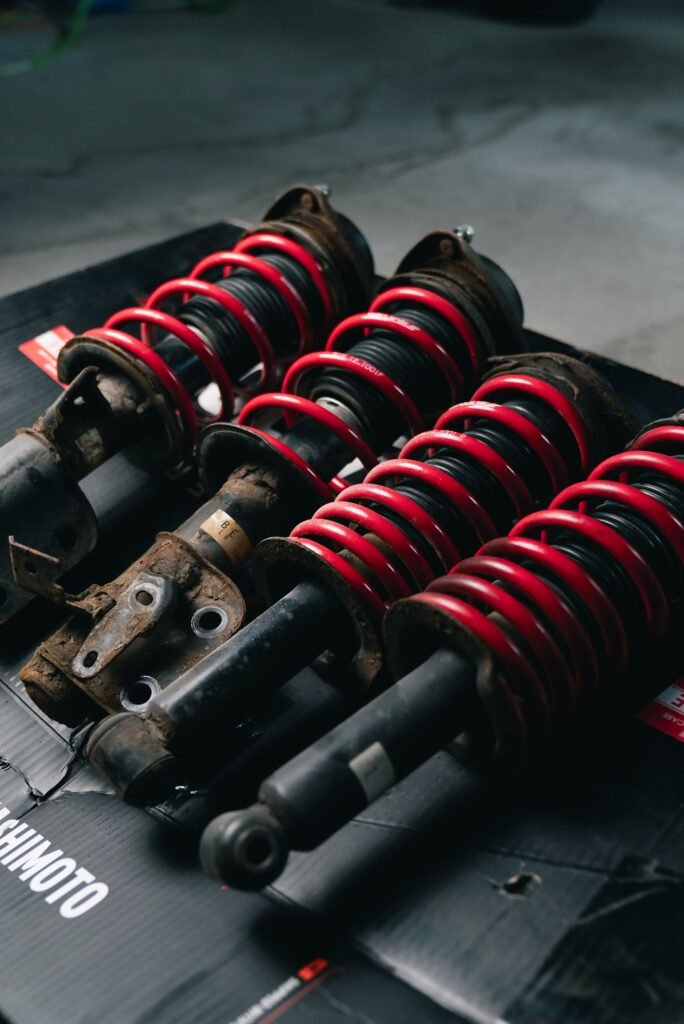
A strut is a complete suspension unit, not just a damper. It combines a shock absorber, a coil spring, a top mount and a spring seat into one assembly, and at the front it often acts as the steering pivot as well. That means the strut carries weight, controls spring movement, locates the wheel and helps hold the wheel angles in place. Take a strut out and the wheel loses a structural link, which is why strut work needs more care, more tools and more time than a simple shock absorber swap.
Most modern front wheel drive cars use MacPherson struts at the front, because the design is compact, light and cheap to build, and it leaves room for the engine, the steering rack and the front wheels to turn. You will find that layout on a huge range of family cars, hatchbacks and crossovers, and on many rear suspensions too. A loaded strut, sometimes called a quick strut, comes as a complete unit with a new spring and mount already fitted, and many shops prefer it because it saves labour time and avoids the risky job of compressing an old spring.
The extra work matters for your wallet and for your safety. A compressed coil spring stores a lot of energy, and it can cause serious injury if it is released without the right tool and the right training, which is why RepairPal warns against attempts by untrained people. A strut job also disturbs the wheel angles, so a wheel alignment is normally needed after front struts are fitted, and that adds cost and time to the visit. If a quote for front struts seems high next to a quote for rear shocks, this structural difference is usually the reason, not a shop trying to pad the bill. Now that you know what each part does, the side by side comparison makes the choice much easier to see.
Struts vs Shocks at a Glance
Use this table when you want the difference in one look. It covers the job each part does, where it usually sits, what it costs to replace and what extra work follows it. Read the row that matches your car, not the row that sounds cheapest, because fitting the wrong description to your car is how a simple job turns into a repeat visit.
| Feature | Shock absorber | Strut |
|---|---|---|
| Main job | Controls spring movement only | Controls spring movement and carries load |
| Spring | Separate from the damper | Built into the same assembly |
| Steering role | None, it does not steer the wheel | Often acts as the steering pivot at the front |
| Wheel angles | Does not set them on its own | Helps set them, so alignment follows replacement |
| Where it sits | Often at the rear, sometimes at the front | Often at the front, sometimes at all four corners |
| Labour time | Usually one to two hours per axle for a pair | Usually two to four hours per axle for a pair |
| Typical cost | Lower, a simpler bolt in job | Higher, a structural job plus alignment |
| Replace in pairs | Yes, both sides on the same axle | Yes, both sides on the same axle |
The table shows why the two words are not interchangeable, even though both parts damp movement. A shock absorber is a single function part, while a strut is a system in one housing. That difference also explains why a strut can cause steering and tyre wear problems when it fails, while a failed shock absorber usually shows up first as poor ride control. Use the table to check the quote you were given, then move on to the next step, which is finding out which layout your own car actually uses. But how do you find that out without crawling under the car?
How to Tell Which One Your Car Has
Start with the easiest source, your owner manual or a parts catalogue for your exact year, make, model and trim. Search for the front suspension type and the rear suspension type separately, because many cars mix the two. The Camry example above is common, with struts at the front and shocks at the rear, but some cars have struts at all four corners, some have shocks at all four corners, and some have air suspension or adaptive dampers that change the price and the procedure completely. If the manual is vague, a parts site that asks for your registration number or VIN will usually list front strut assemblies and rear shock absorbers as separate items, and that listing tells you the layout in seconds.
You can also look, if you can do it safely. With the car parked on level ground, look behind a front wheel and then behind a rear wheel. A strut usually looks like a tall unit with a coil spring wrapped around it, running from near the top of the wheel arch down to the steering knuckle. A separate shock absorber usually looks like a slimmer tube with no spring around it, sitting beside a separate coil spring. Do not jack the car up for this check unless you know how to support it safely with stands on solid ground, and never work under a car held up only by a jack.
If looking does not settle it, call the shop and ask a precise question before you book. Ask whether the quote is for front struts, rear shocks, or both, ask whether it is for a loaded assembly or for a bare damper, and ask whether a wheel alignment is included. A clear answer to those three questions tells you that the shop has identified your layout correctly, and a vague answer tells you to get a second quote. You can also read our guide to car suspension repair for the wider list of parts that wear with struts and shocks, so you know what else a mechanic may mention on the same visit. The next section is the one that saves most drivers money, because it shows the signs to watch for before a small wear problem becomes a tyre and brake problem.
Signs Your Shocks or Struts Are Worn Out
Worn shocks and struts rarely fail in one moment. They fade slowly, so drivers get used to the worse ride and only notice it when a passenger comments or when the tyres show the damage. Kelley Blue Book lists the same warning signs that KYB and Monroe point to, and they are worth checking every year, or whenever the car is in for tyres, brakes or an alignment. Most shocks and struts last 50,000 to 100,000 miles, according to Kelley Blue Book, but rough roads, heavy loads, towing and fast driving over speed bumps can shorten that life a lot.
Watch for a car that keeps bouncing after a bump instead of settling after one movement, and for a ride that feels floaty on a motorway or harsh on broken surfaces. Watch for nose dive when you brake hard, rear squat when you accelerate, and body roll that makes the car lean more than it used to in corners. A car that needs constant small steering corrections, or that feels vague at speed, is also telling you that the tyres are not staying pressed to the road as they should.
Look at the tyres too, because they record what the suspension is doing. Cupped or scalloped wear, a pattern of dips around the tread, is a classic sign of worn dampers, and Monroe warns that replacing the tyre alone only treats the symptom. Look for fluid on the body of the shock or strut as well. A light mist can be normal on some units, but oil wet enough to drip, or a thick coating down the body, means the seal has failed and the unit cannot damp properly. Listen for knocks or rattles over bumps, and note bottoming out over dips or speed bumps, but remember that those noises can also come from mounts, bushings or links, so get the noise traced before you buy parts.
Act on these signs in order of safety, not in order of annoyance. A bounce and a rattle can wait a week while you book a check, but a car that sways in a lane change, dives hard under braking or shows cupped tyres needs an inspection soon, because worn dampers lengthen stopping distance and reduce grip in an emergency stop or swerve. Book a suspension inspection if you see more than one sign at once, if the car has passed 80,000 miles on original dampers, or if you cannot remember the last time they were checked. And if you want a quick check you can do yourself before that booking, the next section gives you two simple tests.
The Bounce Test and Other Checks You Can Do at Home
The bounce test is simple, free and surprisingly useful, as long as you treat it as a clue, not a diagnosis. Park on level ground, push down firmly on one corner of the car above the wheel, release it, and watch. A healthy corner should rise and settle after one movement, or at most one small extra movement. If it bounces two or three times, that corner has a weak damper. Repeat the test at all four corners, because one weak corner can hide while the other three still feel firm.
Do the test when the car is cold and unloaded, and compare the front pair with each other and the rear pair with each other, rather than judging one corner on its own. A front corner that bounces more than the other front corner is a clear flag, even if the ride still feels acceptable. If the car is heavy, if it has a roof load, or if you push on a soft plastic bumper rather than a solid wing, the result can mislead you, so push on a firm metal area and use the same force at each corner.
Add two visual checks while you are there. First, crouch by each wheel and look at the damper body for wet oil, a damaged dust cover, a broken spring or a cracked top mount. Second, run a hand over the tyre tread and feel for uneven wear, dips or a feathered edge, then check the tyre pressures, because low pressure can mimic a suspension problem. If the bounce test, the visual check and the tyre check all point the same way, you have a strong case to take to the shop. If they disagree, book a diagnostic check and let a mechanic test the car on a lift and on a road test, because a mount or a link can feel like a damper from the driver seat. Once you know the part is worn, the next question is the one drivers ask most, so here it is plainly.
Can You Drive With Worn Shocks or Struts
You can drive a short distance with worn shocks or struts, but you should not treat that as safe for normal driving, and you should not leave it for months. The car will still move, steer and brake, but it will take longer to stop, it will grip less in a swerve, and it will wear tyres unevenly while you wait. The risk grows in rain, on rough roads and at motorway speed, where the tyres need firm contact with the road to do their job.
Drive gently to the shop if the symptoms are mild and the car still tracks straight, keeps a steady speed and stops in a straight line. Keep your speed down, leave a larger gap to the car ahead, avoid sharp lane changes and avoid loading the car heavily. Book the inspection within days, not weeks, and ask the shop to check the brakes, tyres and steering at the same time, because worn dampers can hide wear in those parts.
Stop driving and get help sooner if the car sways badly in a lane change, if it pulls to one side under braking, if a spring is broken, if a damper is leaking heavily, if you hear a loud clunk from one corner, or if the car bottoms out on normal roads. Those signs point to a part that may fail further, and a broken spring or a loose mount is a safety problem, not a comfort problem. In that case, call the shop, describe the symptoms exactly, and ask whether it is safe to drive in or whether recovery is the better choice. Once you have decided to book the repair, you need a realistic price, and the next section gives you that from sources checked during this run.
What Replacement Costs and What Changes the Price
Costs vary a lot by car, by part quality and by where you live, so treat every range below as a national average that varies by job, not as a fixed quote for your car. The best way to use these numbers is to compare them with the written quote you receive, and to ask the shop to break its quote into parts and labour, so you can see which part of the bill is driving the total.
RepairPal gives a useful national picture. In a summary published in September 2026 and reported by Auto Body Parts, RepairPal puts a shock or strut replacement job at 1,144 dollars to 1,348 dollars, with about 812 dollars to 862 dollars for parts and 332 dollars to 487 dollars for labour, before taxes and fees. ConsumerAffairs gives a similar 2026 figure in the same summary, an average of 1,260 dollars, with 808 dollars for parts and 452 dollars for labour. Those two sources agree closely, which is why they are a good starting point for a typical family car.
Model examples from RepairPal show how wide the range can be. A 2021 Toyota Camry in Houston is listed at 1,096 dollars to 1,367 dollars for a suspension shock or strut replacement, while a 2008 Toyota Corolla in Sacramento is listed at 674 dollars to 811 dollars. The older, simpler car costs less, the newer car costs more, and your car will sit somewhere on that scale depending on its age, its suspension design and the parts you choose.
EngineerFix breaks the job down by axle and by part type, and that breakdown helps you see why a rear shock job is cheaper than a front strut job. A standard shock absorber costs about 72 dollars to 144 dollars per unit as a part, while a strut assembly can range from 150 dollars to 900 dollars per unit, with luxury or electronic suspension parts costing more than 1,000 dollars per corner. Labour for a pair of shock absorbers usually runs one to two hours per axle, or 150 dollars to 400 dollars, while labour for a pair of struts usually runs two to four hours per axle, or 300 dollars to 800 dollars. EngineerFix puts the total for all four corners at 400 dollars to 700 dollars for basic shocks and 1,000 dollars to 2,500 dollars for struts, with complex vehicles costing more.
Add a wheel alignment after front struts, usually 100 dollars to 200 dollars according to EngineerFix, and ask whether that alignment is included in the quote or charged separately. Read our guide on how long a wheel alignment takes so you know how much extra time to allow on the day, and check wheel balancing charges too, because a shop may suggest balancing at the same visit if the tyres show uneven wear. Ask for a quote that lists the part brand, whether it is a loaded assembly or a bare damper, the labour hours, the alignment charge and any related parts, then compare that quote with one other shop before you commit. But should you replace one side, both sides, or the mounts as well?
Should You Replace One Side or Both, and What Else to Replace at the Same Time
Replace shocks and struts in pairs on the same axle, always. A new damper on one side and a worn damper on the other side will make the car handle unevenly, pull in a turn and wear tyres unevenly, and the mismatch is worst in an emergency manoeuvre. If the front left strut is worn, replace the front left and the front right together, and do the same at the rear. A shop that offers to replace only one side to save money is not saving you money, it is leaving you with an unbalanced car.
You do not need to replace all four corners at once if only one axle is worn, but do check the other axle while the car is on the lift. If the front struts are worn at 90,000 miles and the rear shocks are original, the rear pair may be close behind, and it can be cheaper in labour to do them on a later visit than to pay for a second full inspection and lift. Ask the mechanic to show you the leak, the wear or the test result for each corner, so you are paying for parts that are actually worn, not for parts that are only old.
Ask about the parts that wear with the damper, because replacing them now can save a second labour bill later. Top mounts and bearings, dust covers, bump stops, spring seats and, on some cars, sway bar links are common companions to a strut job, and a loaded strut assembly already includes the spring and mount, which is one reason shops prefer it. Get the shop to list any extra parts separately, with a price for each, and ask which ones are essential now and which ones can wait. If a mount is cracked, a bearing is noisy or a dust cover is torn, replace it now. If a related part still looks sound, note it for the next inspection and do not let it turn a damper job into a full suspension rebuild. The last step before you book is choosing the part, and that choice matters more than most drivers expect.
How to Choose the Right Part and Avoid the Wrong Repair
Start with the part that matches your car, not the part that is cheapest online. Use your exact year, make, model, trim and engine when you search, and check whether your car has standard suspension, sport suspension, adaptive dampers or air suspension, because the wrong damper can change the ride height and the handling. A part that fits a different trim of the same model may bolt in but still be wrong, so confirm the part number with the shop or with the parts catalogue before you order.
Choose between original equipment, a quality aftermarket brand and a budget part with your driving in mind. Original equipment parts usually match the original ride and last well, but they cost more. Quality aftermarket parts from a known damper maker can match that performance for less, and they are a sensible choice for most family cars. Budget parts can be tempting, but they can wear faster, ride harder and cost you a second job sooner, so ask the shop what warranty comes with the part and with the labour, and get that warranty in writing.
Avoid the common traps that turn a simple repair into a repeat visit. Do not buy a single damper to save money, do not skip the wheel alignment after front struts, do not let a shop replace dampers without checking the springs, mounts and links, and do not ignore a tyre that is already cupped, because a new damper will not fix a worn tyre. Get the work done by a shop that will road test the car after fitting, check the wheel angles, and show you the old parts, and keep the invoice with the part numbers and the warranty, so a future shop can see what was fitted. That paper trail is your proof if a noise returns or a tyre wears unevenly again. Now here are the answers to the questions drivers ask most after reading this guide.
Frequently asked questions
Do struts and shocks do the same job?
No, not quite. Both damp spring movement, but a shock absorber only does that one job, while a strut also carries load, locates the wheel and helps set the steering and wheel angles. That is why a strut is a structural part and a shock absorber is not, and why strut replacement usually costs more and needs a wheel alignment after it.
Can a car have both struts and shocks?
Yes, many cars do. A Toyota Camry from the XV70 generation uses MacPherson struts at the front and separate shock absorbers at the rear, so one car can need a strut job at the front and a shock absorber job at the rear at different times. Check the front and the rear separately for your exact year and model.
How long do shocks and struts last?
Most shocks and struts last 50,000 to 100,000 miles, according to Kelley Blue Book, but rough roads, heavy loads, towing and hard driving over bumps can shorten that life. Have them inspected once a year, replace them in pairs on the same axle, and replace them sooner if they leak, fail the bounce test or cause cupped tyre wear.
How much does it cost to replace shocks or struts?
RepairPal puts a typical shock or strut replacement job at 1,144 dollars to 1,348 dollars, with parts at about 812 dollars to 862 dollars and labour at 332 dollars to 487 dollars, before taxes and fees, while EngineerFix puts basic shocks at 400 dollars to 700 dollars for all four corners and struts at 1,000 dollars to 2,500 dollars. Add 100 dollars to 200 dollars for a wheel alignment after front struts, and get a written quote for your exact car before you book.