
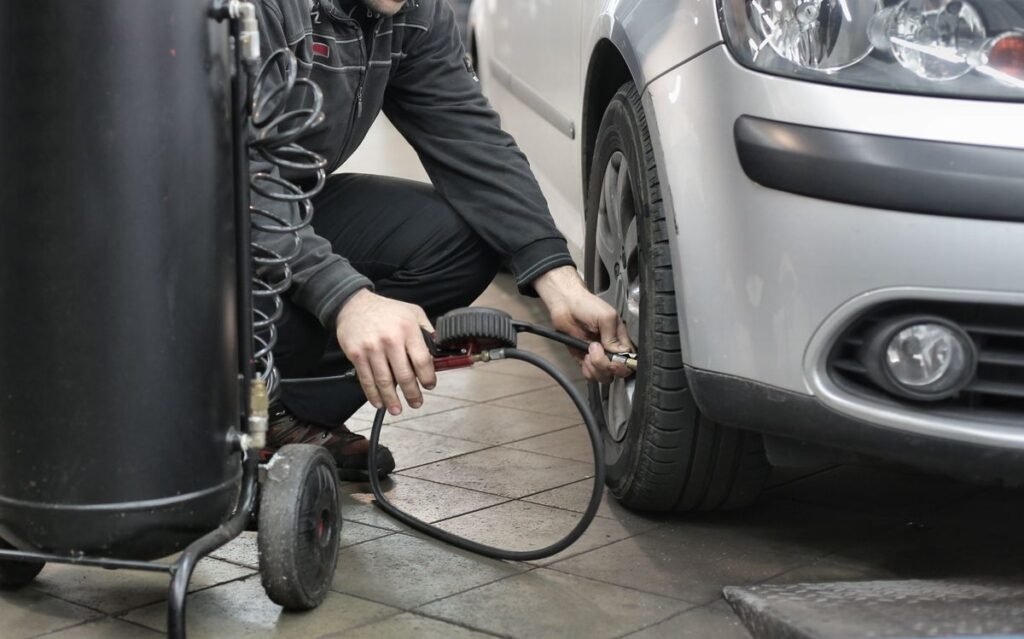
Underinflated tires wear out faster, use more fuel, and handle worse in an emergency, yet checking them takes less than ten minutes. The short answer: check tire pressure at least once a month and before every long trip, always when the tires are cold, and inflate each tire to the pressure shown on the driver door jamb placard, not the maximum pressure printed on the tire sidewall. For most passenger cars that target is 30 to 35 PSI, for many crossovers and small SUVs it is 32 to 36 PSI, and for light pickups it is often 35 to 40 PSI, but your placard is the only number that counts for your car. The first decision is where to look, because using the sidewall maximum is the most common tire pressure mistake.
Cold means the car has been parked for at least three hours or driven less than about one mile. Driving heats the air inside the tire and raises the reading, so a hot reading will look higher than the true cold pressure. If you must check after driving, do not bleed air from a hot tire to reach the placard number. Note the hot reading, then recheck cold in the morning and adjust then. Your action: make cold checking a habit, ideally first thing in the morning, once a month, and always before a highway trip.
Where to find your correct pressure
Open the driver door and look at the placard on the door frame, usually on the B pillar where the door latches. It lists the recommended cold pressure for the front tires, the rear tires, and often the spare, plus the tire size the car was built with. If the placard is missing or unreadable, use the owner manual, which lists the same figures by trim and tire size. Your action: photograph the placard once and keep it on your phone, so you never have to guess at a gas station again. For help reading the size and rating codes on the tire itself, read our guide on tire numbers explained before you buy or compare tires.
The number on the tire sidewall is a maximum, not a target. Inflating to that maximum on a normal car will give a harsh ride, wear the center of the tread faster, and reduce grip on rough roads. Underinflating by even a few PSI does the opposite, wearing the outer edges, raising rolling resistance, and making the tire run hotter at highway speed. Your action: if front and rear placard pressures differ, set each axle to its own number. Do not set all four to one convenient number unless the placard says they are the same.
What you need and how to check
You need a reliable gauge, either digital or dial, which usually costs about 10 to 20 dollars, and access to air, either a home compressor or a gas station pump. Pencil style gauges work in a pinch but are often less accurate, and gas station gauges are often worn or damaged. Your action: buy your own gauge and keep it in the glove box, because a reading you cannot trust is worse than no reading at all.
Remove the valve cap from one tire and press the gauge straight onto the valve stem with a firm, square push. A short hiss is normal. Read the PSI, compare it with the placard target for that axle, and repeat for all four tires and the spare if you have a full size spare. Compact temporary spares are often rated near 60 PSI, so check that number separately and never assume it matches the road tires. Your action: check all four road tires in one pass, even if only one looks low, because a slow leak on another tire is easy to miss by eye.
How to add air or release air
If a tire is low, add air in short bursts, then remove the hose and recheck with your own gauge. Small steps prevent overshooting, which is easy when a compressor delivers air fast. If you overshoot, press the small pin in the center of the valve stem briefly to bleed a little air, then recheck. Repeat until the cold reading matches the placard. Your action: after inflating, replace every valve cap tightly. Caps keep dirt and moisture out of the valve core, and a missing cap can turn into a slow leak over time.
If a tire keeps losing air week after week, that is not normal pressure loss. Check the valve with soapy water and look for bubbles, inspect the tread for a nail or screw, and check the rim edge for corrosion or damage. Your action: if one tire drops more than about 3 PSI in a month while the others stay steady, get it inspected promptly rather than topping it up again and again. A slow leak can become a sudden flat at highway speed.
How temperature and load change pressure
Air contracts when it gets cold and expands when it gets hot. As a rough rule, pressure drops about 1 PSI for every 10 degrees Fahrenheit drop in temperature, which is why a tire pressure warning often appears on the first cold morning of autumn even though nothing punctured the tire. A 30 degree drop can easily take 3 PSI out of every tire. Your action: recheck pressures in autumn and again in deep winter, and reset them to the placard target on a cold morning, not to a summer reading.
Heavy loads and towing also matter. Many placards list a higher rear pressure for a fully loaded car, and some list a separate figure for towing. Your action: before a loaded trip, check the full load line on the placard and set the rear tires to that figure. When you unload, return to the normal figure, because running loaded pressures empty will wear the centers and ride harshly.
What the TPMS light does and does not tell you
Most modern cars have a tire pressure monitoring system that warns when a tire drops well below the target, often by about 25 percent. That warning is a safety net, not a maintenance schedule. By the time it lights up, the tire may already be several PSI low, with extra wear and fuel use already happening. Your action: do not wait for the light. Monthly manual checks catch a 2 or 3 PSI drop long before the system complains. If the warning light stays on after you inflate all tires to the placard, read our guide on TPMS light meaning and fixes to work through a sensor, relearn, or system fault before you assume the gauge was wrong.
A flashing TPMS light usually means a system fault, such as a dead sensor battery, while a steady light usually means low pressure in at least one tire. Your action: if the light flashes, check pressures manually first, then book a sensor check, because a flashing system cannot be trusted to warn you about a real leak.
Common mistakes to avoid
Do not check pressure right after a long drive and call that reading your cold pressure. Do not inflate to the sidewall maximum. Do not skip the spare, because a flat spare discovered during a roadside change helps no one. Do not rely on the look of the tire, because modern radial tires can look normal while running several PSI low. Your action: set a monthly phone reminder for a cold check, and pair it with another monthly job, such as checking oil or washer fluid, so it becomes routine rather than a chore you postpone.
Frequently asked questions
How often should I check tire pressure
At least once a month and before every long trip, plus after any tire service, rotation, or repair, and whenever the temperature swings sharply. Your action: if you drive daily, a quick monthly cold check is enough for most cars, but check weekly in autumn and winter when cold snaps are common.
Should I check pressure when tires are hot or cold
Cold, after at least three hours parked or less than about one mile driven. Your action: if you only have access to air after driving, inflate to a rough figure, then recheck cold the next morning and correct it, rather than bleeding a hot tire down to the placard number.
Why does one tire keep losing air
Common causes are a slow puncture, a leaking valve core or valve stem, rim corrosion, or a poor seal after a repair. Your action: spray soapy water on the valve and tread, look for bubbles, and if you find nothing, have a tire shop check the bead seal and valve. Do not keep topping it up for months without finding the cause.
Checking tire pressure is the cheapest safety and fuel saving job on your car. Find your placard, check cold once a month, set each axle to its own target, replace the valve caps, and act on a tire that keeps losing air. That ten minute habit protects your tires, your fuel bill, and your braking distance every time you drive.
Pingback: How to Choose a Car Mechanic You Can Trust
Pingback: MPG Explained: What It Means and How to Improve Your Fuel Economy
Pingback: US Gas Prices: How Fuel Costs Change Your Car Running Costs
Pingback: Fuel Price in America: Why Pump Prices Rise, Fall, and Differ by State
Pingback: Car Repair and Maintenance: The Complete Owner Guide
Pingback: Auto Repairs: How to Handle a Repair Bill
Pingback: How Long Does a Wheel Alignment Take?
Pingback: TPMS Light Stays On After Filling Tires: What to Check Next
Pingback: What to Do If Your Car Breaks Down on the Highway
Pingback: Car Pulls to One Side Causes and What to Check First
Pingback: Tyre Tread Wear Patterns Explained and What Each Pattern Means
Pingback: Electric Car Maintenance: What EVs Still Need and What They Do Not